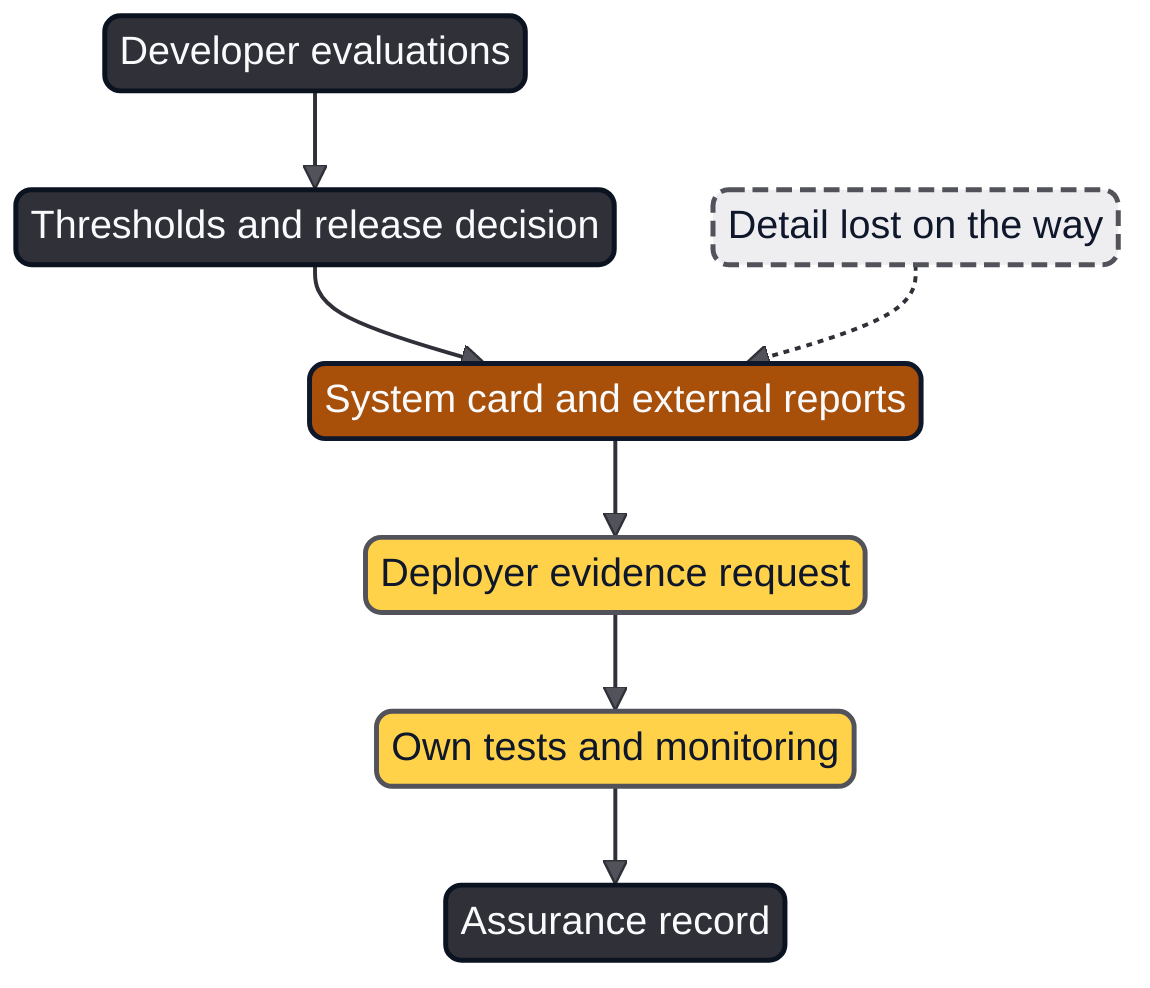
Parts II to V kept arriving at the same place: the strongest evidence about a frontier model, and the strongest safeguards against its most extreme uses, sat with the developer that built it. Chapter 19 showed where the frameworks draw their lines for catastrophic misuse; Chapter 23 showed why tests can be gamed by the systems under test. This chapter asks the question both left open: how much weight can an enterprise or a public authority give to what developers promise?
No regional authority or insurance group can run dangerous-capability evaluations on a frontier model. The series has already established the deployer's half of the bargain: providers of general-purpose AI models with systemic risk carry the duty of adversarial testing under Article 55 of the AI Act, while deployers ask for the evidence and test the compound system themselves (AI Platform and Security, Chapter 20) (179, Nordqvist, 2026). It has also drawn the line between attestation, a party asserting something, and evidence, which is produced by the operation of the system (AI Governance, Chapter 11) (178, Nordqvist, 2026). A system card sits awkwardly between the two, and much of this chapter is about where. Frameworks and evaluations are described by their structure only.
Table 29.1: Who produces which evidence.
Primary topics explored
- From responsible scaling to preparedness
- Dangerous-capability evaluations
- System cards as evidence
- Independent and government evaluation
- Restricted release as a safeguard
- Using the frameworks as a deployer
About AI Threat
AI Threat is Book 5 of The Transformed Architecture. It investigates whether the dystopias of science fiction, with AI as the threat, are coming true. It covers every scale of the threat, from the human mind and society to misuse, machines beyond control and the end of the world, stages every debate constructively, and turns the verdict into what individuals, European enterprises and public authorities can do.
It builds on the conclusions of Architecture as Code, AI Governance, AI Platform and Security and AI Red Team.
Boards, chief risk officers, CISOs, AI governance leads, architects and public-sector leaders.

Gunnar Nordqvist
Conceived, directed and published the books of The Transformed Architecture.
Continue with the full chapter
Chapter 29: Frontier Safety Frameworks: What Developers Promise and What It Is Worth in AI Threat gives the detailed explanations, practical examples and implementation patterns behind this summary.
This whitepaper belongs to “The Response” and is one of 39 drawn from the manuscript.