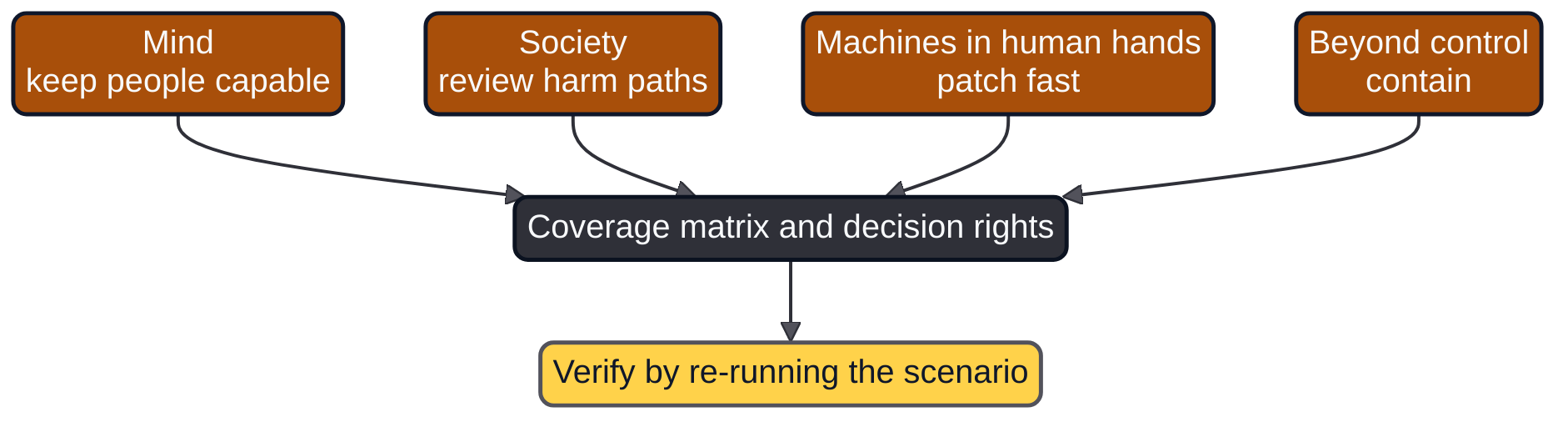
Parts II to V held the dystopian claim against the evidence one strand at a time, and each threat chapter ended with what organisations can do. Read together, those recommendations are long, overlapping and uneven. Some repeat controls the earlier volumes already built; others are new, because the threats at the scale of the human mind and of society fell outside those engineering books. A board cannot act on twenty-two separate lists; it needs one coherent set of defences, mapped to the threats, with a way to tell whether each works.
This chapter therefore consolidates the threat chapters into six disciplines that an enterprise or public authority controls: oversight that keeps people capable, harm-path reviews, containment that holds whatever the system intends, evidence produced by operation, decision rights assigned in advance, and autonomy matched to reversibility. It is modest about reach: many threats are decided by developers, states and markets (Chapters 28 and 29). What an organisation controls is its own systems, people, supplier obligations and exposure, which is less than the whole threat and more than most organisations currently use.
Table 30.1: Defences and the controls of the earlier volumes they draw on.
Primary topics explored
- What lies within reach
- Defences for the human mind
- Defences for society
- Defences against humans wielding machines
- Containment against machines beyond control
- Decision rights before the crisis
About AI Threat
AI Threat is Book 5 of The Transformed Architecture. It investigates whether the dystopias of science fiction, with AI as the threat, are coming true. It covers every scale of the threat, from the human mind and society to misuse, machines beyond control and the end of the world, stages every debate constructively, and turns the verdict into what individuals, European enterprises and public authorities can do.
It builds on the conclusions of Architecture as Code, AI Governance, AI Platform and Security and AI Red Team.
Boards, chief risk officers, CISOs, AI governance leads, architects and public-sector leaders.

Gunnar Nordqvist
Conceived, directed and published the books of The Transformed Architecture.
Continue with the full chapter
Chapter 30: Organisational Defences: Containment, Evidence and Decision Rights in AI Threat gives the detailed explanations, practical examples and implementation patterns behind this summary.
This whitepaper belongs to “The Response” and is one of 39 drawn from the manuscript.