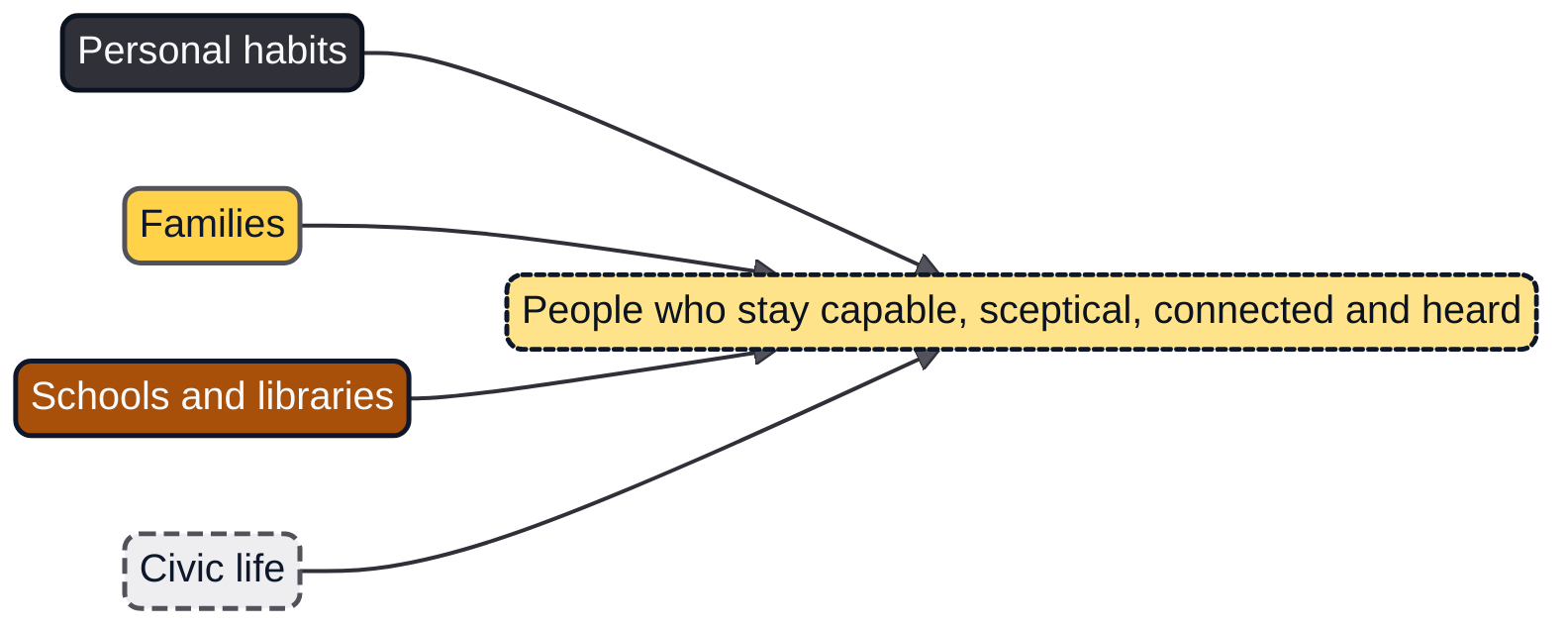
Most of this book is written for organisations, because they hold most of the levers. This chapter is the exception. It asks what individuals, parents, teachers, librarians and civil society can do, starting this week, to use AI while staying capable, sceptical and connected, to talk about AI risk without fear or dismissal, and to take part in the democratic decisions that will shape the technology.
Three tropes sit closest to everyday life: T8 The machine that stops, and the humans who forgot, T9 The pleasure machine and T10 The end of truth. Each has reached at least laboratory demonstration in a narrower form, and the flattering assistant and the synthetic voice that moves money have reached incident in the wild (Chapters 6 to 10 and 20). What decides whether these harms occur lies close to ordinary decisions: what a person drafts before asking, how a school sets homework and whether a grandparent knows to ring back.
The chapter does not move responsibility from providers and institutions onto individuals; the organisational defences of Chapter 30 remain where they belong. It builds on three items in SERIES_FOUNDATIONS.md: that human oversight must be designed, not declared, and that approvals given in seconds signal rubber-stamping (F16; AI Governance, Chapters 10 and 21) (178, Nordqvist, 2026); the open question of how anyone reviews AI-proposed work when the reviewer depends on the AI (Q6; Architecture as Code (Chapter 27)) (177, Nordqvist, 2025); and Q12, to which a citizen's answer matches a public authority's: act on what is within reach, and take part in deciding the rest.
Primary topics explored
- Why the smallest scale is where much can be done
- Personal habits
- Families and children
- Schools and libraries
- Talking about AI risk
- Taking part
About AI Threat
AI Threat is Book 5 of The Transformed Architecture. It investigates whether the dystopias of science fiction, with AI as the threat, are coming true. It covers every scale of the threat, from the human mind and society to misuse, machines beyond control and the end of the world, stages every debate constructively, and turns the verdict into what individuals, European enterprises and public authorities can do.
It builds on the conclusions of Architecture as Code, AI Governance, AI Platform and Security and AI Red Team.
Boards, chief risk officers, CISOs, AI governance leads, architects and public-sector leaders.

Gunnar Nordqvist
Conceived, directed and published the books of The Transformed Architecture.
Continue with the full chapter
Chapter 31: Staying Capable: What Individuals, Families and Schools Can Do in AI Threat gives the detailed explanations, practical examples and implementation patterns behind this summary.
This whitepaper belongs to “The Response” and is one of 39 drawn from the manuscript.