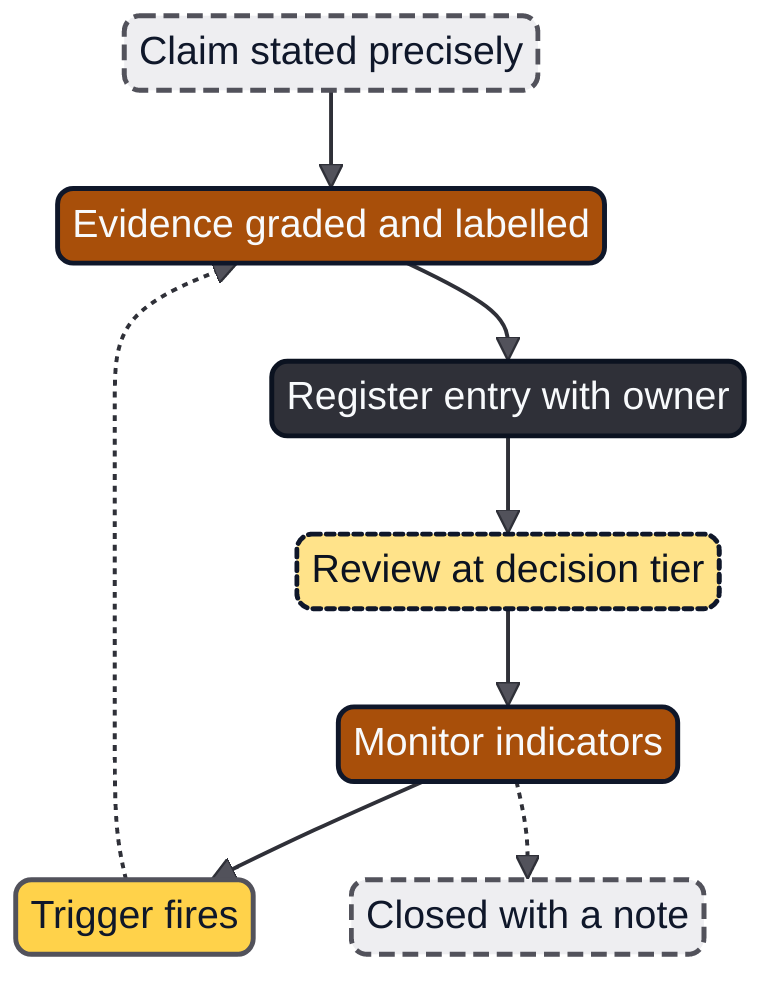
Parts II to V returned a verdict on each trope, but a verdict in a book protects nobody. Organisations need somewhere to keep their conclusions, a way to notice when the evidence changes and a route to the people who can act. Every chapter so far has pointed at the same artefact: the AI threat register, in which each threat scenario carries its scale, trope, evidence rung, label, exposure, controls, owner and triggers, and is reviewed by the right decision tier and reported to the board.
This chapter defines that register, which answers open question Q10, how a board should treat risks that are low in estimated probability, extreme in consequence and contested among experts, in a form that can be operated. It is not a forecast and not a ranking of fears, but a versioned record of what the organisation believes about each threat, why, who acts and which observation would change its mind.
Table 32.1: The four decision tiers at which an entry is reviewed.
Primary topics explored
- From horizon register to threat register
- The schema
- Triggers and review
- Board reporting
- Connecting to existing risk processes
- Keeping the register honest
About AI Threat
AI Threat is Book 5 of The Transformed Architecture. It investigates whether the dystopias of science fiction, with AI as the threat, are coming true. It covers every scale of the threat, from the human mind and society to misuse, machines beyond control and the end of the world, stages every debate constructively, and turns the verdict into what individuals, European enterprises and public authorities can do.
It builds on the conclusions of Architecture as Code, AI Governance, AI Platform and Security and AI Red Team.
Boards, chief risk officers, CISOs, AI governance leads, architects and public-sector leaders.

Gunnar Nordqvist
Conceived, directed and published the books of The Transformed Architecture.
Continue with the full chapter
Chapter 32: The AI Threat Register: Governing Scenarios as Code in AI Threat gives the detailed explanations, practical examples and implementation patterns behind this summary.
This whitepaper belongs to “The Response” and is one of 39 drawn from the manuscript.