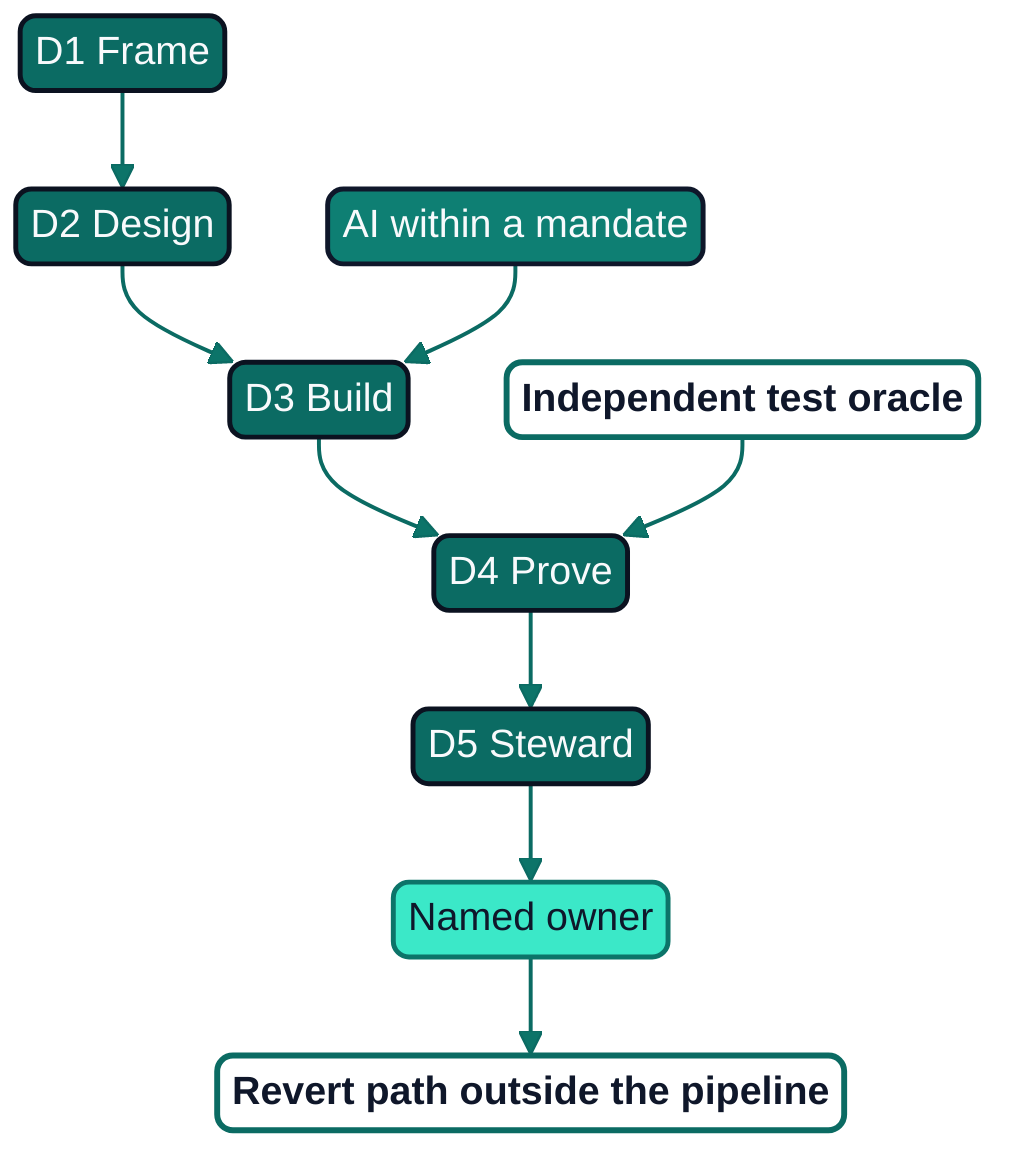
The eleven earlier volumes of this series govern, secure, defend, operate and lead what developers build. Every one of them rests on software that somebody wrote, reviewed, tested and released, and none took that person as its subject. This book does. It asks what happens to the developer, and to the development organisation, when AI writes, reviews, tests and deploys code across the organisation: not in one tool or one team, but in the editor, the pull request, the pipeline, the ticket, the legacy migration and the citizen's low-code application. It concerns all five functions of the developer loop that Chapter 4 defines: D1 Frame (understanding the problem and fixing intent), D2 Design (choosing the constraints), D3 Build (producing and directing the making of software), D4 Prove (showing that the software is right) and D5 Steward (owning software over time).
The chapter has a plain purpose. It states what a developer is and does, why AI changes it now and across the organisation, what the book claims and what would show the claim wrong, which vocabulary the book relies on, and how each kind of reader should use it. The conclusions of the earlier volumes are summarised where they are needed, so that no reader has to have read them.
Two changes of the same kind open the book. Both are illustrative; the organisations that make them are fictional and are described in full below, and their facts are those of the book's canonical profiles.
Primary topics explored
- A change nobody can explain
- Development with AI in 2030
- Why a book on the developer
- The working thesis
- Five functions and five degrees
- Usage modes and degrees of delegation
About AI Developer
AI Developer is Book 12 of The Transformed Architecture. It takes the developer as its subject and asks what happens when AI is used broadly in software development: the five developer functions (frame, design, build, prove, steward), the delegation ladder and the Level 4 prohibitions, the stewardship principle (name, understand, revert), verification as the scarce skill, the junior pipeline, adoption and productivity as claims that need evidence, regulation (the AI Act, the Cyber Resilience Act, the Product Liability Directive, NIS 2, DORA, the GDPR), ethics, intellectual property and sovereignty in the toolchain, and the developer as a person, for European enterprises and public authorities.
It builds on the conclusions of Architecture as Code, AI Governance, AI Platform and Security, AI Red Team, AI Threat, The Transformed Security Architect, AI Boss, AI Blue, AI Purple, AI Operations and AI Leader.
developers at every level, tech leads and engineering managers, architects, platform engineers, site reliability engineers and testers, product owners and designers, leaders who decide on developer tooling, heads of public-sector IT and procurement, works councils and unions, educators, and supervisors and auditors.

Gunnar Nordqvist
Conceived, directed and published the books of The Transformed Architecture.
Continue with the full chapter
Chapter 1: Introduction: The Developer with AI in AI Developer gives the detailed explanations, practical examples and implementation patterns behind this summary.
This whitepaper belongs to “The Developer Role in Question” and is one of 37 drawn from the manuscript.