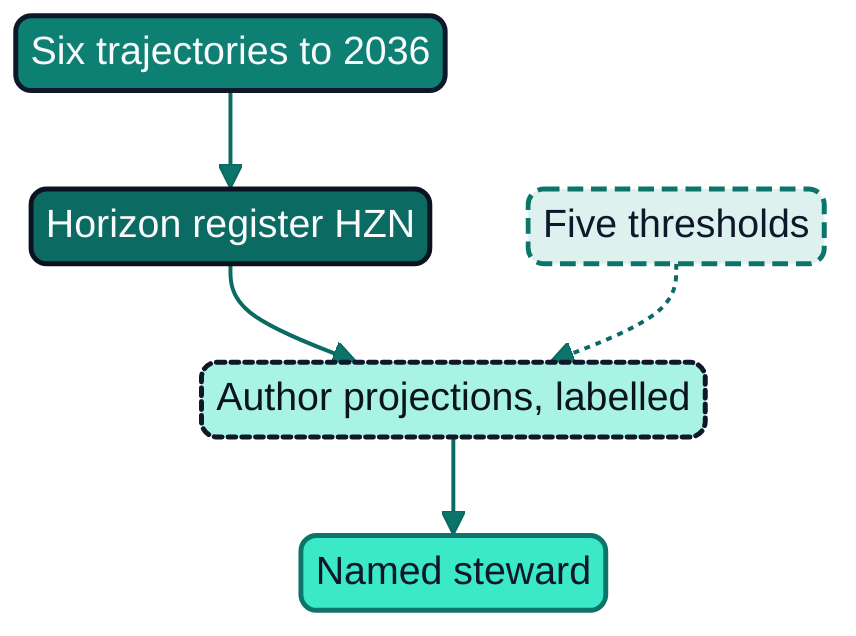
Every earlier chapter described development as it is now, or as it can be built now. This chapter looks ahead, and with Chapter 33 it is the only place in the book where the author states his own projections. It concerns all five developer functions: D1 Frame, because the specification may become the artefact that people spend most of their time on; D2 Design, because the constraints that bound a fleet of agents are a design problem; D3 Build, because the share of code written by people is the figure most often quoted and least often measured; D4 Prove, because verification capacity, not generation capacity, sets the pace of an agent-heavy team; and D5 Steward, because the future of the role is decided where somebody must be named for software that is in production.
The question in the title has three answers, and each is held by serious people. Fewer means fewer posts with the title developer. More means that cheaper software is demanded in larger quantities, so that total employment grows. Different means that the number matters less than the content of the work and the route by which people come to do it. The chapter sets out a horizon register, examines six trajectories, stages the debate in four steps, states the author's projections with the thresholds that would change them, and ends with a verdict and a practice the reader can start.
Four conclusions from earlier volumes set the method. AI Governance (Chapter 22) governs an outlook as a horizon register: each trend is labelled observable, expected or speculation; observable trends justify commitment, expected ones preparation and speculative ones reversibility; and the register is valuable because it can be wrong in a reviewable way (162, Nordqvist, 2026). AI Threat (Chapter 4) supplies the habit of asking which rung of an evidence ladder a claim stands on, from fiction and argument to laboratory demonstration, incident in the wild and pattern at scale (165, Nordqvist, 2026). AI Operations (Chapter 27) gave a labelled projection for operations with five thresholds that would change it (170, Nordqvist, 2026). AI Leader (Chapter 29) did the same for leadership roles and separated the author's judgement from the book's findings (174, Nordqvist, 2026).
Primary topics explored
- What this chapter builds on
- How to read the labels
- A horizon register for developer roles
- Employment and demand
- Agent-heavy teams
- Specification as the main artefact
About AI Developer
AI Developer is Book 12 of The Transformed Architecture. It takes the developer as its subject and asks what happens when AI is used broadly in software development: the five developer functions (frame, design, build, prove, steward), the delegation ladder and the Level 4 prohibitions, the stewardship principle (name, understand, revert), verification as the scarce skill, the junior pipeline, adoption and productivity as claims that need evidence, regulation (the AI Act, the Cyber Resilience Act, the Product Liability Directive, NIS 2, DORA, the GDPR), ethics, intellectual property and sovereignty in the toolchain, and the developer as a person, for European enterprises and public authorities.
It builds on the conclusions of Architecture as Code, AI Governance, AI Platform and Security, AI Red Team, AI Threat, The Transformed Security Architect, AI Boss, AI Blue, AI Purple, AI Operations and AI Leader.
developers at every level, tech leads and engineering managers, architects, platform engineers, site reliability engineers and testers, product owners and designers, leaders who decide on developer tooling, heads of public-sector IT and procurement, works councils and unions, educators, and supervisors and auditors.

Gunnar Nordqvist
Conceived, directed and published the books of The Transformed Architecture.
Continue with the full chapter
Chapter 29: The Future of the Developer: Fewer, More or Different? in AI Developer gives the detailed explanations, practical examples and implementation patterns behind this summary.
This whitepaper belongs to “The Developer as a Person” and is one of 37 drawn from the manuscript.