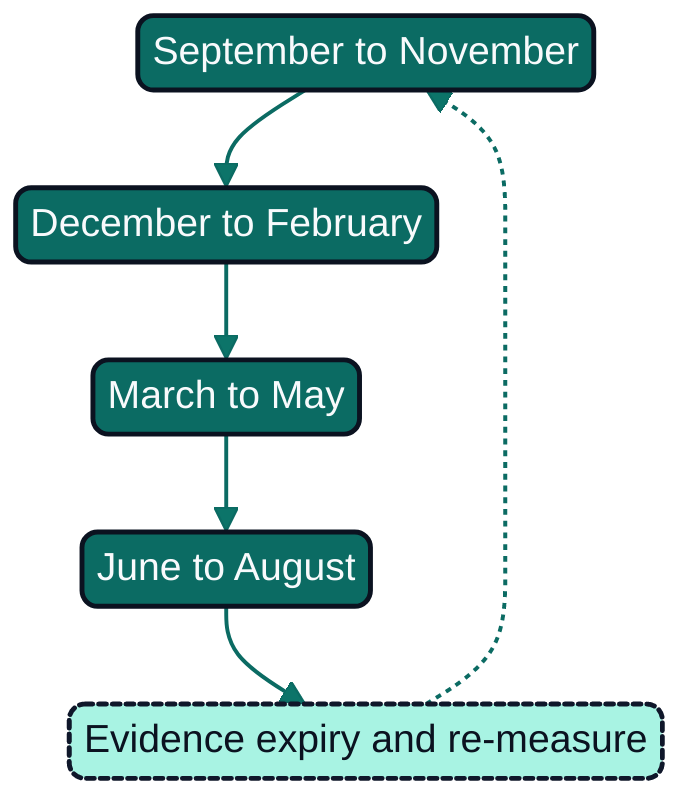
Thirty chapters have built instruments: a loop of five functions, a ladder of delegation, three tests of stewardship and records for specifications, owners, verification, review, agent runs, adoption claims and competence. This chapter uses them for a year. It follows named developers, leads and managers at Nordvik Region and Hansa Mutual from September 2030 to August 2031 and shows where the instruments held, where they did not and what stayed open. It concerns all five functions of the developer loop, D1 Frame, D2 Design, D3 Build, D4 Prove and D5 Steward, because a year does not respect the division of a book into functions.
The year is illustrative. It is built from the records of Chapters 1 to 30 and from a small number of events that this chapter adds, and it measures nothing. Three kinds of statement appear. Most are recorded: an earlier chapter fixed the date, the identifier or the figure. Some are derived: they follow from a recorded date, such as a rehearsal that passed its own 90-day limit on a day that can be counted. A few are illustrative outcomes, marked "in this illustration", and are new in this chapter. Where an earlier chapter set a date and recorded no outcome, this chapter records none either, because an open item is itself a result. No figure here is a rate, and no sentence is evidence that the instruments work.
There was no go-live in September. Both organisations already ran the tools in the profiles: ambient completion, the Mode 2 assistants NR-DEV-001 and HM-DEV-001, agentic work tools at Mode 3 for a few teams and the test-drafting assistant HM-DEV-002. The first month is the point at which delegation profiles began to bind tools that had been in use for months. The people who carry the story are these.
Primary topics explored
- The people and the rules of the year
- September to November 2030: the profiles meet the work
- December 2030 to February 2031: two quiet failures, a lapse and an agreement
- March to May 2031: a supply-chain scare and a decision about legacy
- June to August 2031: drills with the tools off, and a second look
- What the year showed
About AI Developer
AI Developer is Book 12 of The Transformed Architecture. It takes the developer as its subject and asks what happens when AI is used broadly in software development: the five developer functions (frame, design, build, prove, steward), the delegation ladder and the Level 4 prohibitions, the stewardship principle (name, understand, revert), verification as the scarce skill, the junior pipeline, adoption and productivity as claims that need evidence, regulation (the AI Act, the Cyber Resilience Act, the Product Liability Directive, NIS 2, DORA, the GDPR), ethics, intellectual property and sovereignty in the toolchain, and the developer as a person, for European enterprises and public authorities.
It builds on the conclusions of Architecture as Code, AI Governance, AI Platform and Security, AI Red Team, AI Threat, The Transformed Security Architect, AI Boss, AI Blue, AI Purple, AI Operations and AI Leader.
developers at every level, tech leads and engineering managers, architects, platform engineers, site reliability engineers and testers, product owners and designers, leaders who decide on developer tooling, heads of public-sector IT and procurement, works councils and unions, educators, and supervisors and auditors.

Gunnar Nordqvist
Conceived, directed and published the books of The Transformed Architecture.
Continue with the full chapter
Chapter 31: A Year in Development: Nordvik Region and Hansa Mutual in AI Developer gives the detailed explanations, practical examples and implementation patterns behind this summary.
This whitepaper belongs to “Experience and Conclusions” and is one of 37 drawn from the manuscript.