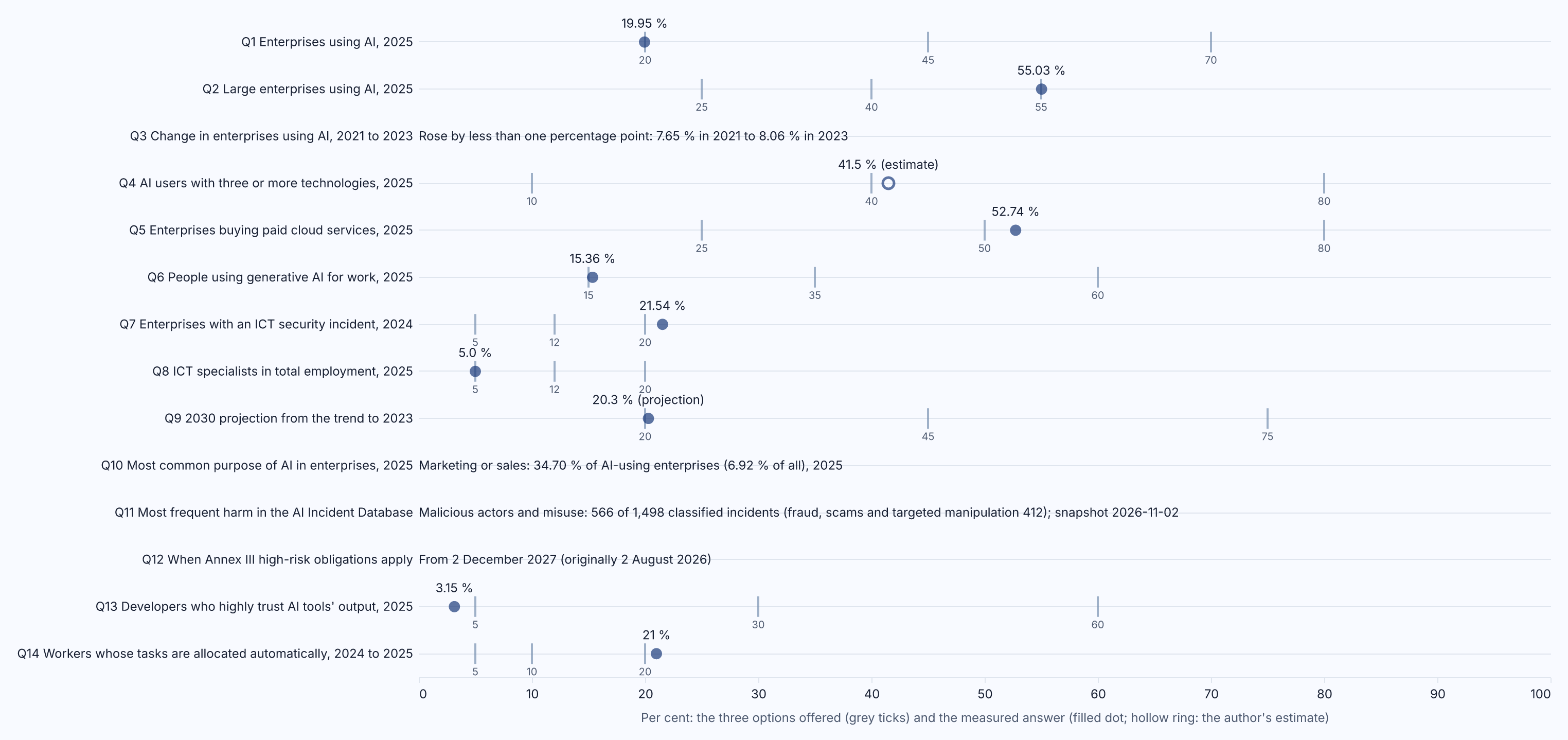
In 2017 the Gapminder Foundation asked polling companies in fourteen countries to put thirteen fact questions about the world to online panels weighted for each country's demographic composition, each question with three answer options (16, Gapminder Foundation, 2017). Hans Rosling had been putting versions of those questions to audiences for years, and the results became the opening of Factfulness (8, Rosling et al., 2018). I do not repeat his questions or his results here. What I have borrowed is the method: ask first, show the measured answer second, and only then talk about why the two differ.
This book is about a narrower world than Rosling's. It is the world that appears inside a large European enterprise or public authority when its architecture becomes code and artificial intelligence (AI) goes to work in it, as an assistant to a person, as a feature a supplier switched on, or as an agent acting on the organisation's systems with an identity of its own. I call that world the landscape. Executives decide about it, architects build it, elected officials regulate it, journalists report on it and citizens live with its results. Most of us carry a picture of it that is a few years out of date, and the picture matters more than the facts, because it is the picture we reason from.
The test comes first. Take it with a pencil, alone or with your team, and write down your answers before you turn to the measured ones. Nobody will see your score. There are fourteen questions, three options each, and every answer traces to a public dataset listed in Appendix C. The rest of the chapter gives the answers, introduces the picture the book draws instead, grades the data it rests on, states my stance, introduces two fictional organisations and says how to read the book.
Primary topics explored
- The test
- The answers
- Why we get them wrong
- A picture drawn the same way every time
- Younger, thinner data
- The stance
About Landscape
Landscape is a companion to The Transformed Architecture. It examines what happens when artificial intelligence takes the manager's chair: algorithmic management of direction, evaluation, consequence, development and care, the effects on people, the management of AI agents, Europe's legal answer, and how to design an accountable AI boss, for European enterprises and public authorities.
It builds on the conclusions of Architecture as Code, AI Governance, AI Platform and Security, AI Red Team, AI Threat and The Transformed Security Architect.
Executives, line managers, HR and people leaders, works councils and trade unions, public employers, architects and AI governance leads, data protection and legal officers, procurement and programme leaders, and risk, compliance and audit.

Gunnar Nordqvist
Conceived, directed and published the books of The Transformed Architecture.
Continue with the full chapter
Chapter 1: Introduction: A Test, a Picture and a Stance in Landscape gives the detailed explanations, practical examples and implementation patterns behind this summary.
This whitepaper belongs to “The Test and the Picture” and is one of 26 drawn from the manuscript.