An email never arrives. A supplier has sent Nordvik Region's procurement unit a revised offer before a deadline, and the message sits in a quarantine folder because a classifier in the Region's email gateway scored it as suspicious. The gateway's vendor switched the classifier on in a product update. Nobody at the Region chose it or set its threshold, and when the procurement officer asks who decided that this message should be held, the honest answer is that nobody did. The scene is illustrative, drawn from the model of Nordvik Region that runs through this book.
That folder is the smallest example of the landscape this book is about. A piece of software acted, with an identity of its own rather than a person's, at the highest degree of autonomy there is, on something that mattered to someone, and no record says who was accountable. This chapter defines that landscape in plain words before Chapter 4 teaches the notation for drawing it. It covers what it means that architecture has become code, that AI works beside people and that AI works as agents, and it introduces by name, each from a scene, the terms the rest of the book depends on.
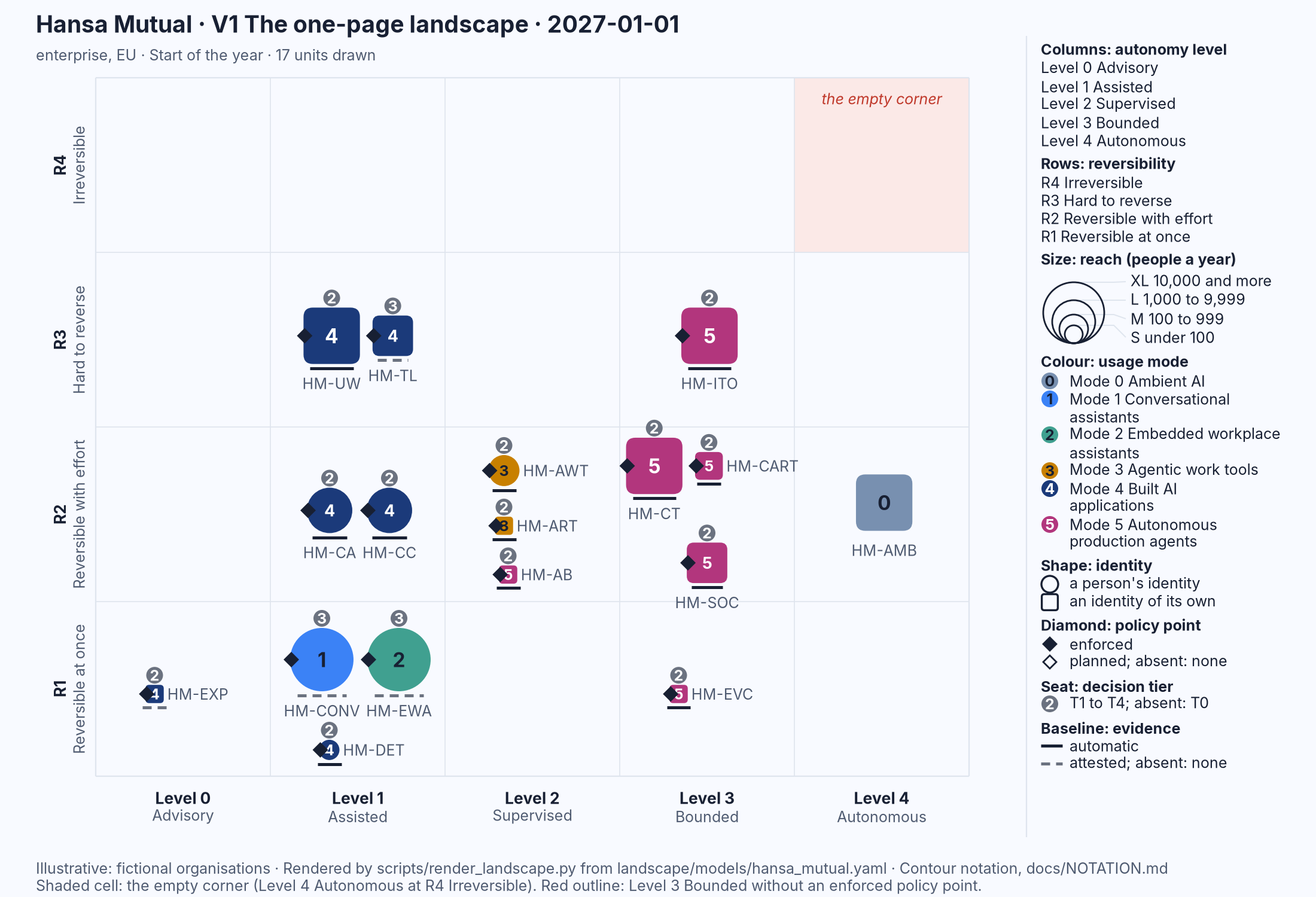
Hansa Mutual is the book's second illustrative organisation, an insurance group, and Figure 3.1 is its landscape. Read two things from it now. There are seventeen marks, not one box labelled "AI". And the grey square at the far right, HM-AMB, has nothing above it, where every other mark carries a small grey circle. That circle is the seat, the place where the notation draws the name of the person who decides about the unit. The square is Hansa Mutual's version of the quarantine folder, and the missing circle is the missing name.
Primary topics explored
- Architecture became code
- AI beside people
- AI as agents
- Six ways an organisation comes to use a model
- Limits that code enforces
- Evidence
About Landscape
Landscape is a companion to The Transformed Architecture. It examines what happens when artificial intelligence takes the manager's chair: algorithmic management of direction, evaluation, consequence, development and care, the effects on people, the management of AI agents, Europe's legal answer, and how to design an accountable AI boss, for European enterprises and public authorities.
It builds on the conclusions of Architecture as Code, AI Governance, AI Platform and Security, AI Red Team, AI Threat and The Transformed Security Architect.
Executives, line managers, HR and people leaders, works councils and trade unions, public employers, architects and AI governance leads, data protection and legal officers, procurement and programme leaders, and risk, compliance and audit.

Gunnar Nordqvist
Conceived, directed and published the books of The Transformed Architecture.
Continue with the full chapter
Chapter 3: The New Landscape: Who Acts, With Whose Identity, Under Whose Decision in Landscape gives the detailed explanations, practical examples and implementation patterns behind this summary.
This whitepaper belongs to “The Test and the Picture” and is one of 26 drawn from the manuscript.