Imagine the paper that reaches the executive committee of Nordvik Region, a fictional regional public authority, in January 2027. The scene is illustrative. The paper is four pages long and headed "The AI system: status, costs and risks". Page one has a diagram: a rectangle labelled "AI system" in the middle, arrows to a rectangle labelled "case management" and another labelled "residents", and a cloud shape above them all. Page two has a budget line and page three a risk line with a single rating. Page four asks the committee to decide whether the system should continue, be paused or be expanded.
The question is a fair one, and it cannot be answered as put, because the thing in the rectangle is not one thing. The Region's AI register, which the committee has not been shown, lists thirteen entries. One ranks applications for financial assistance by urgency and is a high-risk AI system under the AI Act, Regulation (EU) 2024/1689 as amended by Regulation (EU) 2026/1744 (39, European Union, 2024) (40, European Union, 2026). One answers residents' questions from published information without a person approving each answer. One is a set of features that software vendors switched on inside products the Region licenses, which nobody in the Region chose. Two are not yet running and one is paused. Pausing "the AI system" would pause some of these, could not pause others, and would make no difference to the features the vendors run.
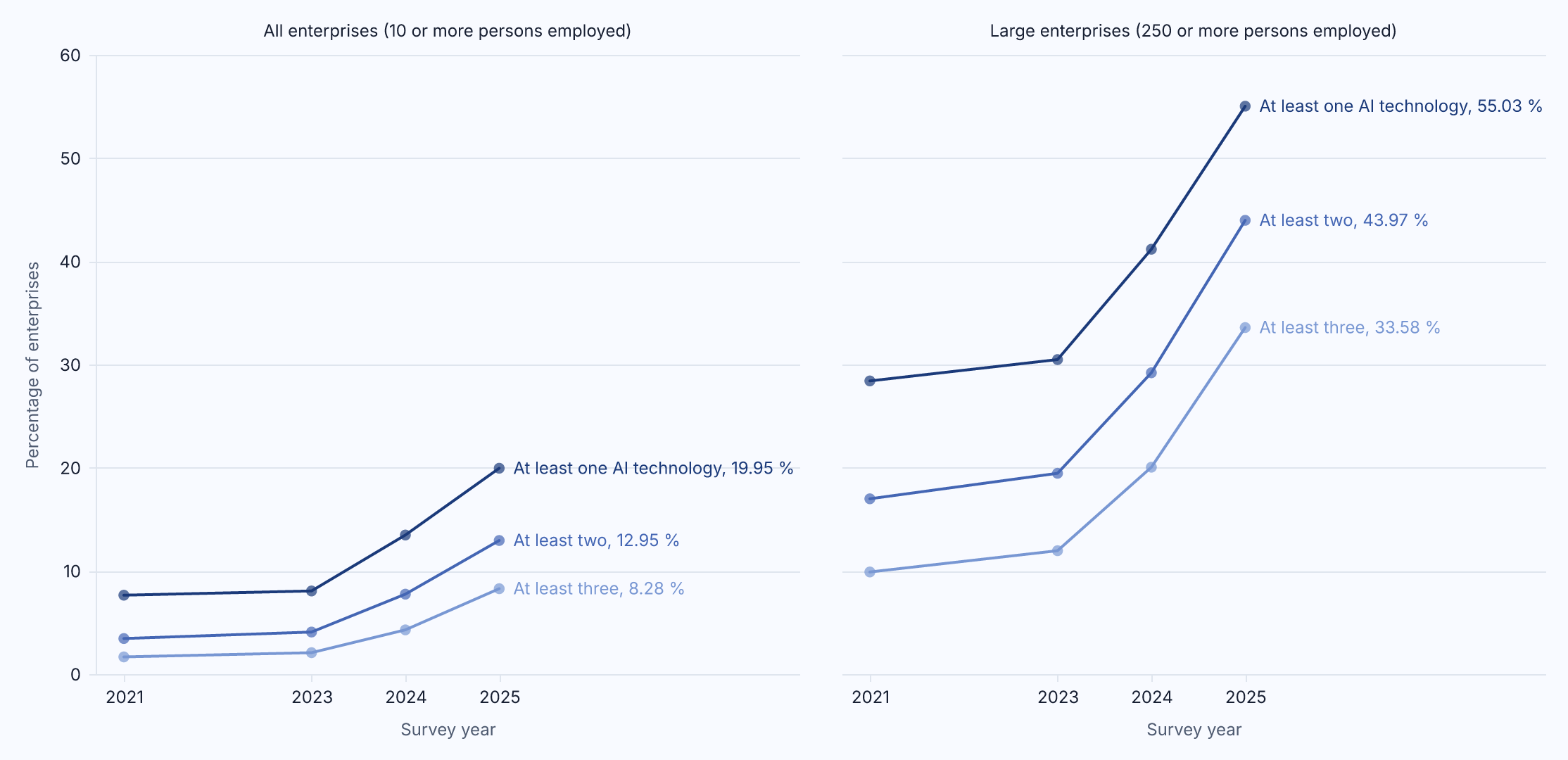
The paper's author cannot be blamed: a board paper has to fit on four pages, and a rectangle is the usual way to show a committee a system. This chapter is about what the rectangle hides: three test questions, the European statistics on how many technologies, purposes and cloud services sit behind "AI" and "the cloud", and Nordvik Region's thirteen entries drawn in the notation of Chapter 4.
Primary topics explored
- The questions
- The instinct
- The evidence
- The picture corrected
- The rule of thumb
- What to do
About Landscape
Landscape is a companion to The Transformed Architecture. It examines what happens when artificial intelligence takes the manager's chair: algorithmic management of direction, evaluation, consequence, development and care, the effects on people, the management of AI agents, Europe's legal answer, and how to design an accountable AI boss, for European enterprises and public authorities.
It builds on the conclusions of Architecture as Code, AI Governance, AI Platform and Security, AI Red Team, AI Threat and The Transformed Security Architect.
Executives, line managers, HR and people leaders, works councils and trade unions, public employers, architects and AI governance leads, data protection and legal officers, procurement and programme leaders, and risk, compliance and audit.

Gunnar Nordqvist
Conceived, directed and published the books of The Transformed Architecture.
Continue with the full chapter
Chapter 5: The Box Instinct: AI Is Not One Thing in Landscape gives the detailed explanations, practical examples and implementation patterns behind this summary.
This whitepaper belongs to “The Instincts” and is one of 26 drawn from the manuscript.