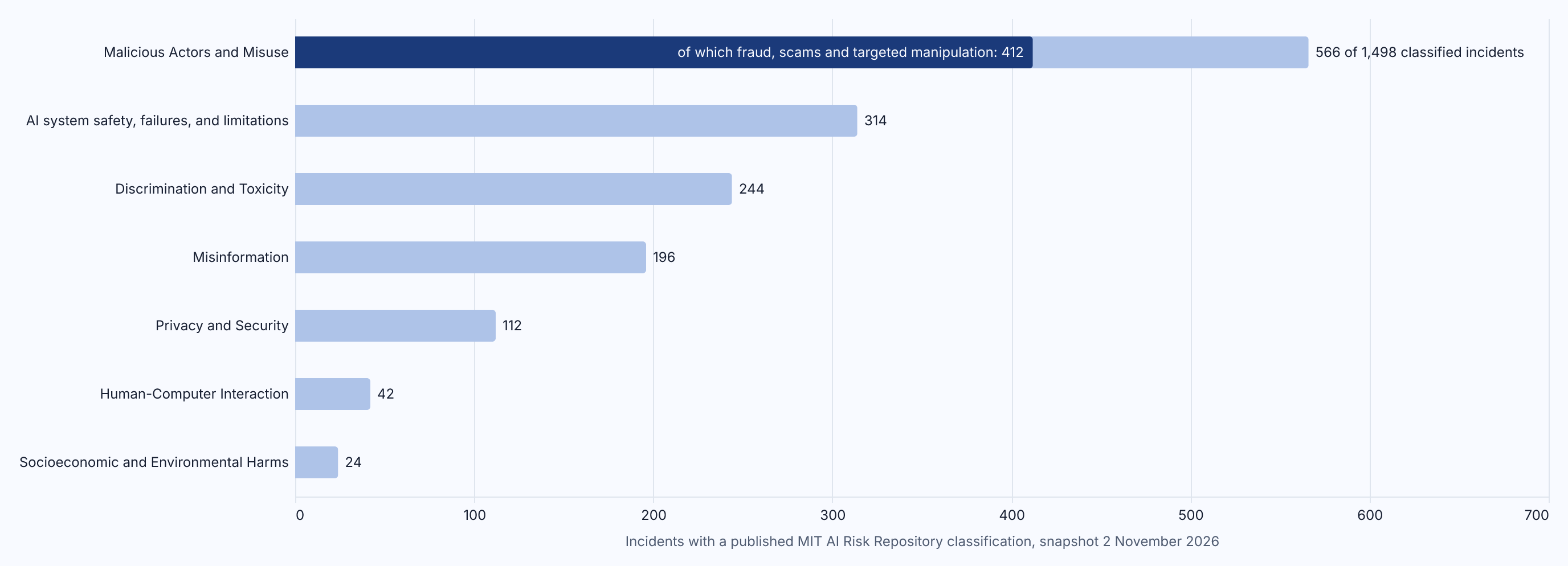
Open the incident table of the AI Incident Database, the public record that the Responsible AI Collaborative keeps of occasions on which an AI system is reported to have caused or nearly caused harm, and look for the column most readers expect: the model. In the export used for this book there is no such column. What each of the 1,786 incidents in the snapshot of 2 November 2026 carries instead is an "alleged deployer", an "alleged developer" and the "alleged harmed or nearly harmed parties", as the database's volunteer editors attributed them from press reports (35, Responsible AI Collaborative, 2026). Sort the deployers by how often they are named and the first three are not organisations at all: "scammers", named in 240 incidents, "deepfake creators" in 129 and "synthetic media creators" in 106 (35, Responsible AI Collaborative, 2026). The first named company comes fourth. Sort the developers and the top of the list is a category of technology rather than a product: "deepfake technology developers" in 452 incidents and "synthetic audio generation technology developers" in 241 (35, Responsible AI Collaborative, 2026).
A reader who expects a league table of models will not find one. What the record holds is a picture of uses: people using a kind of technology to do something to other people, so often that the editors named the practice and not the tool. Reading those entries as categories of people and of technology is my editorial classification, not a field of the database; the entries are attributions from press reports, not legal findings; and what the editors chose to record does not prove that models do not matter. The instinct asks which model. The record answers with what it was used for and by whom.
That gap is the subject of this chapter. Applied to this landscape, the habit of judging a product by its name puts the risk and the value in the wrong place, because the same general-purpose model is a drafting aid at one desk and an agent with its own permissions at another. The chapter draws on two incident records, the structure of the AI Act, and two views of this book's notation.
Primary topics explored
- The questions
- The instinct
- The evidence
- The picture corrected
- The rule of thumb
- What to do
About Landscape
Landscape is a companion to The Transformed Architecture. It examines what happens when artificial intelligence takes the manager's chair: algorithmic management of direction, evaluation, consequence, development and care, the effects on people, the management of AI agents, Europe's legal answer, and how to design an accountable AI boss, for European enterprises and public authorities.
It builds on the conclusions of Architecture as Code, AI Governance, AI Platform and Security, AI Red Team, AI Threat and The Transformed Security Architect.
Executives, line managers, HR and people leaders, works councils and trade unions, public employers, architects and AI governance leads, data protection and legal officers, procurement and programme leaders, and risk, compliance and audit.

Gunnar Nordqvist
Conceived, directed and published the books of The Transformed Architecture.
Continue with the full chapter
Chapter 7: The Model Instinct: The Use Sets the Risk and the Value in Landscape gives the detailed explanations, practical examples and implementation patterns behind this summary.
This whitepaper belongs to “The Instincts” and is one of 26 drawn from the manuscript.