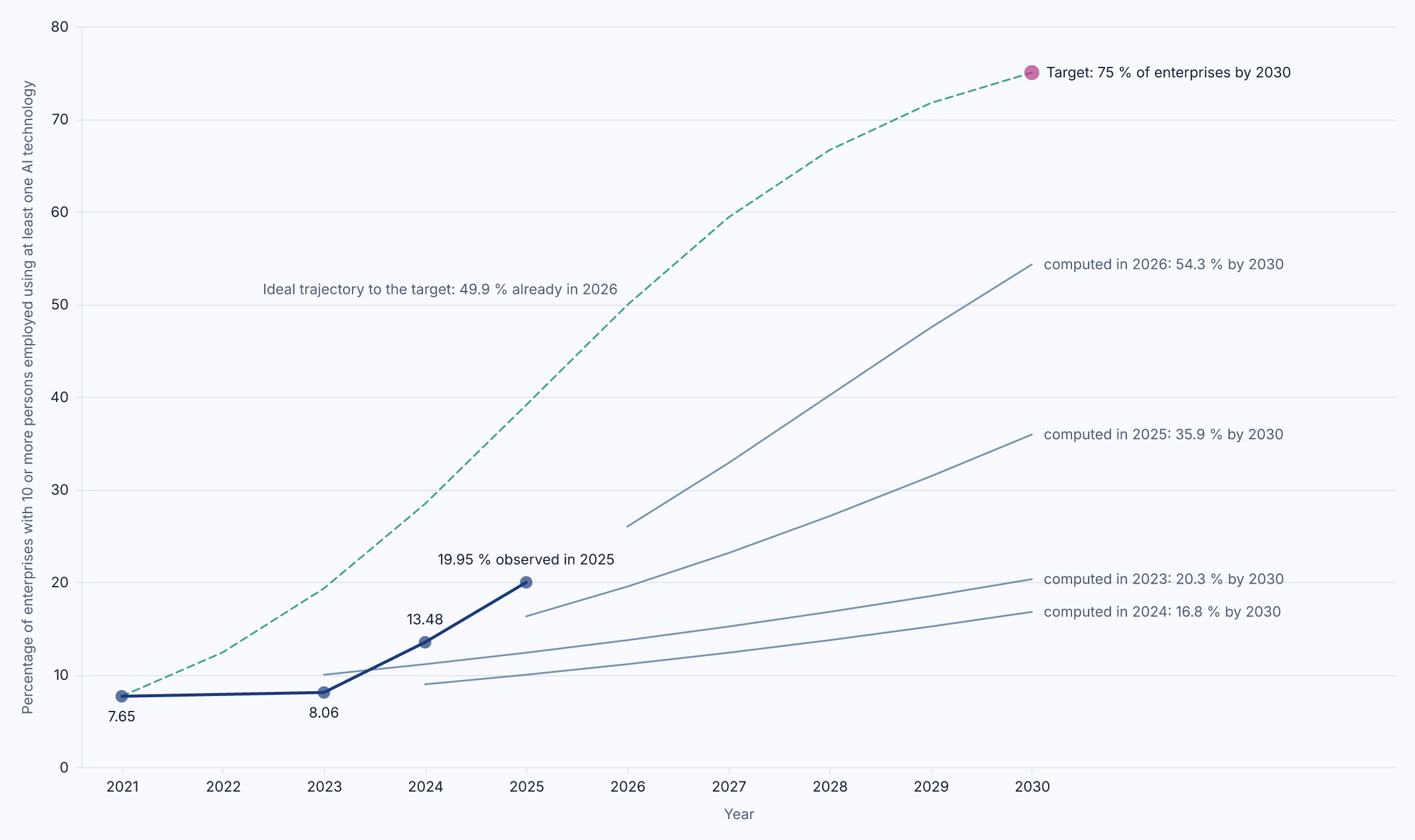
In December 2022 the European Parliament and the Council adopted a decision with a number in it. Decision (EU) 2022/2481 establishes the Digital Decade Policy Programme 2030, the Union's set of digital targets for the end of the decade. One of them is that by 2030 at least 75 per cent of enterprises in the Union have taken up cloud computing services, big data or artificial intelligence, in line with their business operations (Article 4(1), point (3)(a)) (43, European Union, 2022). An enterprise counts if it has taken up one or more of the three, so the Decision sets one target for the three together. The Commission's dashboard tracks a combined indicator for it, which stood at 63.2 per cent in 2025, and draws each technology separately beside it against the same 75 per cent (15, European Commission, 2026). For AI the dashboard's chart therefore has a single point at 2030: 75 per cent of enterprises with ten or more persons employed using at least one AI technology. That line is the Commission's chart of AI alone, not a separate target in the Decision.
Beside that point the dashboard draws the past. In 2021, the first year of Eurostat's table on AI use in enterprises, 7.65 per cent of enterprises in the EU with ten or more persons employed, outside the financial sector, said they used at least one AI technology. In 2023 the share was 8.06 per cent, in 2024 it was 13.48 per cent, and in 2025 it was 19.95 per cent (15, European Commission, 2026). Four points, five years, and a target far above them. Anyone who looks at the chart does what people do with a few points and a distant goal: they lay a ruler along the points and see where it lands.
The Commission does the same, openly, every year. The dashboard publishes a baseline trajectory, labelled "Baseline trajectory based on past perfomance" (sic), which is a line drawn forward from the observed points, and an ideal trajectory, labelled "DD trajectory (ideal path to reach the target)", the path the share would have to follow to reach 75 per cent in 2030. The dataset behind this chapter holds four of the baseline trajectories, computed in 2023, 2024, 2025 and 2026 (15, European Commission, 2026). They are the Commission's projections, not observations. The 2023 baseline, drawn when the only observation was the 2021 value, reached 20.29 per cent in 2030. The 2024 baseline, drawn after a second observation had barely moved, reached 16.76 per cent. The 2025 baseline, after one fast year, reached 35.92 per cent. The 2026 baseline, after two fast years, reaches 54.28 per cent. Four rulers, laid along the same series by the same office with the same method, pointing at four futures: each is what a straight line through the latest points says, and the latest points keep bending.
Primary topics explored
- The questions
- The instinct
- The evidence
- The picture corrected
- The rule of thumb
- What to do
About Landscape
Landscape is a companion to The Transformed Architecture. It examines what happens when artificial intelligence takes the manager's chair: algorithmic management of direction, evaluation, consequence, development and care, the effects on people, the management of AI agents, Europe's legal answer, and how to design an accountable AI boss, for European enterprises and public authorities.
It builds on the conclusions of Architecture as Code, AI Governance, AI Platform and Security, AI Red Team, AI Threat and The Transformed Security Architect.
Executives, line managers, HR and people leaders, works councils and trade unions, public employers, architects and AI governance leads, data protection and legal officers, procurement and programme leaders, and risk, compliance and audit.

Gunnar Nordqvist
Conceived, directed and published the books of The Transformed Architecture.
Continue with the full chapter
Chapter 8: The Straight-Line Instinct: Curves That Bend in Landscape gives the detailed explanations, practical examples and implementation patterns behind this summary.
This whitepaper belongs to “The Instincts” and is one of 26 drawn from the manuscript.