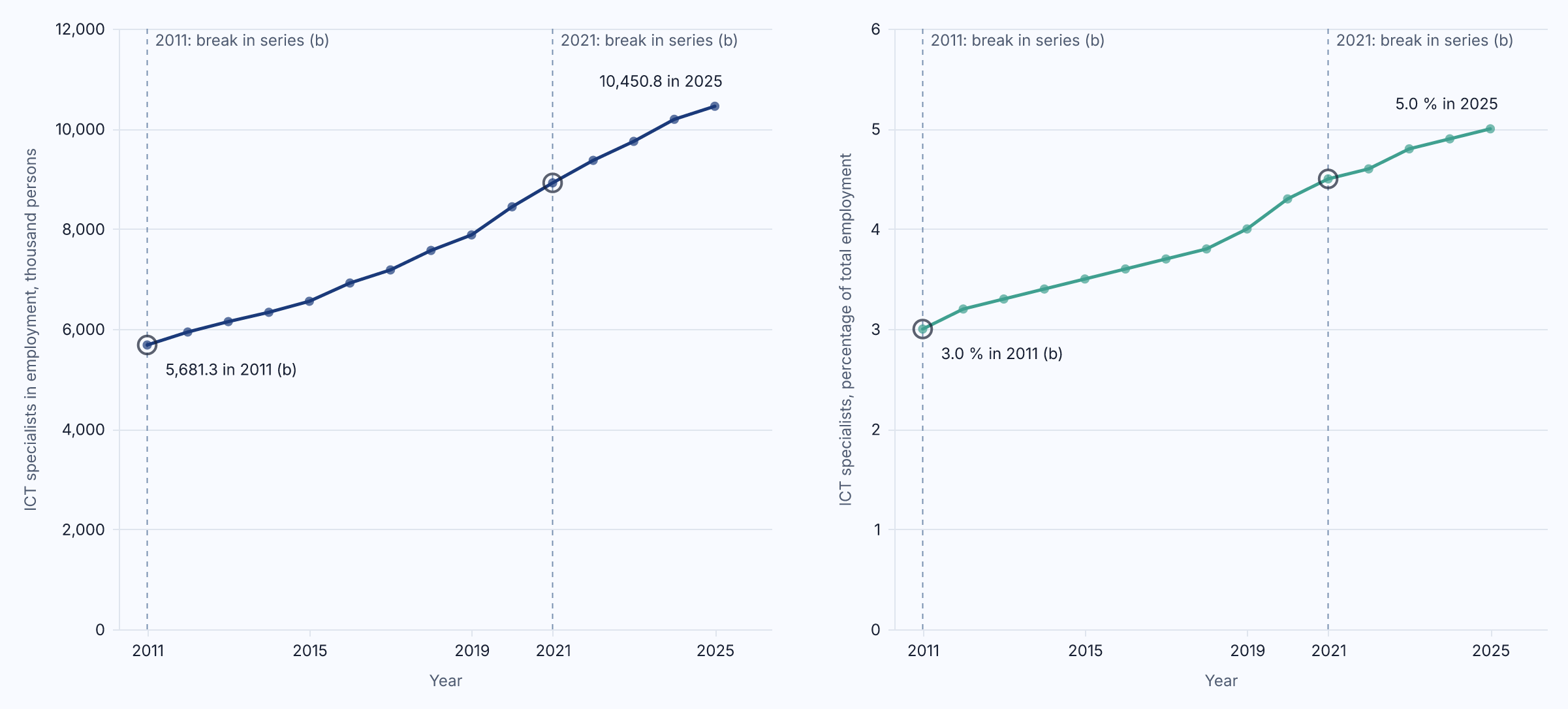
Four numbers, each from a public source, laid out as a briefing might lay them out on its first page. The European Union Agency for Cybersecurity analysed 4,875 cyber incidents in the twelve months to June 2025, and 11,079 the year before (38, ENISA, 2025) (37, ENISA, 2024). The AI Incident Database held 1,786 records of AI systems that caused or nearly caused harm at the start of November 2026, 463 of them dated 2025 (35, Responsible AI Collaborative, 2026). Two thirds of respondents to a Eurobarometer survey in the spring of 2024, 66 per cent, agreed with the statement that "due to the use of robots and artificial intelligence, more jobs will disappear than new jobs will be created" (29, European Commission, 2025). And the Union employed 10.45 million ICT specialists in 2025, the workers whose main job is to develop, operate or maintain information and communications technology systems (12, Eurostat, 2026).
Every one of these numbers is true, and each has a source that stands behind it. Read together, they produce a feeling rather than a picture: attacks in their thousands, harms in their hundreds, jobs under threat, a vast technical workforce. The feeling is of scale.
Now read the same numbers with the piece the briefing left off. The 2025 ENISA report states that it used the agency's updated methodology of August 2025, so the later count is no baseline for the earlier one, and about 76.7 per cent of its incidents were denial-of-service attacks, which ENISA describes as having very low impact overall (38, ENISA, 2025). The AI Incident Database counts what the press reported and volunteers submitted (17, Maslej et al., 2025). The two thirds were giving an opinion about the future, not reporting a job lost; in the same survey, 66 per cent of those in work said the newest digital technologies had a positive effect on their own employment (29, European Commission, 2025). And the 10.45 million specialists were 5.0 per cent of everyone in work (12, Eurostat, 2026).
Primary topics explored
- The questions
- The instinct
- The evidence
- The picture corrected
- The rule of thumb
- What to do
About Landscape
Landscape is a companion to The Transformed Architecture. It examines what happens when artificial intelligence takes the manager's chair: algorithmic management of direction, evaluation, consequence, development and care, the effects on people, the management of AI agents, Europe's legal answer, and how to design an accountable AI boss, for European enterprises and public authorities.
It builds on the conclusions of Architecture as Code, AI Governance, AI Platform and Security, AI Red Team, AI Threat and The Transformed Security Architect.
Executives, line managers, HR and people leaders, works councils and trade unions, public employers, architects and AI governance leads, data protection and legal officers, procurement and programme leaders, and risk, compliance and audit.

Gunnar Nordqvist
Conceived, directed and published the books of The Transformed Architecture.
Continue with the full chapter
Chapter 10: The Size Instinct: Numbers Without Denominators in Landscape gives the detailed explanations, practical examples and implementation patterns behind this summary.
This whitepaper belongs to “The Instincts” and is one of 26 drawn from the manuscript.