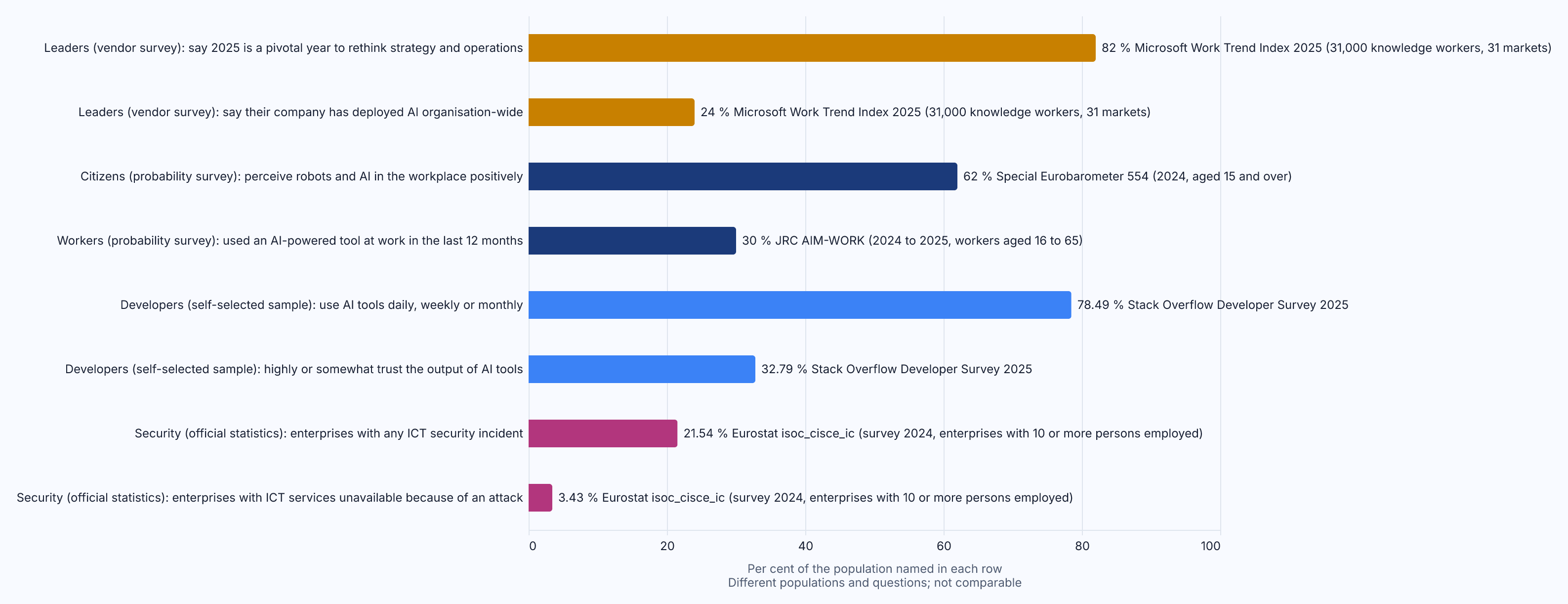
Three people describe the same thing, and none of them is wrong. The thing is a drafting assistant for office staff, and the three descriptions come from published surveys of the three groups who sit closest to such tools. The first voice is a leader's. In a vendor survey of 31,000 knowledge workers in 31 markets, fielded for Microsoft's Work Trend Index in February and March 2025, 81 per cent of the respondents classed as leaders expected agents to be moderately or extensively integrated into their company's AI strategy within twelve to eighteen months (25, Microsoft, 2025). From that chair the assistant is a first step on a path already scheduled.
The second voice is a worker's. The Joint Research Centre's AIM-WORK survey, a telephone survey of 70,316 individuals aged 16 to 65 across the 27 member states, asked workers "In the last 12 months, did you use an AI-powered tool when performing your main paid job?"; 30 per cent answered yes (51, Gonzalez Vazquez et al., 2025). From that chair the assistant is a tool that a minority has used.
The third voice belongs to the person who keeps the record of what goes wrong. Eurostat's enterprise survey of 2024 found that 3.43 per cent of EU enterprises with ten or more persons employed, outside the financial sector, had seen their ICT services made unavailable by an attack from outside (11, Eurostat, 2026). From that chair the assistant is one more channel into the organisation, one more place where a credential, a document or an instruction can leave or arrive.
Primary topics explored
- The questions
- The instinct
- The evidence
- The picture corrected
- The rule of thumb
- What to do
About Landscape
Landscape is a companion to The Transformed Architecture. It examines what happens when artificial intelligence takes the manager's chair: algorithmic management of direction, evaluation, consequence, development and care, the effects on people, the management of AI agents, Europe's legal answer, and how to design an accountable AI boss, for European enterprises and public authorities.
It builds on the conclusions of Architecture as Code, AI Governance, AI Platform and Security, AI Red Team, AI Threat and The Transformed Security Architect.
Executives, line managers, HR and people leaders, works councils and trade unions, public employers, architects and AI governance leads, data protection and legal officers, procurement and programme leaders, and risk, compliance and audit.

Gunnar Nordqvist
Conceived, directed and published the books of The Transformed Architecture.
Continue with the full chapter
Chapter 12: The Single-Perspective Instinct: Security, Compliance and Productivity Share One Landscape in Landscape gives the detailed explanations, practical examples and implementation patterns behind this summary.
This whitepaper belongs to “The Instincts” and is one of 26 drawn from the manuscript.