Picture five people on the same morning, each with a document about AI in front of them. A board member in Hamburg opens a paper headed "AI programme: status and outlook". An architect in a Nordic regional authority opens a proposal that would let a rostering system offer open shifts without a manager approving each one. A regional director takes a seat in a council chamber where a question about "rogue AI" is on the order paper. A journalist opens a press release with a large number in its first line. A citizen reads on a phone that AI is coming for the jobs. None of the five has an hour.
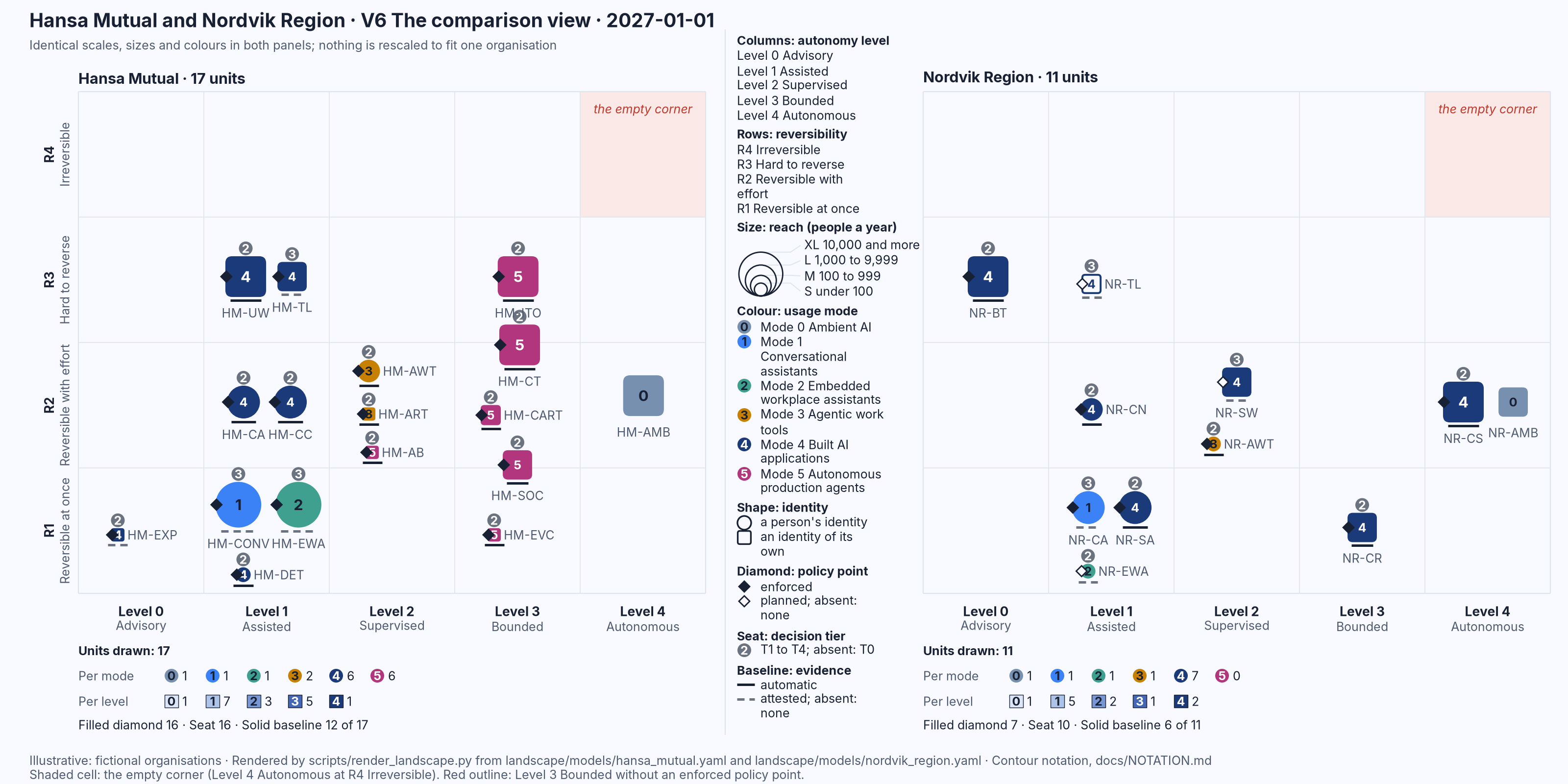
This chapter is for that morning. It collects the nine rules of thumb that Chapters 5 to 13 arrived at, each with one measured fact, and then follows the five readers through their documents. The scenes are illustrative. The board member's and the architect's sit inside the scenario of Chapter 18, which is not a forecast, and the journalist's and the citizen's rest on the public record as it stands in November 2026. The facts about Nordvik Region and Hansa Mutual come from the landscape models from which Figure 19.1 is rendered, at the start of 2027.
Each rule is quoted as its chapter set it, with the instinct it answers, the chapter that gives the evidence and one measured fact from it.
Primary topics explored
- The nine rules
- The executive
- The architect
- The public official
- The journalist
- The citizen
About Landscape
Landscape is a companion to The Transformed Architecture. It examines what happens when artificial intelligence takes the manager's chair: algorithmic management of direction, evaluation, consequence, development and care, the effects on people, the management of AI agents, Europe's legal answer, and how to design an accountable AI boss, for European enterprises and public authorities.
It builds on the conclusions of Architecture as Code, AI Governance, AI Platform and Security, AI Red Team, AI Threat and The Transformed Security Architect.
Executives, line managers, HR and people leaders, works councils and trade unions, public employers, architects and AI governance leads, data protection and legal officers, procurement and programme leaders, and risk, compliance and audit.

Gunnar Nordqvist
Conceived, directed and published the books of The Transformed Architecture.
Continue with the full chapter
Chapter 19: The Rules of Thumb in Practice in Landscape gives the detailed explanations, practical examples and implementation patterns behind this summary.
This whitepaper belongs to “Seeing Clearly” and is one of 26 drawn from the manuscript.