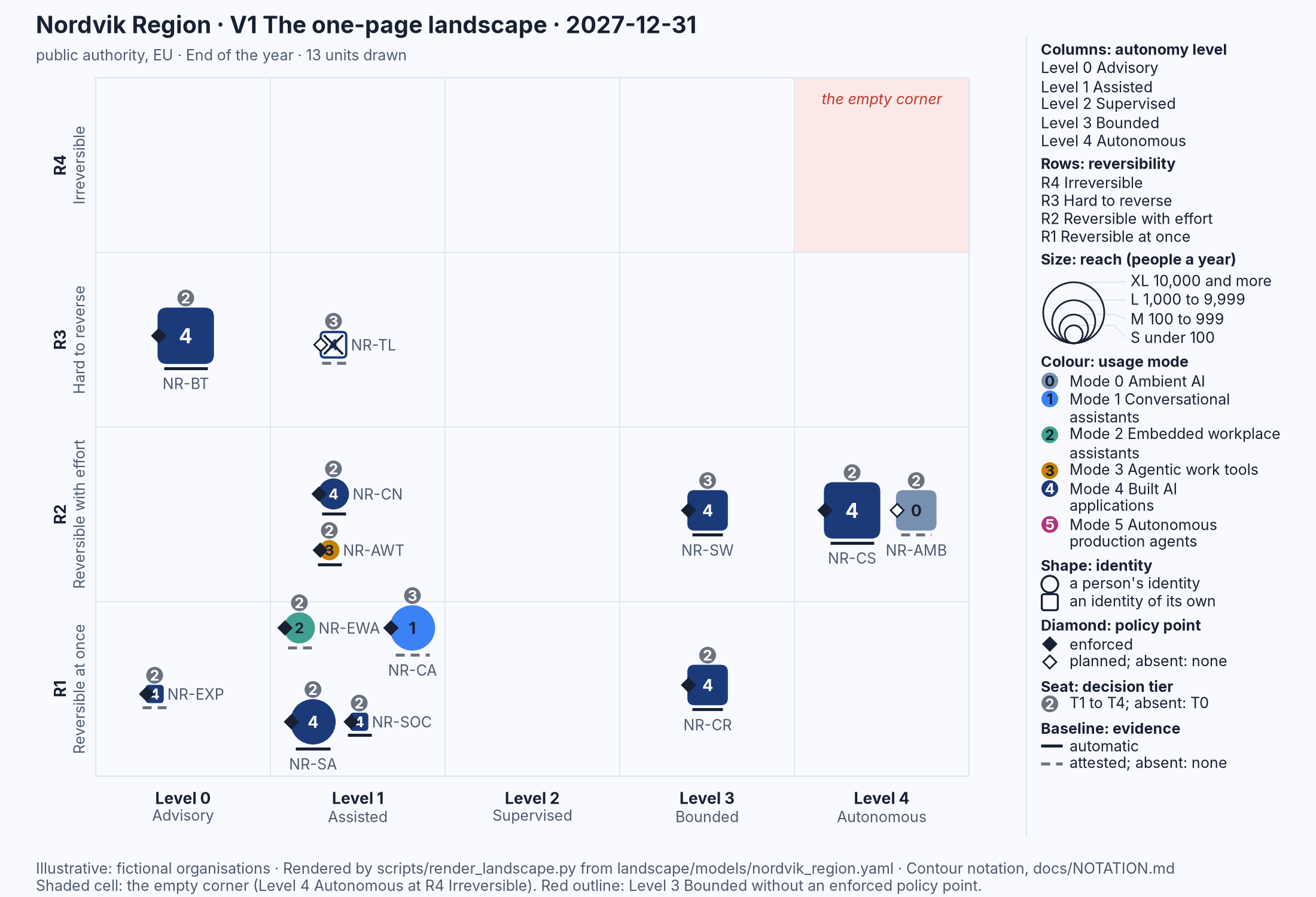
This appendix is meant to be used, not read through. The first part is the reference card of Contour, the notation of this book: the seven dimensions, their scales, the frames, the legend and the thirty-second reading order, on one page, in the exact names that docs/NOTATION.md gives them. Keep it beside a landscape while you read one. The second part lists the six standard views and the file names under which they are rendered. The third part describes the landscape model, the machine-readable file from which every view is drawn, field by field, with the register of the series that already holds each field, the semantics of its timeline, the commands of the renderer and the tests that keep model and picture in step. The fourth part shows one rendered view and quotes, from the committed model, the few lines of YAML behind one of its marks. Chapter 4 teaches the notation; Appendix B shows how to draw each view by pen.
Nothing on the card is the renderer's choice. The renderer, scripts/render_landscape.py, draws what the specification says and nothing else, and every colour on the card comes from docs/chart_palette.json.
The thing drawn is an AI use, called a unit: one way in which an organisation puts a model to work, with the people who work with it. The same model used in two ways is two units; one product that drafts and also files is two units. Each unit is drawn as one mark, and every mark carries seven dimensions. Nothing else is encoded.
Primary topics explored
- The reference card
- The six standard views
- The landscape model
- One view, and the model behind one mark
- Sources
About Landscape
Landscape is a companion to The Transformed Architecture. It examines what happens when artificial intelligence takes the manager's chair: algorithmic management of direction, evaluation, consequence, development and care, the effects on people, the management of AI agents, Europe's legal answer, and how to design an accountable AI boss, for European enterprises and public authorities.
It builds on the conclusions of Architecture as Code, AI Governance, AI Platform and Security, AI Red Team, AI Threat and The Transformed Security Architect.
Executives, line managers, HR and people leaders, works councils and trade unions, public employers, architects and AI governance leads, data protection and legal officers, procurement and programme leaders, and risk, compliance and audit.

Gunnar Nordqvist
Conceived, directed and published the books of The Transformed Architecture.
Continue with the full chapter
Appendix A: Appendix A: The Notation Reference Card and the Landscape Model in Landscape gives the detailed explanations, practical examples and implementation patterns behind this summary.
This whitepaper belongs to “Appendices” and is one of 26 drawn from the manuscript.