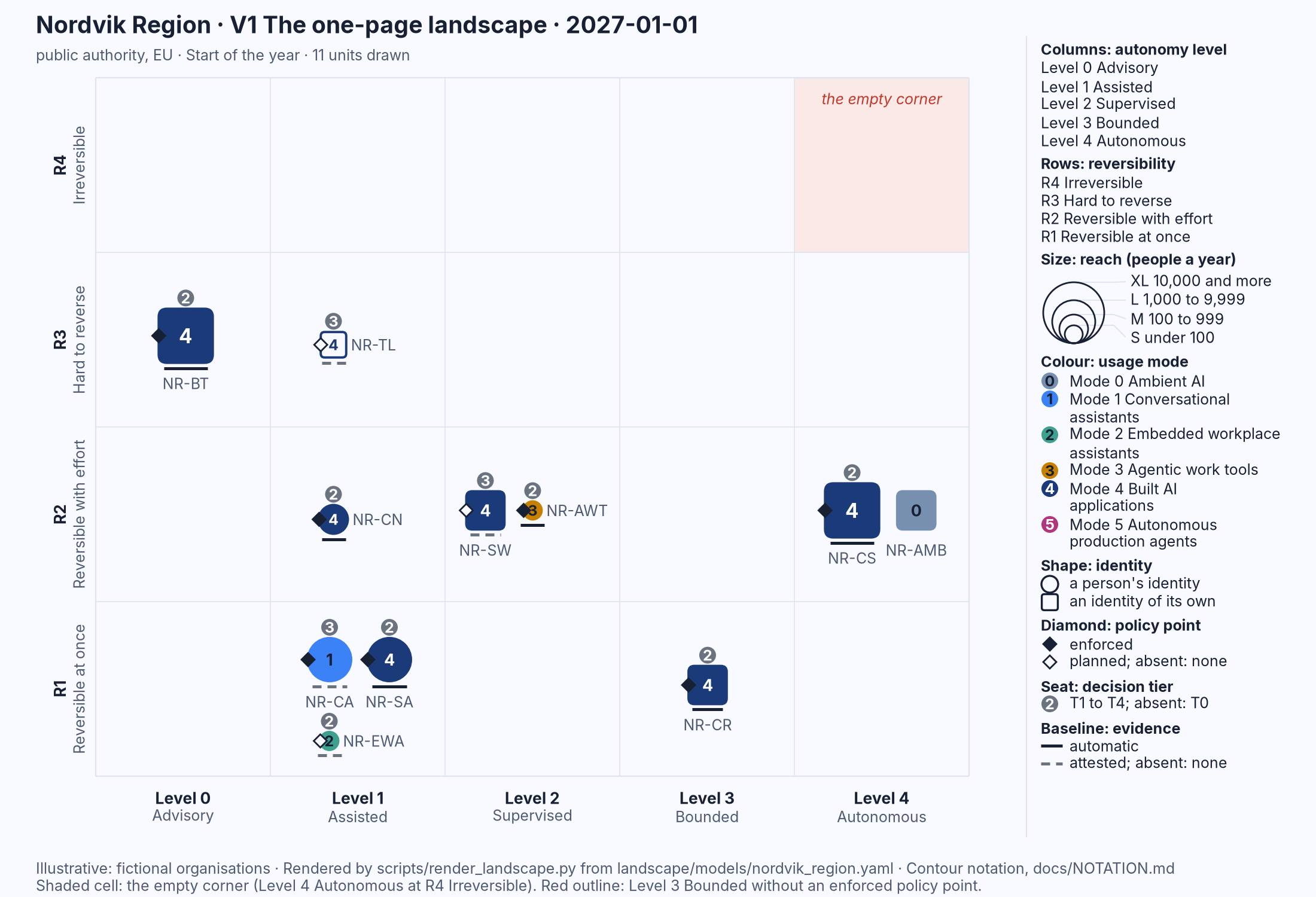
The notation of this book, Contour, was designed so that a person with a pen can draw it before anyone opens a file. The renderer, scripts/render_landscape.py, makes the sketch exact, not possible: it places every mark from a committed model, keeps the sizes and colours identical from one picture to the next and refuses to draw what the specification does not define. The sketch comes first, in the meeting where the question is asked, and most first landscapes are drawn that way. This appendix gives one page per view, V1 to V6, each as a numbered pen-and-paper procedure, each followed by the renderer's exact version of the same view so that you can check your sketch against it, and each ending with the three mistakes people make when they draw it. The last page carries the nine rules of thumb of Part II on one page, with nothing else, so that it can be torn out.
You need four things: a pen, one sheet of paper, landscape orientation, five minutes, and the organisation's list of AI uses. The list is the inventory that Chapter 14 describes, or, failing that, whatever the room can name in the first two minutes; a landscape drawn from an incomplete list is still a landscape, and the gaps are its first finding. For each use you need, or will have to guess and mark as a guess, the seven dimensions: the autonomy level, the reversibility tier, the reach, the usage mode, the identity, whether a policy point exists and who holds the decision right, and where the evidence comes from. The tables that define the scales are in Appendix A and are not repeated here; keep the reference card beside you. One pen is enough. The mode's digit, written inside every mark, carries what the colour carries in the rendered view, and the notation never depends on colour alone. If you have six coloured pens, use the mode colours that Appendix A names; if you have one, the picture loses nothing the notation requires.
Three conventions hold on every page. Write the organisation's name and the date in the top-left corner, because a landscape is always drawn at one date. Write the unit's id beside a small mark and beneath a large one, as the renderer does, so that the ids do not collide. And draw what you do not know as absent rather than leaving the unit off the page: a mark without a seat says that nobody has been named, which is a finding; a unit left off the page says nothing.
Primary topics explored
- Page 1: the one-page landscape (V1)
- Page 2: the landscape over time (V2)
- Page 3: the supply and sovereignty view (V3)
- Page 4: the decision-rights view (V4)
- Page 5: the evidence view (V5)
- Page 6: the comparison view (V6)
About Landscape
Landscape is a companion to The Transformed Architecture. It examines what happens when artificial intelligence takes the manager's chair: algorithmic management of direction, evaluation, consequence, development and care, the effects on people, the management of AI agents, Europe's legal answer, and how to design an accountable AI boss, for European enterprises and public authorities.
It builds on the conclusions of Architecture as Code, AI Governance, AI Platform and Security, AI Red Team, AI Threat and The Transformed Security Architect.
Executives, line managers, HR and people leaders, works councils and trade unions, public employers, architects and AI governance leads, data protection and legal officers, procurement and programme leaders, and risk, compliance and audit.

Gunnar Nordqvist
Conceived, directed and published the books of The Transformed Architecture.
Continue with the full chapter
Appendix B: Appendix B: Drawing the Views by Hand, and the Rules on One Page in Landscape gives the detailed explanations, practical examples and implementation patterns behind this summary.
This whitepaper belongs to “Appendices” and is one of 26 drawn from the manuscript.