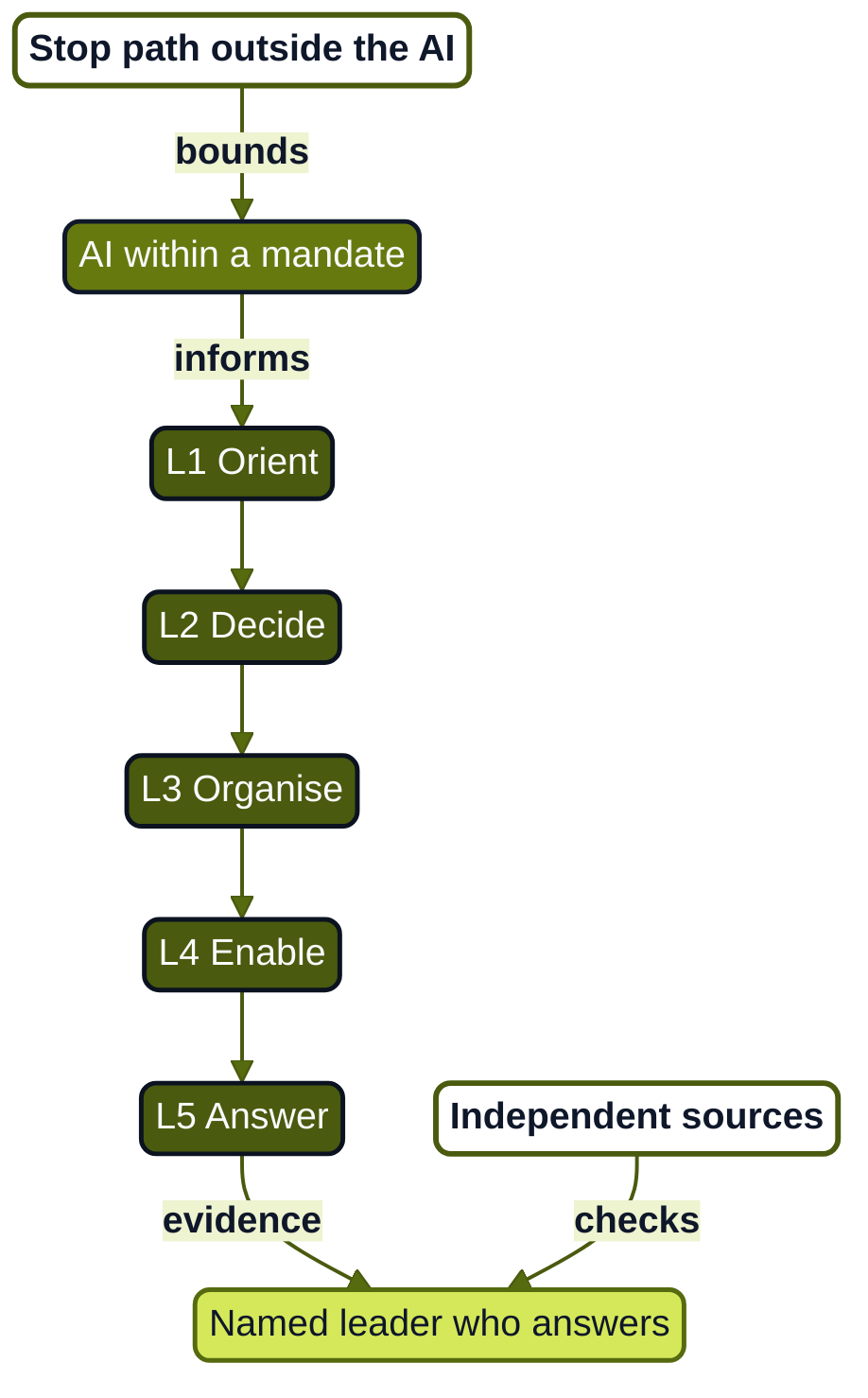
The ten earlier volumes of this series ended, one after another, in a decision that somebody must take, a risk that somebody must accept, an exception that somebody must grant and a failure that somebody must answer for. None of them took the person who does those things as its subject. This book does. It asks what happens to leadership, in the board, the executive team, the middle layer, the first line and the public authority, when AI is used broadly across the organisation and not in one system or one function. It concerns all five functions of the leadership loop that Chapter 4 defines: L1 Orient (making sense of the situation and setting direction), L2 Decide (taking decisions of quality and deciding who decides), L3 Organise (shaping structure and work), L4 Enable (developing people and the conditions in which they work) and L5 Answer (being accountable for the outcome and able to say why).
The chapter has a plain purpose. It states what leadership means in this book, why AI changes it now, what the book claims and what would show the claim wrong, which instruments and vocabulary the book relies on, and how each kind of reader should use it. The conclusions of the earlier volumes are summarised where they are needed, so that no reader has to have read them.
Two decisions of the same kind, taken in two organisations in 2029, open the book. In both, a leader acted on material that an AI system had helped to prepare. In both, someone later asked who had decided, on what basis and who answered. Both organisations are fictional and are described in full in the section on the two organisations below; their facts are those of the book's canonical profiles.
Primary topics explored
- A decision nobody can answer for
- Leadership with AI in 2029
- Why a book on leadership
- The working thesis
- Five functions and five degrees
- Usage modes and degrees of delegation
About AI Leader
AI Leader is Book 11 of The Transformed Architecture. It takes leadership as its subject and asks what happens when AI is used broadly: the five leadership functions (orient, decide, organise, enable, answer), the delegation ladder and the Level 4 prohibitions, the answerability principle (name, explain, reach), the span and the middle layer, human-agent work, the board and the management body, change and adoption as claims that need evidence, regulation (the AI Act, DORA, NIS 2, the GDPR), ethics and sovereignty, and the leader as a person, for European enterprises and public authorities.
It builds on the conclusions of Architecture as Code, AI Governance, AI Platform and Security, AI Red Team, AI Threat, The Transformed Security Architect, AI Boss, AI Blue, AI Purple and AI Operations.
chairs and members of boards, chief executives and executive teams, the changing C-suite, middle managers and first-line leaders, heads of public authorities and the politicians who oversee them, HR specialists, works councils and unions, architects who advise leaders, and supervisors and auditors.

Gunnar Nordqvist
Conceived, directed and published the books of The Transformed Architecture.
Continue with the full chapter
Chapter 1: Introduction: Leadership with AI in AI Leader gives the detailed explanations, practical examples and implementation patterns behind this summary.
This whitepaper belongs to “The Leadership Role in Question” and is one of 37 drawn from the manuscript.