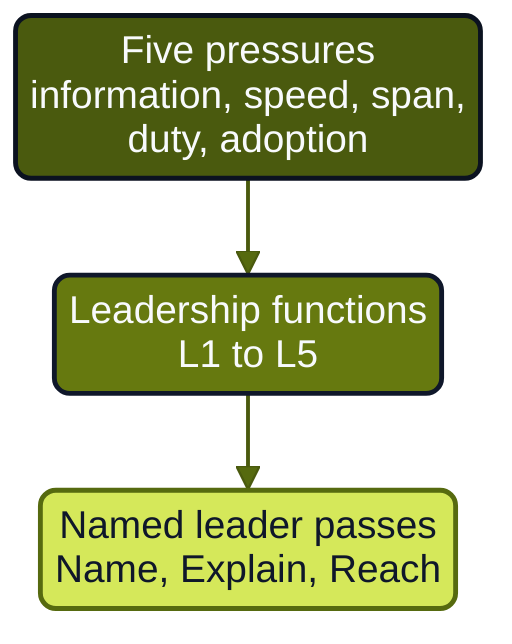
Leaders are said to be under pressure so often that the statement has stopped carrying information. This chapter breaks it into parts that can be graded. Six pressures act on the person who leads: the volume of information and the interruption of attention, the speed of decisions and of the clocks that law sets, the span of control and the number of layers, the duty that European law places on named people and bodies, the pressure to show results from AI, and adversaries who use the same tools. The chapter concerns all five leadership functions, L1 Orient, L2 Decide, L3 Organise, L4 Enable and L5 Answer, which Chapter 4 defines, and shows on which of them each pressure lands.
The chapter is also an exercise in restraint. Statements about leaders under strain come from three kinds of source: measurements, surveys run by consultancies, vendors and research firms, and opinion. Chapter 2 described a role that was partly an information junction, where reports met, were summarised and were passed up and down. This chapter asks what strains that role now, and it keeps what was measured apart from what executives, consultancies and vendors report. It builds on several conclusions of the earlier volumes: that adversaries work at machine speed and that identity and approvals must resist synthetic media (F35 and F36, AI Platform and Security, Chapter 18) (222, Nordqvist, 2026); that AI moves work from the queue to the loop and that a loop without a cap on open drafts is another queue (F94, AI Blue, Chapter 6) (227, Nordqvist, 2026); that measures which reward closing items faster are gamed (F105, AI Blue, Chapter 20); that the load on a person's attention is the scarce resource and that whether AI relieves or intensifies it is open (F110, AI Blue, Chapter 21); and that decision rights are requirements, each with a holder, deputies, a response time, an evidence standard, a record and a ceiling for AI (F148, AI Operations, Chapter 22) (229, Nordqvist, 2026).
A claim that leaders are under pressure can mean three things, and the chapter keeps them apart. The grades are a simplification of the evidence ladder of AI Threat, Chapter 4 (224, Nordqvist, 2026), fitted to leadership in the way AI Operations, Chapter 3 fitted them to operations (229, Nordqvist, 2026).
Primary topics explored
- Reading the evidence: three grades
- Information and attention
- Speed
- Span and layers
- Duty
- Adoption pressure
About AI Leader
AI Leader is Book 11 of The Transformed Architecture. It takes leadership as its subject and asks what happens when AI is used broadly: the five leadership functions (orient, decide, organise, enable, answer), the delegation ladder and the Level 4 prohibitions, the answerability principle (name, explain, reach), the span and the middle layer, human-agent work, the board and the management body, change and adoption as claims that need evidence, regulation (the AI Act, DORA, NIS 2, the GDPR), ethics and sovereignty, and the leader as a person, for European enterprises and public authorities.
It builds on the conclusions of Architecture as Code, AI Governance, AI Platform and Security, AI Red Team, AI Threat, The Transformed Security Architect, AI Boss, AI Blue, AI Purple and AI Operations.
chairs and members of boards, chief executives and executive teams, the changing C-suite, middle managers and first-line leaders, heads of public authorities and the politicians who oversee them, HR specialists, works councils and unions, architects who advise leaders, and supervisors and auditors.

Gunnar Nordqvist
Conceived, directed and published the books of The Transformed Architecture.
Continue with the full chapter
Chapter 3: The Pressure on Leaders: Information, Speed, Span and Accountability in AI Leader gives the detailed explanations, practical examples and implementation patterns behind this summary.
This whitepaper belongs to “The Leadership Role in Question” and is one of 37 drawn from the manuscript.