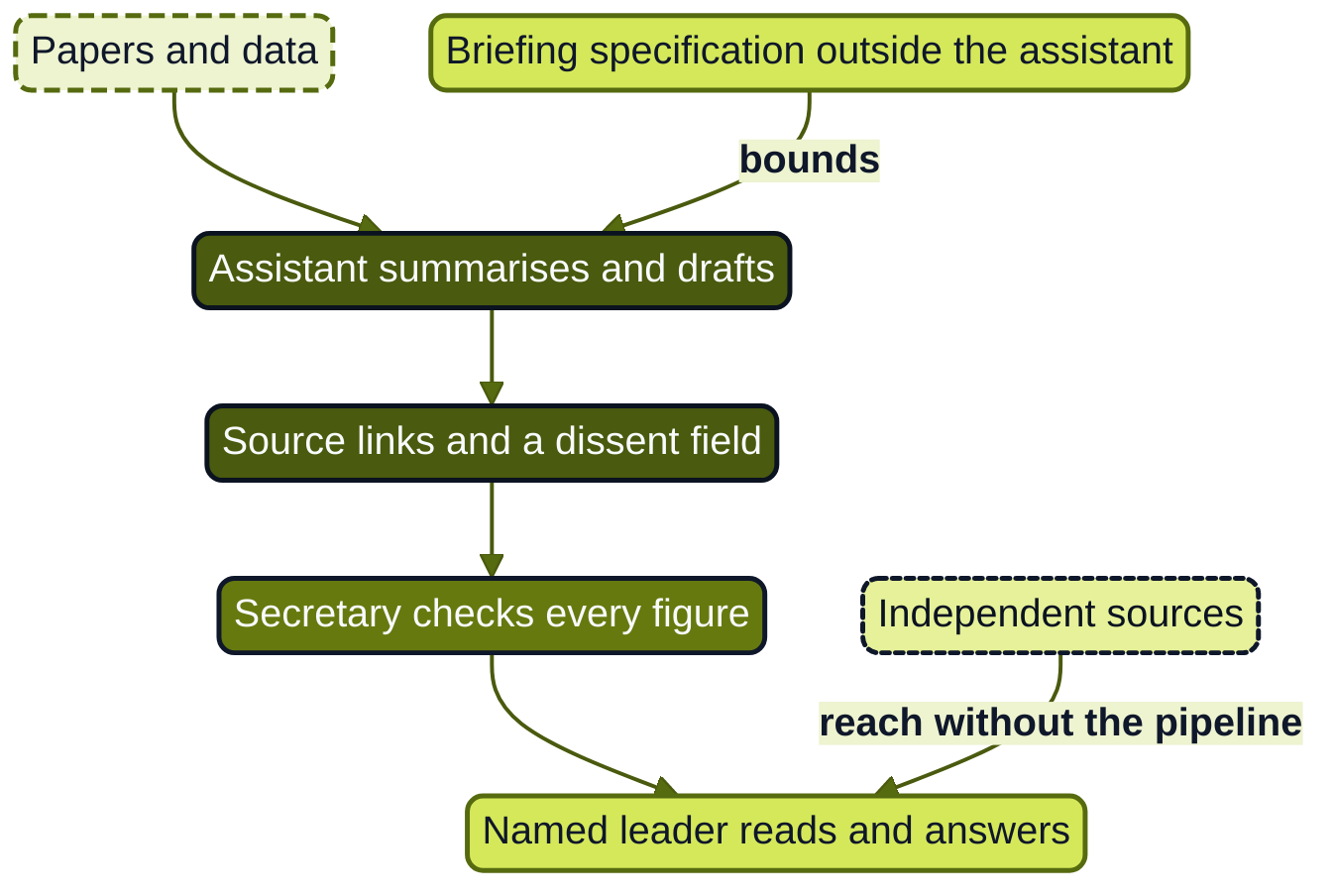
A leader who is handed a one-page summary of a forty-page paper has been given a choice by someone else: which of the forty pages matter. Until recently that someone was a person with a name, an office and a record of being right or wrong. Now it is often an assistant, and the choice is made at a speed and volume that no secretariat could match. This chapter treats what that does to L1 Orient, the leadership function of making sense of the situation and setting direction, and to the part of L2 Decide that depends on it: the quality of a decision cannot exceed the quality of the picture of the situation on which it rests. Chapter 5 described orientation without AI: sense-making, the choice that strategy is, and the leader's information diet. This chapter asks what changes when part of that diet is prepared by a model.
The argument has four steps. AI adds real capacity to orientation: it reads more, drafts faster and varies more than a person can. The same properties produce characteristic failures, because the tools produce plausible, agreeable and fluent text, whereas orientation depends on the implausible, the disagreeable and the awkward. The evidence on how well models forecast and advise is real but narrow, and it measures something other than what a leader needs. The design answer is an arrangement, not a better model: a briefing that carries its provenance and its dissent, checks that are independent of the assistant, and channels to the leader that bypass the briefing. The corollary of the answerability principle of Chapter 4 is that a leader informed only by machine summaries cannot Explain, and so cannot answer.
Six conclusions from the earlier volumes carry the chapter. AI Threat, Chapters 6 and 14, found that relying on AI reduces effort and recall and, among those who trust the tool, checking (F66) (224, Nordqvist, 2026). The Transformed Security Architect, Chapter 14, drew the consequence for review: a reviewer who depends on the AI must reproduce independently, use seeded errors and not start from the AI's answer (F76) (225, Nordqvist, 2026). AI Blue, Chapter 14, added that soundness is defined in advance, that the key fact is reproduced by another route and that a stop rule freezes delegation when the catch rate falls (F99) (227, Nordqvist, 2026). AI Purple, Chapters 4 and 15, stated the independence principle: a check counts as verification only when its failure modes are shown not to be those of the thing it checks, in several dimensions (model, data, authorship, vendor and time), with a statement of independence that carries an expiry (F118) (228, Nordqvist, 2026). AI Operations, Chapter 17, added that correlated errors among capable models make a model checking a model a partial remedy at best (F145) (229, Nordqvist, 2026). AI Red Team, Chapters 13 and 28, showed that everything an AI system reads may be written by an adversary, so that the defence sits outside the model (F54) (223, Nordqvist, 2026). This chapter carries the independence principle to the person who is oriented by a machine's work.
Primary topics explored
- What this chapter builds on
- What AI adds to orientation
- Failure modes
- What the evidence shows
- Independent sources
- The briefing specification
About AI Leader
AI Leader is Book 11 of The Transformed Architecture. It takes leadership as its subject and asks what happens when AI is used broadly: the five leadership functions (orient, decide, organise, enable, answer), the delegation ladder and the Level 4 prohibitions, the answerability principle (name, explain, reach), the span and the middle layer, human-agent work, the board and the management body, change and adoption as claims that need evidence, regulation (the AI Act, DORA, NIS 2, the GDPR), ethics and sovereignty, and the leader as a person, for European enterprises and public authorities.
It builds on the conclusions of Architecture as Code, AI Governance, AI Platform and Security, AI Red Team, AI Threat, The Transformed Security Architect, AI Boss, AI Blue, AI Purple and AI Operations.
chairs and members of boards, chief executives and executive teams, the changing C-suite, middle managers and first-line leaders, heads of public authorities and the politicians who oversee them, HR specialists, works councils and unions, architects who advise leaders, and supervisors and auditors.

Gunnar Nordqvist
Conceived, directed and published the books of The Transformed Architecture.
Continue with the full chapter
Chapter 6: Orient with AI: Briefings, Scenarios and the Consensus Machine in AI Leader gives the detailed explanations, practical examples and implementation patterns behind this summary.
This whitepaper belongs to “The Craft of Leading” and is one of 37 drawn from the manuscript.