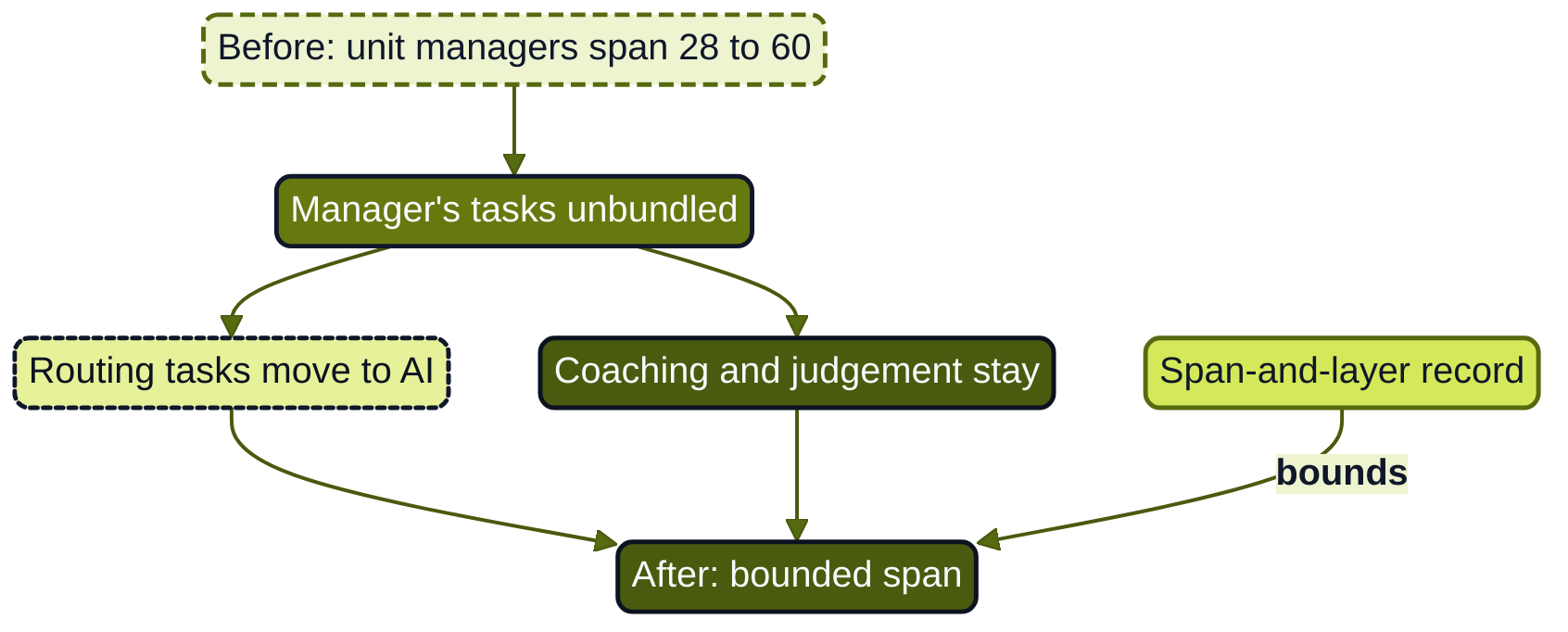
Structure is the part of leadership that outlasts the leader. A decision is taken once, but the number of layers, the width of each manager's span and the tasks that sit in each role decide, every day for years, who hears what, who can say no and who learns the craft from whom. This chapter concerns L3 Organise: shaping structure and work through spans, layers and roles. It touches L4 Enable, because the layers are also where leaders are made, and L5 Answer, because every layer is a link in a chain of answerability that Chapter 12 examines. The chapter asks what spans and layers do, what the evidence on removing layers shows, which of the middle manager's tasks AI unbundles, which it does not, what flat-organisation experiments report, and how a change to spans and layers is recorded so that its result can be checked afterwards. Chapter 10 then turns from the shape of the organisation to the design of work for people and agents.
The thesis of the book gives the chapter its direction: the span grows and the middle layer is redesigned, not deleted. That sentence is a claim with conditions, and the chapter earns it in pieces. The evidence on delayering is conditional. The evidence that AI takes over the coordinating tasks of the middle manager is narrow. The evidence that the layer does work no tool replaces, in coaching, judgement and the making of the next generation of leaders, is stronger but also indirect.
An organisation has a structure because three things are scarce: attention, expertise and agreement. A leader's attention covers a limited number of people. Expertise is distributed unevenly, so someone must match problems to those who can solve them. Agreement between units must be produced, and producing it takes time. Layers and spans are the ways in which an organisation allocates these scarce resources. Garicano's model of knowledge-based hierarchies formalised the middle of this: when matching problems to those who can solve them is costly, production workers learn to handle the common problems and specialised problem-solvers, higher in the hierarchy, handle the exceptional ones, and changes in production and information technology change the optimal design (190, Garicano, 2000). The model is a theory, not a measurement, but it states exactly why a cheap first-line answerer, human or machine, changes the structure: it moves the line between the problems a worker solves alone and those that escalate.
Primary topics explored
- What structure is for
- Evidence on delayering
- What AI unbundles
- The apprenticeship function of layers
- Flat experiments
- What a change costs the people in it
About AI Leader
AI Leader is Book 11 of The Transformed Architecture. It takes leadership as its subject and asks what happens when AI is used broadly: the five leadership functions (orient, decide, organise, enable, answer), the delegation ladder and the Level 4 prohibitions, the answerability principle (name, explain, reach), the span and the middle layer, human-agent work, the board and the management body, change and adoption as claims that need evidence, regulation (the AI Act, DORA, NIS 2, the GDPR), ethics and sovereignty, and the leader as a person, for European enterprises and public authorities.
It builds on the conclusions of Architecture as Code, AI Governance, AI Platform and Security, AI Red Team, AI Threat, The Transformed Security Architect, AI Boss, AI Blue, AI Purple and AI Operations.
chairs and members of boards, chief executives and executive teams, the changing C-suite, middle managers and first-line leaders, heads of public authorities and the politicians who oversee them, HR specialists, works councils and unions, architects who advise leaders, and supervisors and auditors.

Gunnar Nordqvist
Conceived, directed and published the books of The Transformed Architecture.
Continue with the full chapter
Chapter 9: Organise: Structure, Span of Control and the Middle Layer in AI Leader gives the detailed explanations, practical examples and implementation patterns behind this summary.
This whitepaper belongs to “The Craft of Leading” and is one of 37 drawn from the manuscript.