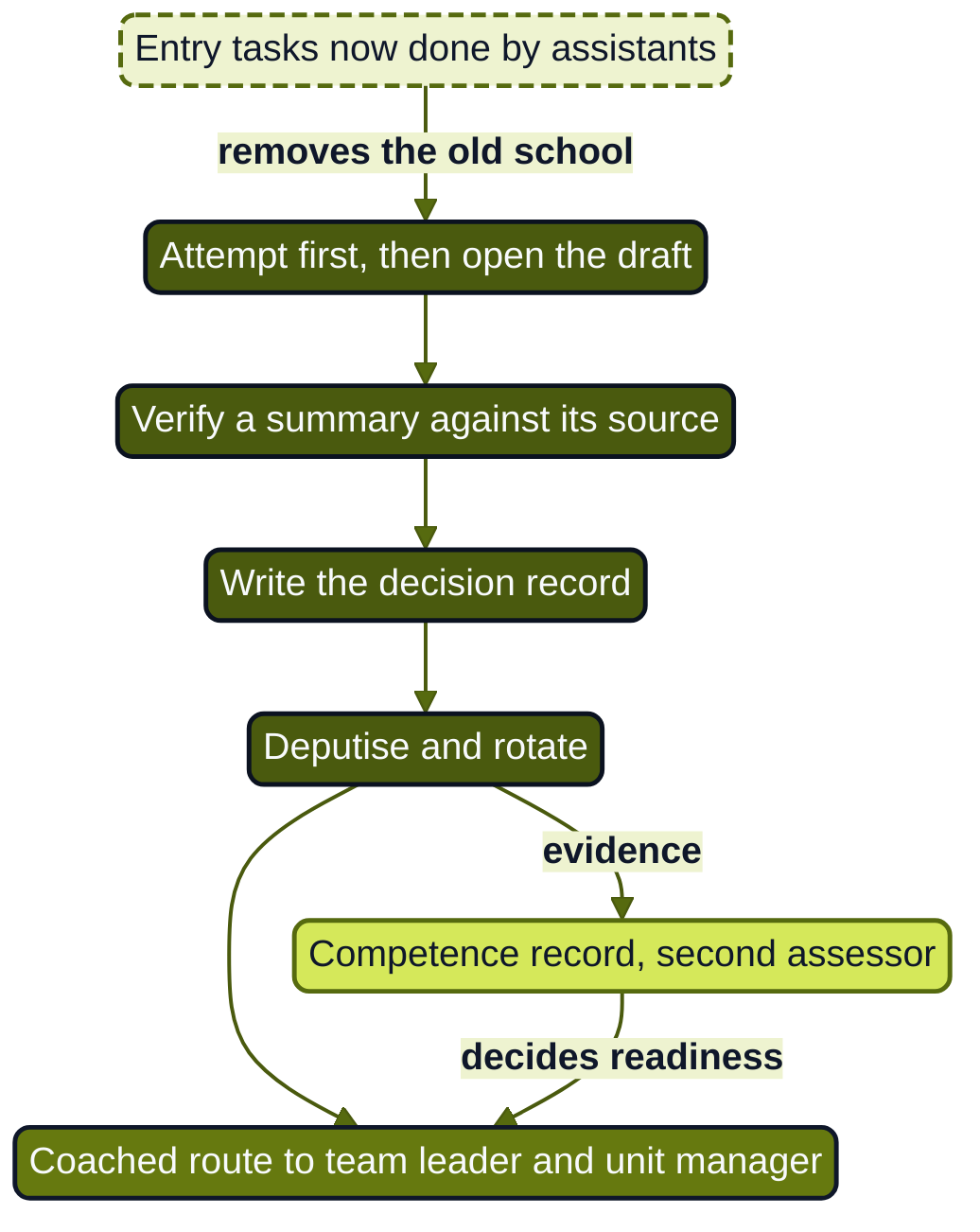
A leader is judged late and developed early. The part of leadership that decides whether an organisation has competent leaders in ten years is done now, in the daily work of people who are not yet leaders and by the leaders who coach them. This chapter asks what happens to that work when the entry tasks of many professions are done by assistants: the first drafts, the summaries, the minutes, the routine reports, the coordination that new staff once did and learned from. It concerns L4 Enable: developing people and the conditions in which they work, through coaching, feedback, learning on the job, psychological safety, AI literacy and the early-career route. It touches L2 Decide where a development decision about a named person is taken, and L5 Answer where the organisation has to show that its claims about competence rest on evidence.
The chapter builds on conclusions that the earlier volumes reached for other roles. Architecture as Code (Chapter 18) managed competence as a skills matrix by level, in a loop of assessment, planning, learning, application, knowledge sharing and measurement (220, Nordqvist, 2025). AI Governance, Chapter 14, made AI literacy role-specific and evidenced in individual records, preferred upskilling to hiring and agreed the use of assessment results with employee representatives (221, Nordqvist, 2026). AI Red Team, Chapters 6 and 15, showed that skills erode when AI does most of the work, and that autonomy must be paced to the skills available to supervise it (223, Nordqvist, 2026). The Transformed Security Architect, Chapters 15, 21 and 22, made keeping the craft a design decision and judged competence by records of judgement exercised (225, Nordqvist, 2026). AI Blue, Chapter 23, and AI Operations, Chapter 26, then described the apprenticeship problem for analysts and operators, with its two halves and its remedies: a protected share of unassisted work, a craft register, rotation in both directions and new first rungs (227, Nordqvist, 2026), (229, Nordqvist, 2026). AI Purple, Chapter 24, added that the effect depends on how the assistant is used (228, Nordqvist, 2026). This chapter carries those conclusions from the specialist to the leader and asks what is different when the thing to be developed is the capacity to direct, decide, organise and answer.
Developing people is the part of leadership that has the least visible output and the longest delay. A decision shows its effect in a quarter; a team leader who has been coached shows it over years, and the organisation that did not coach can rarely say what it lost. Three activities carry most of the work: coaching, feedback and the design of career paths. Each has evidence behind it, and each has limits that a leader should know before relying on it.
Primary topics explored
- Developing people
- Psychological safety
- The apprenticeship problem
- AI literacy as development
- Learning on the job
- The competence record
About AI Leader
AI Leader is Book 11 of The Transformed Architecture. It takes leadership as its subject and asks what happens when AI is used broadly: the five leadership functions (orient, decide, organise, enable, answer), the delegation ladder and the Level 4 prohibitions, the answerability principle (name, explain, reach), the span and the middle layer, human-agent work, the board and the management body, change and adoption as claims that need evidence, regulation (the AI Act, DORA, NIS 2, the GDPR), ethics and sovereignty, and the leader as a person, for European enterprises and public authorities.
It builds on the conclusions of Architecture as Code, AI Governance, AI Platform and Security, AI Red Team, AI Threat, The Transformed Security Architect, AI Boss, AI Blue, AI Purple and AI Operations.
chairs and members of boards, chief executives and executive teams, the changing C-suite, middle managers and first-line leaders, heads of public authorities and the politicians who oversee them, HR specialists, works councils and unions, architects who advise leaders, and supervisors and auditors.

Gunnar Nordqvist
Conceived, directed and published the books of The Transformed Architecture.
Continue with the full chapter
Chapter 11: Enable: Developing People, Coaching and the Early-Career Route in AI Leader gives the detailed explanations, practical examples and implementation patterns behind this summary.
This whitepaper belongs to “The Craft of Leading” and is one of 37 drawn from the manuscript.