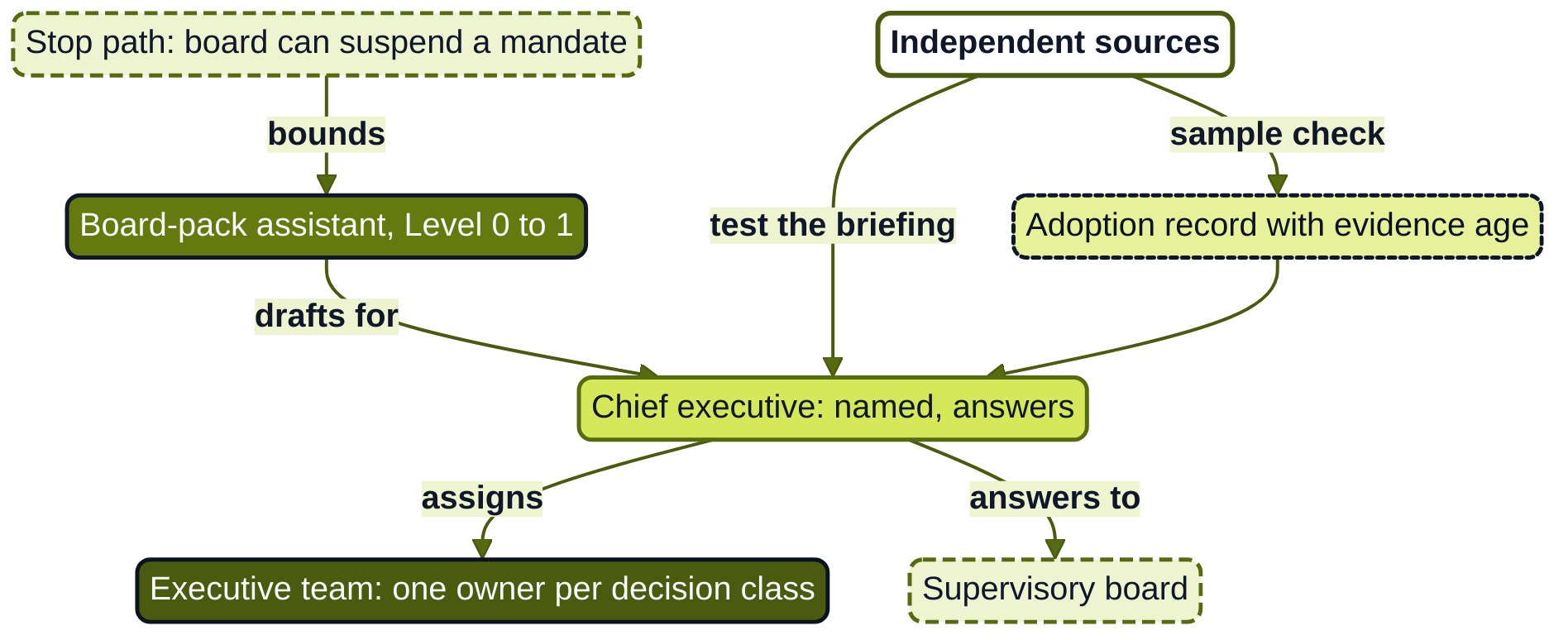
The chief executive is the one leader in an organisation whom nobody can route a decision around. Every earlier chapter of this book describes a function that somebody below the chief executive performs: the board pack, the briefing, the structure, the development plan. This chapter describes what remains with the chief executive when AI is used broadly, and how the executive team around the chief executive divides what the chief executive cannot hold alone. It concerns all five leadership functions. L1 Orient is the chief executive's thesis about what AI is for in this organisation. L2 Decide is the pace of adoption, the allocation of decision rights between executives and the acceptance of residual risk. L3 Organise is the shape of the executive team and the charters of its members. L4 Enable is what the chief executive's own conduct teaches the organisation about using AI. L5 Answer is the point of the chapter: whatever the assistants, dashboards and agents do, a named person answers to the board, the supervisor, the employees and the public, and at the top that person cannot be delegated away.
The chapter builds on conclusions of earlier volumes. AI Governance, Chapter 13, concluded that governance as code does not remove forums but changes what they are for: pipelines enforce, observe and remember, while forums decide what pipelines cannot, namely appetite, policy, exceptions and residual risk, and that NIS 2 Article 20 and DORA Article 5 anchor oversight in a trained management body (221, Nordqvist, 2026). The Transformed Security Architect, Chapter 18, concluded that European regulation places duties on named people and bodies and that accountability cannot be delegated to a system (225, Nordqvist, 2026). AI Boss, Chapter 29, described the manager as the accountable leader of people and conductor of agents (226, Nordqvist, 2026), and AI Operations, Chapter 17, gave the observer principle: what verifies an action must be independent of what performed it (229, Nordqvist, 2026). This chapter applies the generalisation that Chapter 4 draws, the answerability principle with its three tests, Name, Explain and Reach, to the top of the organisation.
A chief executive owns five things that no assistant, committee or deputy can own on the chief executive's behalf. The list is the book's own conclusion from the duties discussed below and from Chapter 4; it is not a finding of any study.
Primary topics explored
- What the chief executive owns
- Setting the pace
- Executive AI theatre
- The executive team
- The executive's own use
- What surveys of executives report
About AI Leader
AI Leader is Book 11 of The Transformed Architecture. It takes leadership as its subject and asks what happens when AI is used broadly: the five leadership functions (orient, decide, organise, enable, answer), the delegation ladder and the Level 4 prohibitions, the answerability principle (name, explain, reach), the span and the middle layer, human-agent work, the board and the management body, change and adoption as claims that need evidence, regulation (the AI Act, DORA, NIS 2, the GDPR), ethics and sovereignty, and the leader as a person, for European enterprises and public authorities.
It builds on the conclusions of Architecture as Code, AI Governance, AI Platform and Security, AI Red Team, AI Threat, The Transformed Security Architect, AI Boss, AI Blue, AI Purple and AI Operations.
chairs and members of boards, chief executives and executive teams, the changing C-suite, middle managers and first-line leaders, heads of public authorities and the politicians who oversee them, HR specialists, works councils and unions, architects who advise leaders, and supervisors and auditors.

Gunnar Nordqvist
Conceived, directed and published the books of The Transformed Architecture.
Continue with the full chapter
Chapter 14: The Chief Executive and the Executive Team in AI Leader gives the detailed explanations, practical examples and implementation patterns behind this summary.
This whitepaper belongs to “Leadership Roles Across the Organisation” and is one of 37 drawn from the manuscript.