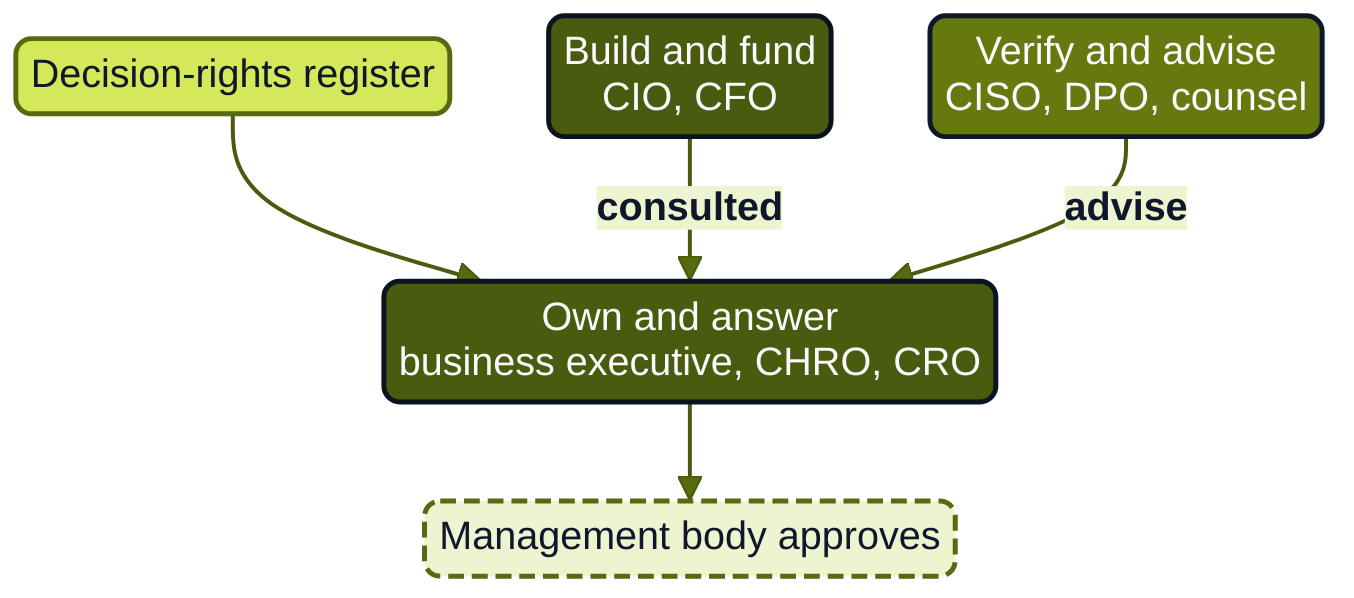
Every executive seat in a large organisation was drawn around a scarcity: the CIO around scarce computing, the CISO around scarce trust in that computing, the CFO around scarce capital, the CHRO around scarce people, the general counsel around scarce legal certainty. AI used broadly cuts across all five scarcities at once, and the lines between the seats no longer follow the lines between the problems. This chapter asks which seats change, which new seat is claimed, where the boundaries between them now chafe, and how an executive team writes down who decides what so that a named person can answer. It concerns L2 Decide, because the chapter is about deciding who decides; L3 Organise, because it is about how the executive team divides the work between people and where the seams run; and L5 Answer, because every seam is a place where an answer can go missing.
The chapter takes over four conclusions of the series. AI Governance, Chapter 14, showed that new roles follow the usage modes (the AI system owner, the agent operator, the skills curator) and that existing roles such as procurement, internal audit and the data protection officer change (221, Nordqvist, 2026). AI Red Team, Chapter 6, and The Transformed Security Architect, Chapter 18, showed that European regulation places duties on named people and on the management body, so that someone must turn each article into a control and no duty passes to a tool (223, Nordqvist, 2026) (225, Nordqvist, 2026). AI Operations, Chapter 22, showed how decision rights are written as requirements with a holder, two deputies, a response time, an evidence standard, a record and a ceiling for AI (229, Nordqvist, 2026). This chapter lifts that last device from the incident night to the executive table.
A seat changes in one of three ways. Its subject can grow, as when the CIO becomes responsible for platforms that other executives' staff use to draft, decide and act. Its independence can become more important, as when the CISO is asked to verify systems that the CIO's own teams build. Or its duties can acquire a new object, as when the CHRO's duty to inform workers now reaches an assistant that summarises performance conversations. The seven seats below are described by what each gains, what each must not hold and which instrument anchors the point. The descriptions are the book's own architectural reading of the instruments, not legal advice.
Primary topics explored
- The seats that change
- The chief AI officer: what is known and what is claimed
- Boundary conflicts
- Where AI accountability sits
- Role charters as code
- The decision-rights register
About AI Leader
AI Leader is Book 11 of The Transformed Architecture. It takes leadership as its subject and asks what happens when AI is used broadly: the five leadership functions (orient, decide, organise, enable, answer), the delegation ladder and the Level 4 prohibitions, the answerability principle (name, explain, reach), the span and the middle layer, human-agent work, the board and the management body, change and adoption as claims that need evidence, regulation (the AI Act, DORA, NIS 2, the GDPR), ethics and sovereignty, and the leader as a person, for European enterprises and public authorities.
It builds on the conclusions of Architecture as Code, AI Governance, AI Platform and Security, AI Red Team, AI Threat, The Transformed Security Architect, AI Boss, AI Blue, AI Purple and AI Operations.
chairs and members of boards, chief executives and executive teams, the changing C-suite, middle managers and first-line leaders, heads of public authorities and the politicians who oversee them, HR specialists, works councils and unions, architects who advise leaders, and supervisors and auditors.

Gunnar Nordqvist
Conceived, directed and published the books of The Transformed Architecture.
Continue with the full chapter
Chapter 15: The Changing C-Suite: CAIO, CIO, CISO, CDO, CHRO, CFO and General Counsel in AI Leader gives the detailed explanations, practical examples and implementation patterns behind this summary.
This whitepaper belongs to “Leadership Roles Across the Organisation” and is one of 37 drawn from the manuscript.