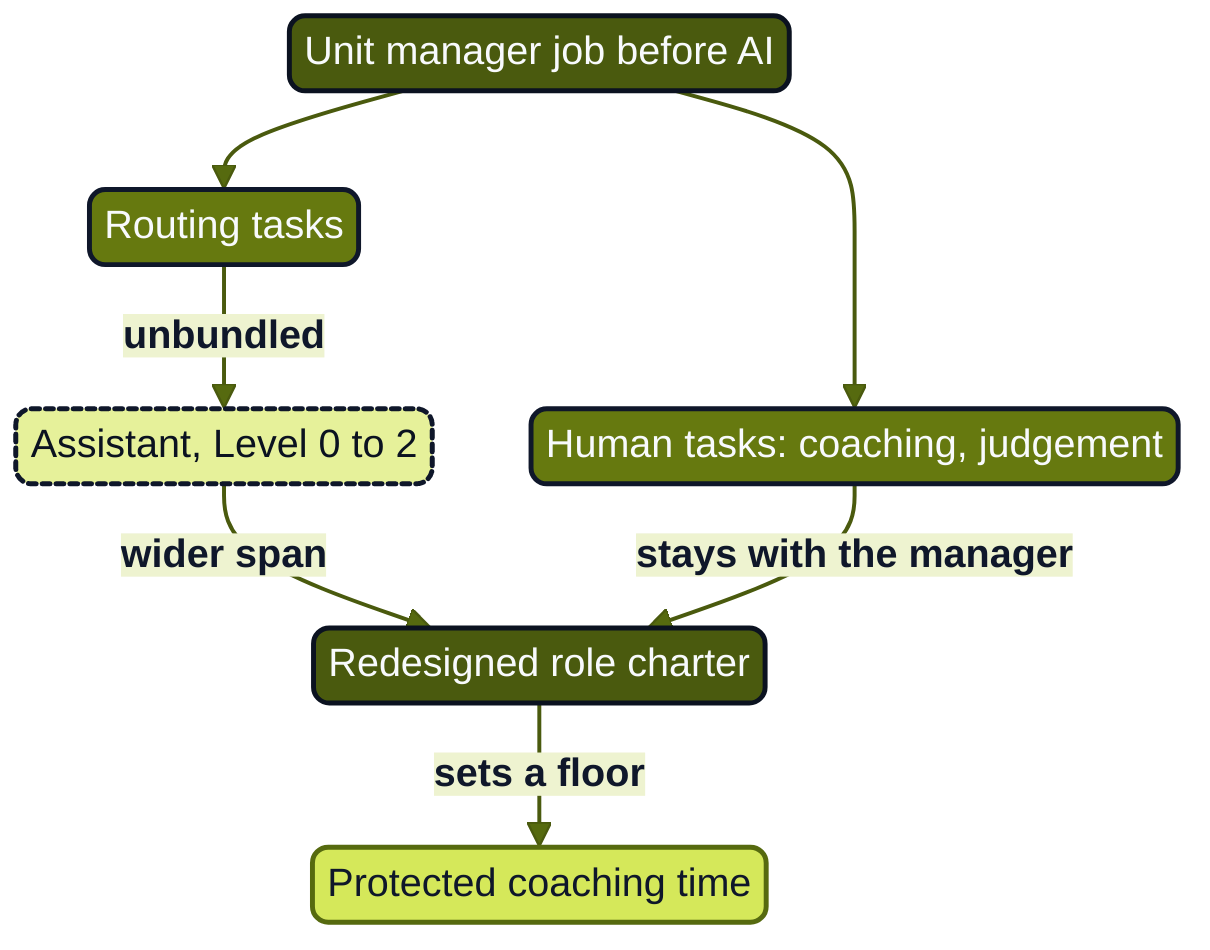
The middle manager is the first role that most organisations propose to remove when they say that AI makes them flatter, and the last role that most employees would choose to lose. This chapter treats the unit manager, the head of department and the team leader above the first line as one layer, and asks what AI does to the tasks that fill the job, what studies measured about it, and what an organisation can responsibly do with the layer. It concerns L3 Organise, because spans, layers and the allocation of work between people and systems are structural decisions, and L4 Enable, because the middle manager is where most people are coached, where most careers start and where the early-career route to leadership either holds or breaks. It touches L5 Answer at one point that matters for the verdict: a manager whose span is too wide can no longer pass the tests Name, Explain and Reach for the team's decisions.
The chapter builds on conclusions of the earlier volumes and states them again where the argument needs them. AI Boss, Chapter 29, concluded that the manager's role is transformed, not abolished: from supervisor of tasks to accountable leader of people and conductor of agents (226, Nordqvist, 2026). AI Boss, Chapter 15, found the evidence on algorithmic management mixed, with short-run gains for less experienced workers, limits for experts and outcomes that depend on institutions and on whether workers took part in the design. AI Blue, Chapters 17, 22 and 23, showed what happens to a profession whose entry rung is automated: the pyramid becomes a diamond whose weak point is the entry rung, and the design problem is where the next practitioners come from (227, Nordqvist, 2026). The open question that Chapter 9 of this book and this chapter share is where the work of coordinating, reporting and first-line answering goes when AI unbundles the middle manager's tasks, and what remains that only a person can do.
A middle manager's week looks like one job and is several. Chapter 2 treated what managers have been observed to do; this chapter does not repeat it. The useful step here is to unbundle the work into the tasks that an organisation can place, one by one, with a person, with a system or with both. Six tasks cover most of what a unit manager at Nordvik Region or a team leader at Hansa Mutual does.
Primary topics explored
- The unbundled job
- What studies measured
- The debate
- A redesigned role
- The transition
- Verdict
About AI Leader
AI Leader is Book 11 of The Transformed Architecture. It takes leadership as its subject and asks what happens when AI is used broadly: the five leadership functions (orient, decide, organise, enable, answer), the delegation ladder and the Level 4 prohibitions, the answerability principle (name, explain, reach), the span and the middle layer, human-agent work, the board and the management body, change and adoption as claims that need evidence, regulation (the AI Act, DORA, NIS 2, the GDPR), ethics and sovereignty, and the leader as a person, for European enterprises and public authorities.
It builds on the conclusions of Architecture as Code, AI Governance, AI Platform and Security, AI Red Team, AI Threat, The Transformed Security Architect, AI Boss, AI Blue, AI Purple and AI Operations.
chairs and members of boards, chief executives and executive teams, the changing C-suite, middle managers and first-line leaders, heads of public authorities and the politicians who oversee them, HR specialists, works councils and unions, architects who advise leaders, and supervisors and auditors.

Gunnar Nordqvist
Conceived, directed and published the books of The Transformed Architecture.
Continue with the full chapter
Chapter 16: The Middle Manager: Thinned, Transformed or Indispensable? in AI Leader gives the detailed explanations, practical examples and implementation patterns behind this summary.
This whitepaper belongs to “Leadership Roles Across the Organisation” and is one of 37 drawn from the manuscript.