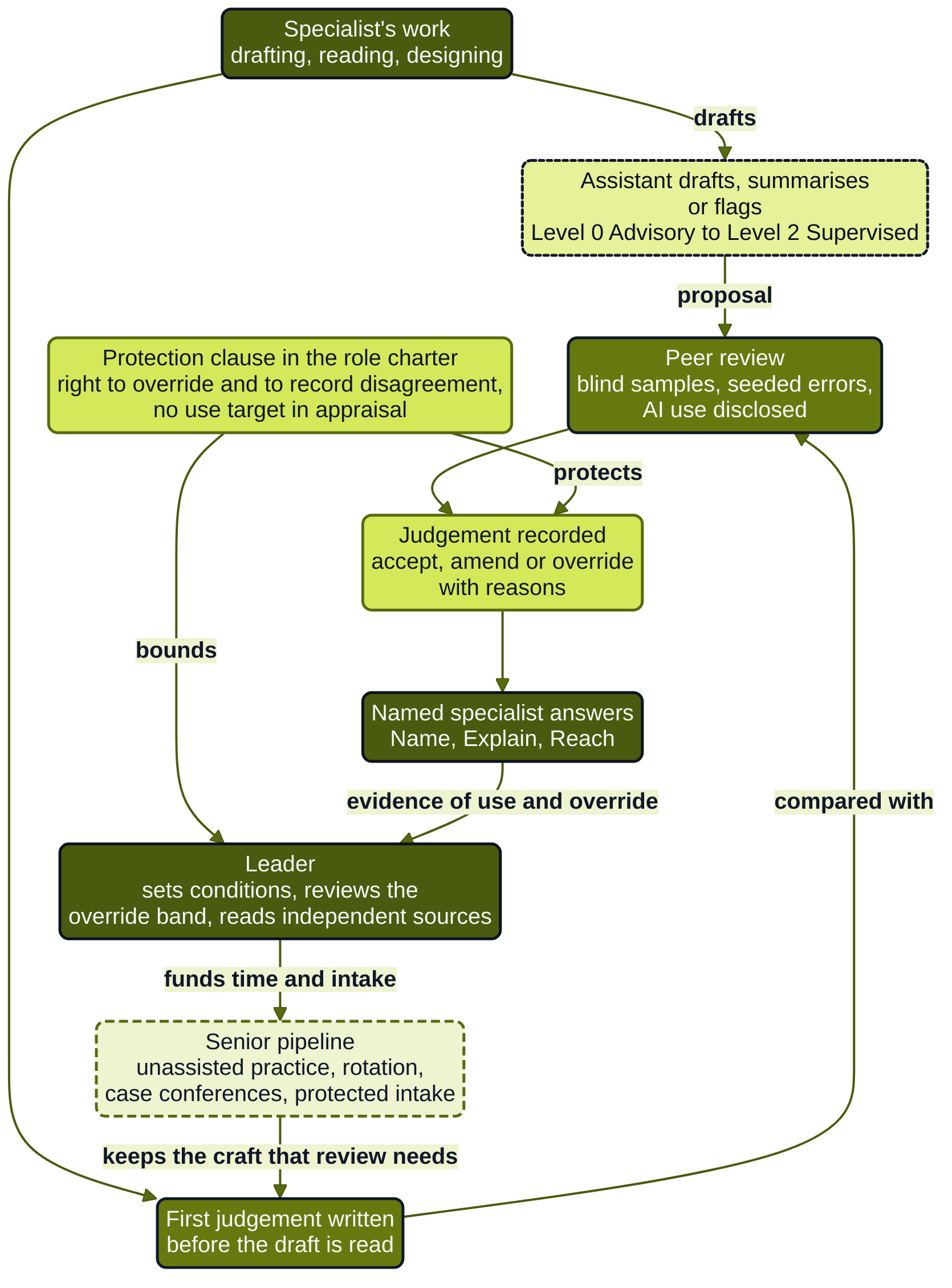
A leader of specialists holds a position that earlier chapters have not yet described. The regional director, the chief executive and the unit manager lead people whose work they can mostly see and judge. The head of a gastroenterology department, the head of an actuarial department and the lead of an architecture team lead people whose work they often cannot judge by rank at all: the specialist knows more about the craft than the leader does, and the organisation depends on that being so. When AI drafts what specialists used to draft, summarises what they used to read and flags what they used to find, three things that the leader has relied on become uncertain. The leader's ability to tell good work from fluent work weakens, the specialist's own judgement is exposed to the habits that automation produces, and the route by which new specialists become senior ones runs through tasks that AI now does first. This chapter concerns L3 Organise and L4 Enable: organising expert work so that review, accountability and unassisted practice survive, and enabling specialists to stay, and to become, the people whose judgement the organisation needs.
The chapter builds on conclusions of earlier volumes. The security architect's role is transformed, not abolished, and what remains scarce is accountable human judgement: the ability to verify what AI proposes and to answer for the decision (The Transformed Security Architect, Chapters 1 and 27; F71). A role is itself a versioned artefact, a charter with mandate, accountabilities and decision rights (Chapter 4 of that volume; F73). Verifying AI output requires independent reproduction and review that does not start from the AI's answer (Chapter 14; F76), and keeping the craft is a design decision, with unassisted practice and apprenticeship routes that survive the automation of junior work (Chapter 15; F77) (225, Nordqvist, 2026). Those chapters speak to one specialist, the security architect. This one asks what the leader of any group of specialists must do so that the same conclusions hold in a hospital department, an actuarial department or an engineering team.
Henry Mintzberg described one configuration of organisations in which the operating work is done by trained professionals who have considerable control over their own work, because the skills are learned outside the organisation and cannot be specified by managers (157, Mintzberg, 1979). Hospitals, universities, courts and the expert departments of insurers share the pattern to different degrees. Two kinds of authority sit side by side in it: the authority of the line, which allocates resources, sets the rules of the organisation and answers to its owners, and the authority of expertise, which decides what is true, safe or sound in the specialist's field. In a specialist organisation the settlement was that the line left technical judgement to the expert and the expert left allocation to the line.
Primary topics explored
- Leading expertise
- Peer review
- Professional judgement and its protection
- The senior-expert pipeline
- Architects
- Clinicians, engineers and other experts
About AI Leader
AI Leader is Book 11 of The Transformed Architecture. It takes leadership as its subject and asks what happens when AI is used broadly: the five leadership functions (orient, decide, organise, enable, answer), the delegation ladder and the Level 4 prohibitions, the answerability principle (name, explain, reach), the span and the middle layer, human-agent work, the board and the management body, change and adoption as claims that need evidence, regulation (the AI Act, DORA, NIS 2, the GDPR), ethics and sovereignty, and the leader as a person, for European enterprises and public authorities.
It builds on the conclusions of Architecture as Code, AI Governance, AI Platform and Security, AI Red Team, AI Threat, The Transformed Security Architect, AI Boss, AI Blue, AI Purple and AI Operations.
chairs and members of boards, chief executives and executive teams, the changing C-suite, middle managers and first-line leaders, heads of public authorities and the politicians who oversee them, HR specialists, works councils and unions, architects who advise leaders, and supervisors and auditors.

Gunnar Nordqvist
Conceived, directed and published the books of The Transformed Architecture.
Continue with the full chapter
Chapter 19: Leading Specialists: Architects, Engineers, Clinicians and Experts in AI Leader gives the detailed explanations, practical examples and implementation patterns behind this summary.
This whitepaper belongs to “Leadership Roles Across the Organisation” and is one of 37 drawn from the manuscript.