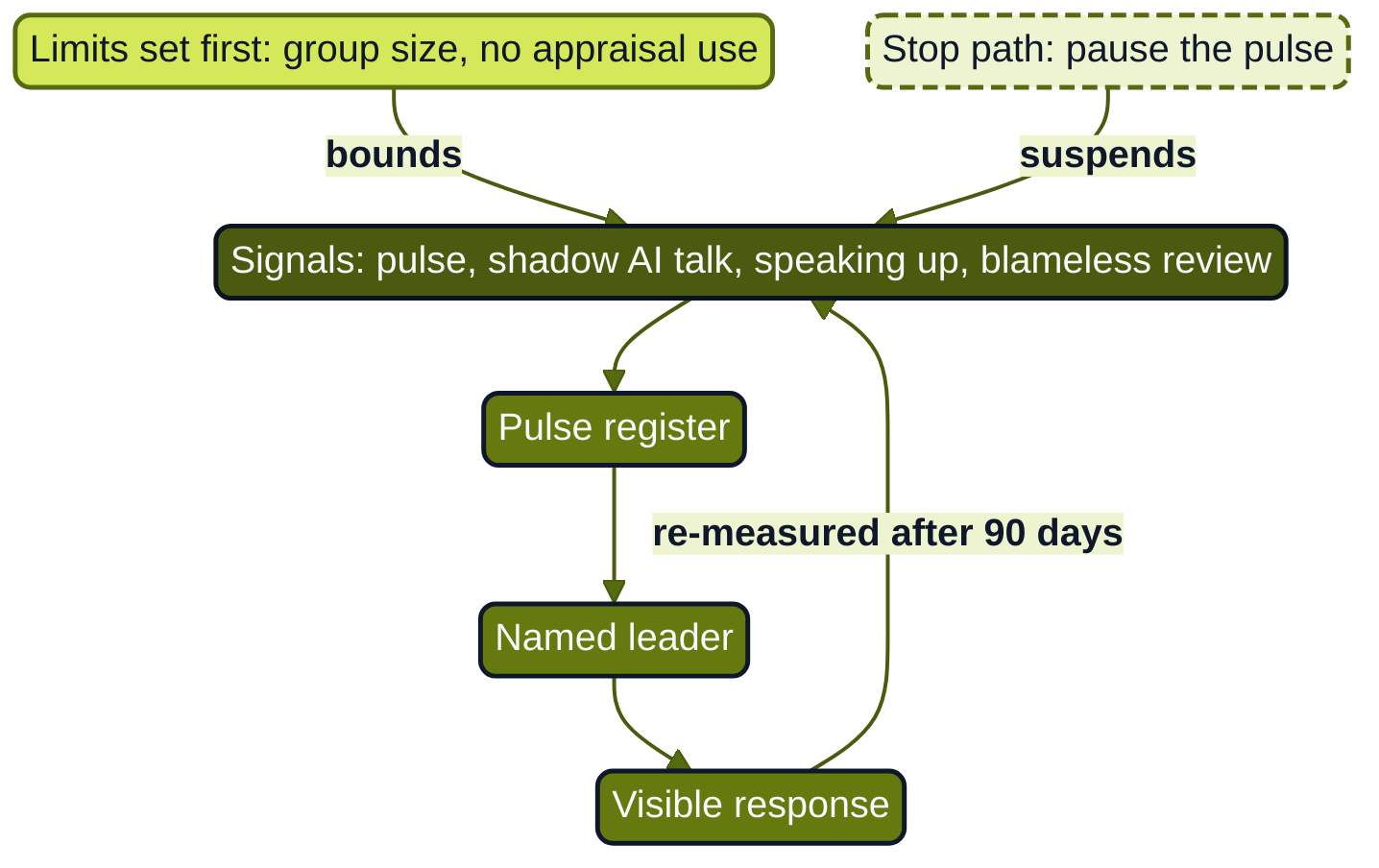
Chapter 20 ended with a claim that the organisation counted people without asking them anything. This chapter asks them, and asks what a leader must do so that the answers are true. It concerns L4 Enable, because trust, speaking up and the freedom to say "I do not know" are conditions in which people work and learn, and L5 Answer, because a leader who cannot hear that an assistant's output was wrong, or that a team fears for its jobs, cannot answer for what the organisation does with AI. The chapter treats trust in leaders and in AI, psychological safety, the fear of replacement, shadow AI, the measurement of all of these without surveillance, and blameless review of errors in which AI took part.
The argument has four parts. First, trust in AI is not a quantity to maximise; it is a relation to be calibrated, and what people report about it is mixed. Second, speaking up depends on what happens to the person who speaks, and an assistant that records, summarises and counts changes what a person risks by speaking. Third, fear of replacement and shadow AI are two sides of one signal: people are making their own arrangements with a technology about which their leaders have said too little that is true. Fourth, the organisation can listen to these signals with a short, bounded pulse, but only if the limits on the pulse are set before the first question and agreed with the people it concerns.
The chapter takes five conclusions as its starting point. AI Boss, Chapter 11, concluded that the quiet harms of algorithmic management, to autonomy, dignity, pace, voice and the willingness to speak, deserve attention before the loud ones, and AI Boss, Chapter 13, treated the chilling effect of monitoring (226, Nordqvist, 2026). AI Blue, Chapter 21, found the research on the load of analysts small and mostly qualitative, and set the rule that measures concern the system and never the person (227, Nordqvist, 2026). AI Purple, Chapter 23, set out when a session is safe for the truth: the charter is written first, records name roles and not people, no result enters an appraisal and anyone may pause (228, Nordqvist, 2026). AI Operations, Chapter 25, concluded that required availability and the residue of automation bear on people, that responsibility tends to land on the person nearest the system, and that the design response is structural: a stop right without penalty and metrics about the rota, never the person (229, Nordqvist, 2026). Chapter 11 of this book introduced psychological safety as a condition for learning; this chapter takes it to the organisation as a whole. Chapter 10 treated shadow AI as a signal about work allocation; this chapter treats it as a signal about trust.
Primary topics explored
- What the earlier volumes settle
- Trust in leaders and in AI
- Psychological safety
- Fear of replacement
- Shadow AI
- Measuring without surveillance
About AI Leader
AI Leader is Book 11 of The Transformed Architecture. It takes leadership as its subject and asks what happens when AI is used broadly: the five leadership functions (orient, decide, organise, enable, answer), the delegation ladder and the Level 4 prohibitions, the answerability principle (name, explain, reach), the span and the middle layer, human-agent work, the board and the management body, change and adoption as claims that need evidence, regulation (the AI Act, DORA, NIS 2, the GDPR), ethics and sovereignty, and the leader as a person, for European enterprises and public authorities.
It builds on the conclusions of Architecture as Code, AI Governance, AI Platform and Security, AI Red Team, AI Threat, The Transformed Security Architect, AI Boss, AI Blue, AI Purple and AI Operations.
chairs and members of boards, chief executives and executive teams, the changing C-suite, middle managers and first-line leaders, heads of public authorities and the politicians who oversee them, HR specialists, works councils and unions, architects who advise leaders, and supervisors and auditors.

Gunnar Nordqvist
Conceived, directed and published the books of The Transformed Architecture.
Continue with the full chapter
Chapter 21: Culture, Trust and Psychological Safety in a Human-Agent Organisation in AI Leader gives the detailed explanations, practical examples and implementation patterns behind this summary.
This whitepaper belongs to “Leading Change and Adoption” and is one of 37 drawn from the manuscript.