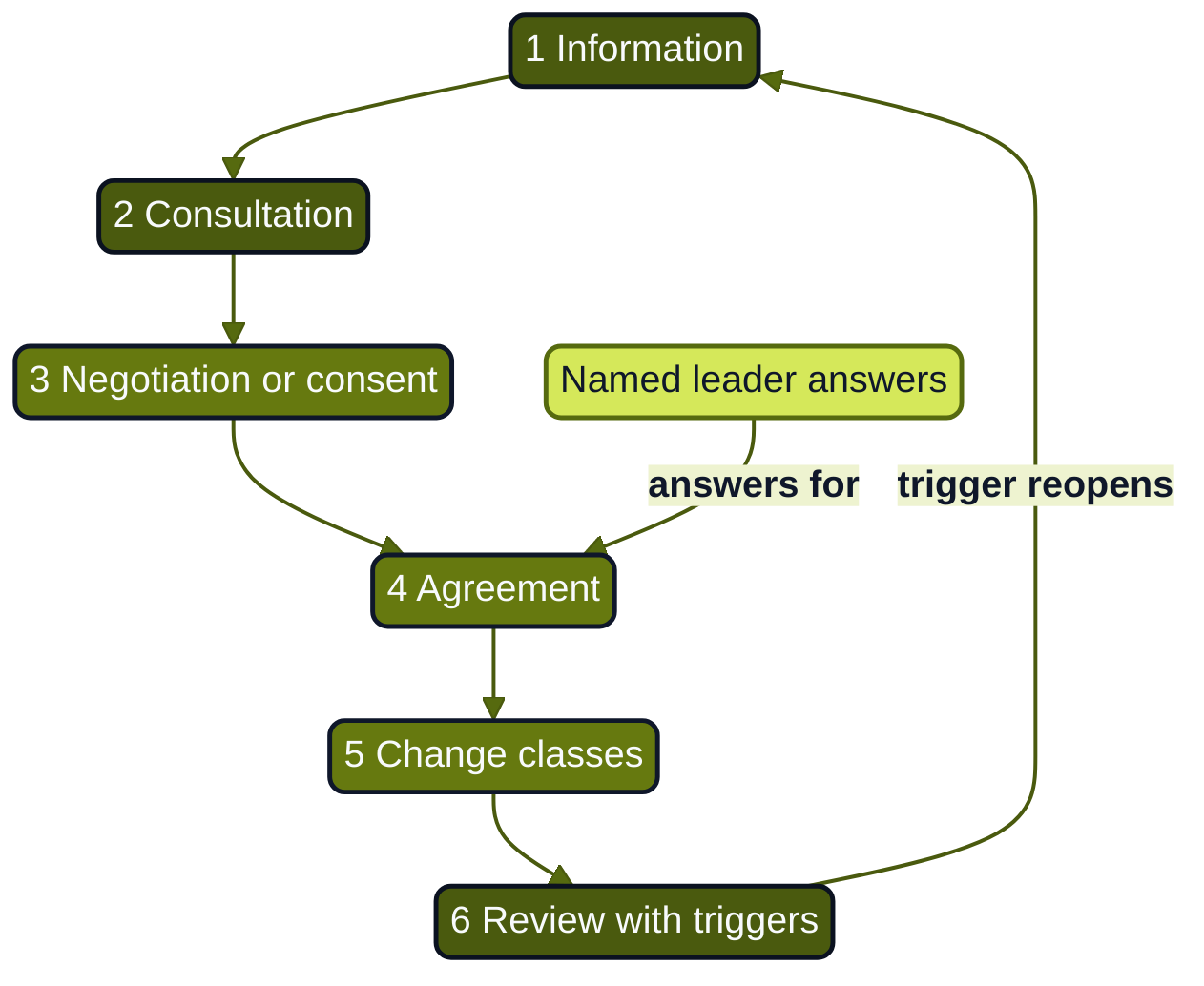
When AI is used broadly, the people whose work changes are the people who meet the leader's decisions first, and in much of Europe the law has given them a body that speaks for them: a works council, a union with a right to negotiate, an employee council, a European works council. This chapter takes the leader's side of that relationship. It concerns three of the five leadership functions. L3 Organise is the shaping of structure, roles and human-agent work, which is where the rights of representatives attach. L4 Enable is the development of people and the conditions in which they work, to which representatives bring knowledge that the leader does not have. L5 Answer is the duty to be accountable, which includes explaining to employees, through those who represent them, what systems will be used on them and why.
The chapter argues two things that are usually kept apart. The leader has a duty: to inform early and completely, to consult before the decision and not after it, and to negotiate or obtain consent where the law requires it. The leader also has an opportunity: representatives know where the work really goes wrong, and an agreement that is written with them is a better design document than one written without them. The sections that follow set out the rights, the duty, the opportunity, an outline of an agreement for the assistants that leaders themselves use, the way collective agreements are kept in step with software that changes monthly, and the conduct that is excluded. The chapter describes obligations and good practice. It does not describe any way of avoiding or defeating the rights of representatives, and it is not legal advice.
Five conclusions of the earlier volumes carry this chapter, and each is summarised here so that the chapter stands alone. They come from AI Boss (226, Nordqvist, 2026) and AI Operations (229, Nordqvist, 2026).
Primary topics explored
- What the earlier volumes settle
- Rights of representatives
- The leader's duty
- The leader's opportunity
- An agreement outline
- Collective agreements and the pace of software
About AI Leader
AI Leader is Book 11 of The Transformed Architecture. It takes leadership as its subject and asks what happens when AI is used broadly: the five leadership functions (orient, decide, organise, enable, answer), the delegation ladder and the Level 4 prohibitions, the answerability principle (name, explain, reach), the span and the middle layer, human-agent work, the board and the management body, change and adoption as claims that need evidence, regulation (the AI Act, DORA, NIS 2, the GDPR), ethics and sovereignty, and the leader as a person, for European enterprises and public authorities.
It builds on the conclusions of Architecture as Code, AI Governance, AI Platform and Security, AI Red Team, AI Threat, The Transformed Security Architect, AI Boss, AI Blue, AI Purple and AI Operations.
chairs and members of boards, chief executives and executive teams, the changing C-suite, middle managers and first-line leaders, heads of public authorities and the politicians who oversee them, HR specialists, works councils and unions, architects who advise leaders, and supervisors and auditors.

Gunnar Nordqvist
Conceived, directed and published the books of The Transformed Architecture.
Continue with the full chapter
Chapter 22: Leading with Works Councils, Unions and Employees: Co-determination and Dialogue in AI Leader gives the detailed explanations, practical examples and implementation patterns behind this summary.
This whitepaper belongs to “Leading Change and Adoption” and is one of 37 drawn from the manuscript.