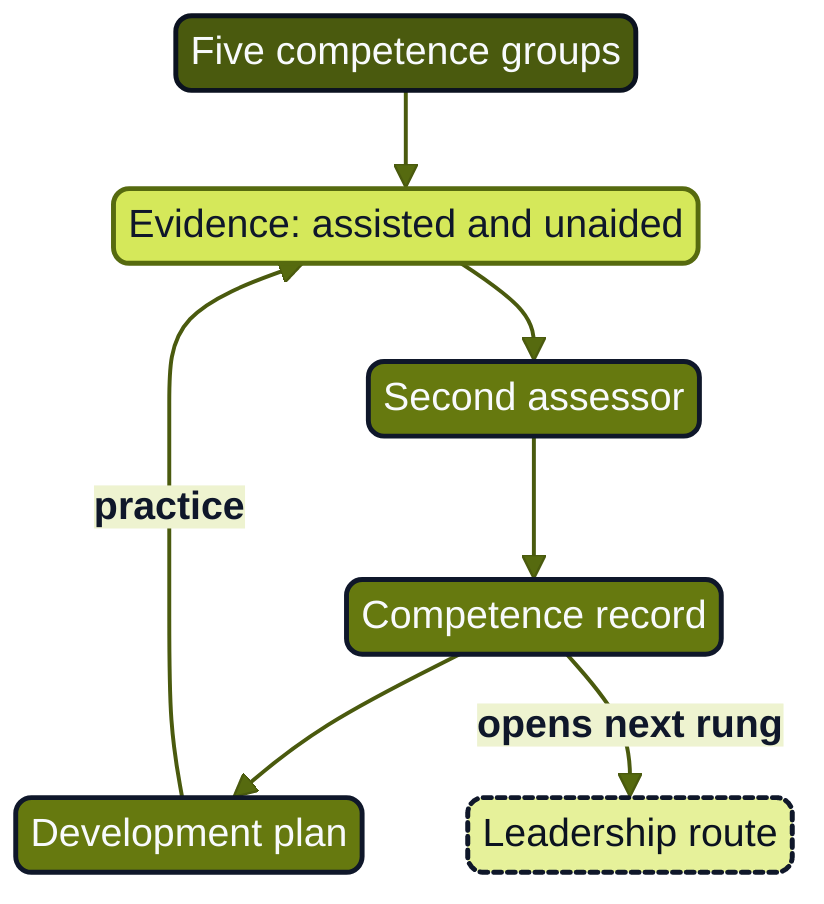
Every chapter of this book so far has asked something of the leader: read the source behind the summary, keep sources that are independent of the briefing, state the degree of delegation, be reachable, say who answers. This chapter asks what the leader must be able to do in order to meet those demands, how an organisation can know that the leader can do it, and how leaders are developed when the work that once developed them is changing. It frames all five leadership functions, L1 Orient, L2 Decide, L3 Organise, L4 Enable and L5 Answer, because competence is the condition of each of them. A leader who cannot tell a sound summary from a plausible one cannot orient; one who cannot reconstruct the reasons for a decision cannot answer for it; one who has never done the job unaided cannot enable others to do it.
The claim of the chapter is narrow and is meant to be tested. The competence of a leader is a claim that needs evidence (Chapter 4), and the evidence that serves is a record of judgement exercised, dated and with an expiry, not a record of attendance. The chapter sets out five groups of competence, the kinds of evidence that support a statement about each, what leadership development looks like when it is built to produce that evidence, what the early-career route to leadership needs, and what the available European and international frameworks can and cannot do. It ends with a competence record for a unit manager at Nordvik Region.
The chapter takes over four conclusions. Architecture as Code (Chapter 18) managed competence as a skills matrix by level, from Foundation to Expert, in a loop of assessment, planning, learning, application, knowledge sharing and measurement, and held that certifications validate knowledge while practical demonstration on real delivery shows capability (220, Nordqvist, 2025). AI Governance, Chapter 14, concluded that upskilling is the strategy, that careers need a path between building and verifying, that competence is assessed by practical demonstration and that assessment results are personal data whose use is agreed with employee representatives (221, Nordqvist, 2026). The Transformed Security Architect, Chapters 15, 21 and 22, held that keeping a craft is a design decision and that competence is evidenced by records of judgement exercised, mapped to frameworks and reviewable (225, Nordqvist, 2026). AI Operations, Chapter 26, added the discipline of a manual-practice clause with an interval of 90 days, an evidenced holder who did not write the procedure, a record of every missing step, and a consequence that falls on the delegation when evidence lapses (229, Nordqvist, 2026). Chapter 11 of this book applied these to the developing of people in general: coaching, the attempt-first rule, rotation, designed first rungs and the first competence record, for a claims team leader at Hansa Mutual. This chapter does not repeat them. It takes the competence of the leader as a whole and sets the early-career route for leaders against the open question that Chapter 11 left: if the entry rungs of the leadership route are automated, where do the next leaders come from?
Primary topics explored
- What this chapter builds on
- What a leader needs now
- Evidence of competence
- Frameworks
- Development in practice
- The competence record: a unit manager at Nordvik Region
About AI Leader
AI Leader is Book 11 of The Transformed Architecture. It takes leadership as its subject and asks what happens when AI is used broadly: the five leadership functions (orient, decide, organise, enable, answer), the delegation ladder and the Level 4 prohibitions, the answerability principle (name, explain, reach), the span and the middle layer, human-agent work, the board and the management body, change and adoption as claims that need evidence, regulation (the AI Act, DORA, NIS 2, the GDPR), ethics and sovereignty, and the leader as a person, for European enterprises and public authorities.
It builds on the conclusions of Architecture as Code, AI Governance, AI Platform and Security, AI Red Team, AI Threat, The Transformed Security Architect, AI Boss, AI Blue, AI Purple and AI Operations.
chairs and members of boards, chief executives and executive teams, the changing C-suite, middle managers and first-line leaders, heads of public authorities and the politicians who oversee them, HR specialists, works councils and unions, architects who advise leaders, and supervisors and auditors.

Gunnar Nordqvist
Conceived, directed and published the books of The Transformed Architecture.
Continue with the full chapter
Chapter 27: Competences and Developing the Leader in AI Leader gives the detailed explanations, practical examples and implementation patterns behind this summary.
This whitepaper belongs to “The Leader as a Person” and is one of 37 drawn from the manuscript.