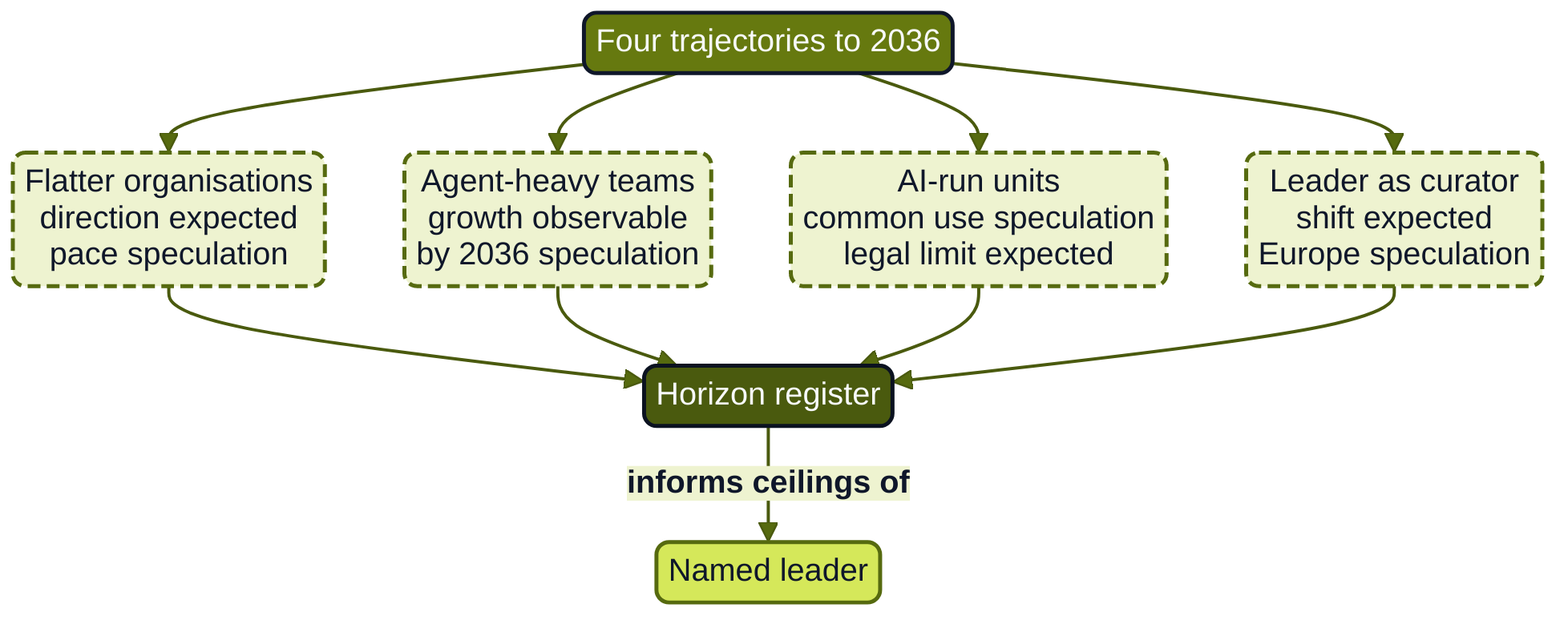
Every earlier chapter described leadership as it is now, or as it can be built now. This chapter looks ahead, and it is the one place in Part VI, with Chapter 33, where the author states his own projections. It concerns all five leadership functions: L1 Orient, because a leader's picture of the world will increasingly be assembled by machines; L2 Decide, because the share of decisions taken inside a mandate will grow; L3 Organise, because the number of layers and the size of spans are what the question "fewer leaders?" is about; L4 Enable, because the route by which people become leaders is the part of the future most at risk; and L5 Answer, because the future of leadership is decided at the point where somebody must be named.
Four conclusions from earlier volumes set the method. AI Governance (Chapter 22) governs an outlook as a horizon register: each trend is labelled observable, expected or speculation; observable trends justify commitment, expected ones preparation and speculative ones reversibility; and the register is valuable because it can be wrong in a reviewable way (221, Nordqvist, 2026). The Transformed Security Architect (Chapters 23 and 27) applied the labels to a role and concluded that the role persists wherever accountability for a boundary must be human (225, Nordqvist, 2026). AI Blue (Chapters 24 and 28) gave a labelled projection for 2036 and named the first refutation of it, which is multi-year outcome evidence that a team without a human able to verify and stop its AI does better (227, Nordqvist, 2026). AI Purple (Chapter 25) and AI Operations (Chapter 27) did the same for the loop and for operations, each with five thresholds that would change the author's view (228, Nordqvist, 2026) (229, Nordqvist, 2026).
This chapter takes over the form and applies it to the role that all those volumes presuppose, keeping the author's judgement apart from the book's findings. The open question is whether there will be fewer leaders in 2036, or more leaders of fewer, larger and more agent-rich units.
Primary topics explored
- What this chapter builds on
- How to read the labels
- A horizon register for leadership roles
- Four trajectories
- Regulation and the labour market
- The debate
About AI Leader
AI Leader is Book 11 of The Transformed Architecture. It takes leadership as its subject and asks what happens when AI is used broadly: the five leadership functions (orient, decide, organise, enable, answer), the delegation ladder and the Level 4 prohibitions, the answerability principle (name, explain, reach), the span and the middle layer, human-agent work, the board and the management body, change and adoption as claims that need evidence, regulation (the AI Act, DORA, NIS 2, the GDPR), ethics and sovereignty, and the leader as a person, for European enterprises and public authorities.
It builds on the conclusions of Architecture as Code, AI Governance, AI Platform and Security, AI Red Team, AI Threat, The Transformed Security Architect, AI Boss, AI Blue, AI Purple and AI Operations.
chairs and members of boards, chief executives and executive teams, the changing C-suite, middle managers and first-line leaders, heads of public authorities and the politicians who oversee them, HR specialists, works councils and unions, architects who advise leaders, and supervisors and auditors.

Gunnar Nordqvist
Conceived, directed and published the books of The Transformed Architecture.
Continue with the full chapter
Chapter 29: The Future of Leadership: Will There Be Fewer Leaders? in AI Leader gives the detailed explanations, practical examples and implementation patterns behind this summary.
This whitepaper belongs to “The Leader as a Person” and is one of 37 drawn from the manuscript.