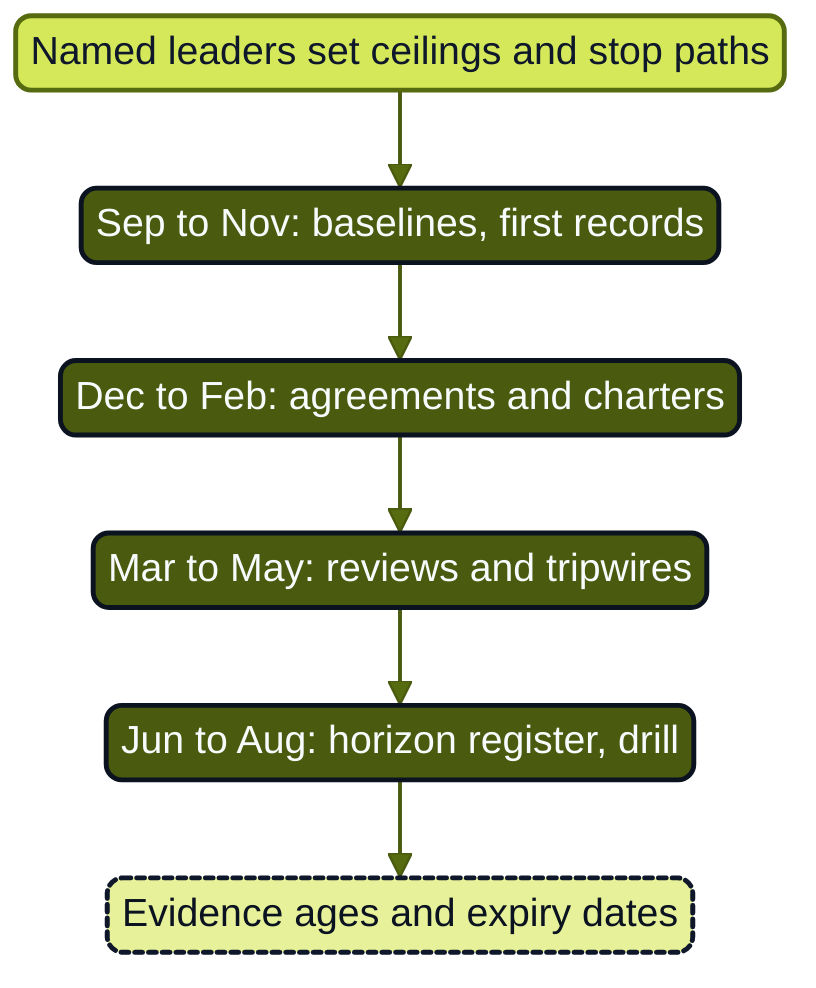
Thirty chapters have built instruments: a loop of five functions, a ladder of delegation, three tests of answerability and records for decisions, spans, adoption claims and drills. This chapter uses them for a year. It follows eight named leaders in Nordvik Region and Hansa Mutual from September 2029 to August 2030 and shows what the instruments look like in a calendar: where they held, where they did not and what stayed open. It concerns all five functions of the leadership loop, L1 Orient, L2 Decide, L3 Organise, L4 Enable and L5 Answer, because a year does not respect the division of a book into functions. One week brings a count from a home-care round (L1), a contested post (L2), a roster (L3), a coaching hour (L4) and a letter to a council (L5).
The year is illustrative. It is built from the records of Chapters 1 to 30 and from nothing else. Three kinds of statement appear. Most are recorded: an earlier chapter fixed the date, the identifier or the figure, and the text names the chapter. Some are derived: they follow from a recorded date, such as a claim that expired on its own stated day. A few are illustrative outcomes: the story needed a result and the text says "in this illustration". Where an earlier chapter set a date and recorded no outcome, this chapter records none either, because an open item is itself a result, and the section "What the year showed" counts them. Nothing here measures an organisation, and no figure should be read as a rate or as evidence that the instruments work.
At Nordvik Region the regional director is Elisabet Holmgren, who answers to the regional executive committee chaired by Lars-Erik Nyström and to the council. The HR director is Ingrid Halvorsen, the CIO is Henrik Dahl, and Mikael Strand leads the Strandvik home-care unit of about 35 staff. At Hansa Mutual the chief executive is Friedrich Albrecht, the chief risk officer Dr. Annette Krämer, who chairs the group AI governance board, and the chief HR officer and labour director Marlene Voss. Jana Petersen leads about 20 claims handlers in Hamburg and, in the pilot HM-AB-PILOT-01, two agents. Birgitta Almqvist speaks for the union side of the central work-environment committee, Thomas Brandt for the Konzernbetriebsrat, Dr. Margarethe Linde chairs the supervisory board, Dorothea Keil is chief financial officer and Rainer Lehmann group CIO.
Primary topics explored
- The leaders and the rules of the year
- September to November: commissions, ceilings and the first honest numbers
- December to February: an expired claim, two agreements and a drill
- March to May: the contract, the cut layer and the tripwire
- June to August: the report, the date and the drill with the assistants off
- What the year showed
About AI Leader
AI Leader is Book 11 of The Transformed Architecture. It takes leadership as its subject and asks what happens when AI is used broadly: the five leadership functions (orient, decide, organise, enable, answer), the delegation ladder and the Level 4 prohibitions, the answerability principle (name, explain, reach), the span and the middle layer, human-agent work, the board and the management body, change and adoption as claims that need evidence, regulation (the AI Act, DORA, NIS 2, the GDPR), ethics and sovereignty, and the leader as a person, for European enterprises and public authorities.
It builds on the conclusions of Architecture as Code, AI Governance, AI Platform and Security, AI Red Team, AI Threat, The Transformed Security Architect, AI Boss, AI Blue, AI Purple and AI Operations.
chairs and members of boards, chief executives and executive teams, the changing C-suite, middle managers and first-line leaders, heads of public authorities and the politicians who oversee them, HR specialists, works councils and unions, architects who advise leaders, and supervisors and auditors.

Gunnar Nordqvist
Conceived, directed and published the books of The Transformed Architecture.
Continue with the full chapter
Chapter 31: A Year in Leadership: Nordvik Region and Hansa Mutual in AI Leader gives the detailed explanations, practical examples and implementation patterns behind this summary.
This whitepaper belongs to “Experience and Conclusions” and is one of 37 drawn from the manuscript.