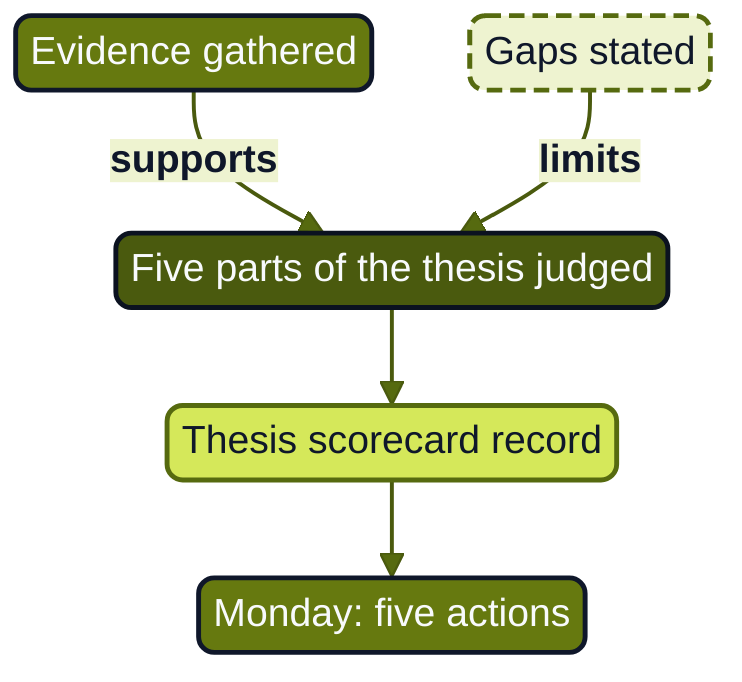
Thirty-two chapters have built a thesis, tested its parts one function at a time and followed two organisations through a year of living with it. This chapter judges it. It concerns all five functions of the leadership loop, L1 Orient, L2 Decide, L3 Organise, L4 Enable and L5 Answer, because a conclusion that favoured one of them would misdescribe a loop whose point is that the five hold one another up. The judgement is made against the evidence the book actually gathered, which is narrower than the claims that circulate about leadership and AI, and the chapter says where it is narrow. It also says what would show the thesis wrong, whether anything seen so far does, what the author projects beyond the evidence, and what a reader can do on Monday with records an organisation already has.
The book uses three labels for every statement about the future, taken from AI Governance, Chapter 22 (221, Nordqvist, 2026). A statement is observable when it describes something happening now and documented in a source the book opened. It is expected when it follows from a stated trend or from an instrument that has been decided. It is speculation when it is plausible and unevidenced. This chapter adds a discipline to those labels. Where the earlier chapters called something observable, the chapter asks what exactly was observed, in whom, and whether the observation bears on leaders. Most of what the book found is observable about other people and other tasks, and its bearing on leadership is the book's own inference. The word "established" is used below only for what is both observable and in force: a duty written in an instrument, a documented failure, a measured effect with its limits. No part of the thesis as a whole is established in that sense. The five parts are claims about how leadership should be organised so that it works under AI, and the evidence supports mechanisms and premises more than it supports outcomes.
A second discipline concerns the book's own conventions. The ceilings of Chapter 4, the evidence clocks of Chapter 20 (90 days for usage, 180 days for value) and the starting levels in the tables of Chapters 8 and 16 are the author's recommendations. They were chosen to be reviewable, and no study measured them. They are design choices offered for testing, and a reader who adopts them is running the test.
Primary topics explored
- How the judgement is made
- The thesis, part by part
- The scorecard
- Where the book's evidence is thin
- What would show the thesis wrong
- The author's projections
About AI Leader
AI Leader is Book 11 of The Transformed Architecture. It takes leadership as its subject and asks what happens when AI is used broadly: the five leadership functions (orient, decide, organise, enable, answer), the delegation ladder and the Level 4 prohibitions, the answerability principle (name, explain, reach), the span and the middle layer, human-agent work, the board and the management body, change and adoption as claims that need evidence, regulation (the AI Act, DORA, NIS 2, the GDPR), ethics and sovereignty, and the leader as a person, for European enterprises and public authorities.
It builds on the conclusions of Architecture as Code, AI Governance, AI Platform and Security, AI Red Team, AI Threat, The Transformed Security Architect, AI Boss, AI Blue, AI Purple and AI Operations.
chairs and members of boards, chief executives and executive teams, the changing C-suite, middle managers and first-line leaders, heads of public authorities and the politicians who oversee them, HR specialists, works councils and unions, architects who advise leaders, and supervisors and auditors.

Gunnar Nordqvist
Conceived, directed and published the books of The Transformed Architecture.
Continue with the full chapter
Chapter 33: Conclusions: Leadership with AI in AI Leader gives the detailed explanations, practical examples and implementation patterns behind this summary.
This whitepaper belongs to “Experience and Conclusions” and is one of 37 drawn from the manuscript.