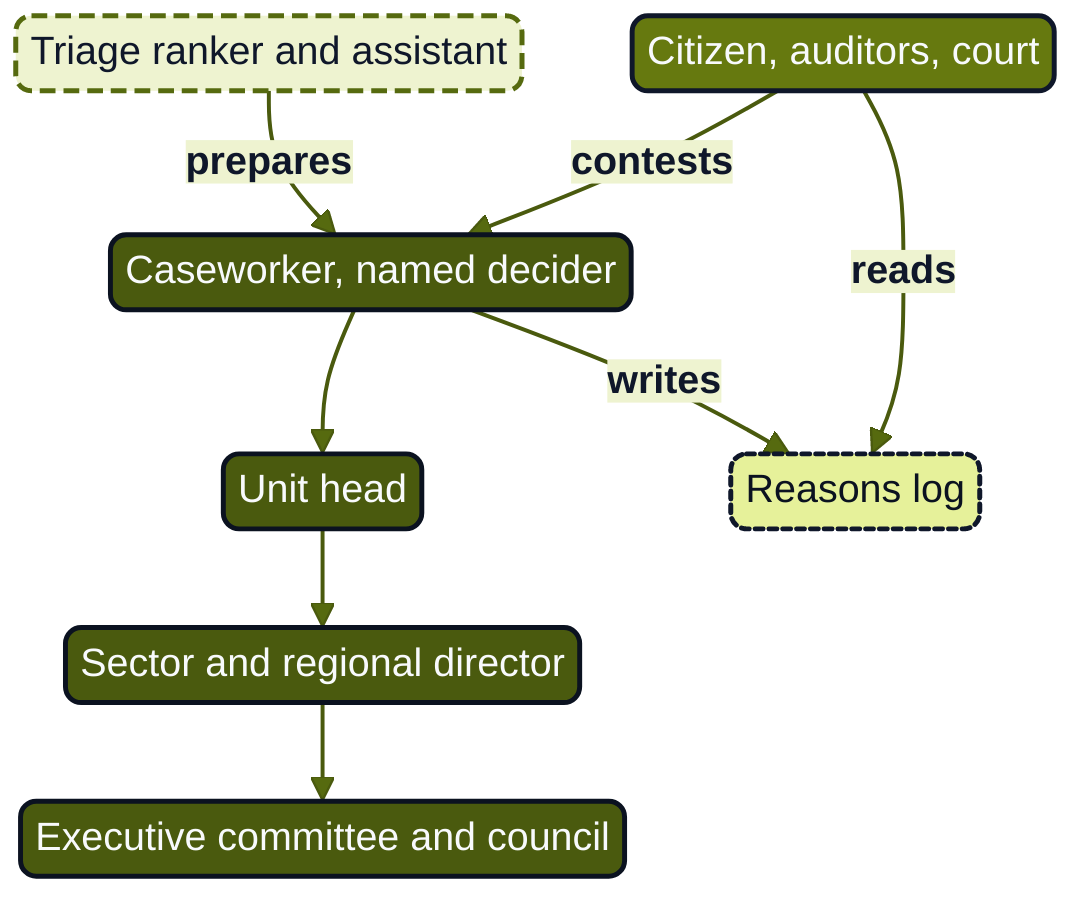
Every earlier chapter of Part II ends in the same place. The leader has oriented the organisation, decided, structured the work and developed the people, and somebody now has to stand in front of a forum and say why. This chapter treats that last act, L5 Answer: to whom a leader answers, for what, by what means, and what has to be true of a decision for the answer to be possible at all. It also touches L2 Decide, because a decision that cannot be answered for was never fully taken, and L3 Organise, because the chains along which answers travel are built by structure.
The chapter makes one claim and defends it against the evidence. Delegation moves work, never answerability. An AI system may inform, draft, prepare and, within a mandate, execute; it may not answer, because answering is a relation between a person and a forum, and a model is neither. For every consequential decision a named leader must therefore pass three tests, which Chapter 4 defines and this chapter applies. Name: the person who answers is identifiable to those affected and to the person's supervisor. Explain: the person can reconstruct the reasons for the decision without the help of the system that took part. Reach: the person has the authority, the time and the information to change or stop the decision, outside the system that proposed it.
Bovens defines accountability, in a widely used formulation, as a relationship between an actor and a forum in which the actor has an obligation to explain and justify conduct, the forum can pose questions and pass judgement, and the actor may face consequences (131, Bovens, 2007). The definition is narrow on purpose, and the narrowness is useful here. It has three parts that can each fail separately: an obligation to explain, a forum that can question, and a consequence that can attach to a person. A leader who is obliged to explain but faces no forum has a duty without a mechanism. A forum that can question a leader who cannot reconstruct the reasons has a hearing without content. A consequence that attaches to someone who had no way to change the outcome is punishment, not accountability. The three tests of this book are the leader-side counterparts of the three parts: Name ties the obligation to a person, Explain gives the forum something to question, and Reach makes the consequence fair.
Primary topics explored
- Answerability
- Chains of answerability
- Transparency and explanation
- The accountability gap
- The three tests in practice
- Legitimacy in the public sector
About AI Leader
AI Leader is Book 11 of The Transformed Architecture. It takes leadership as its subject and asks what happens when AI is used broadly: the five leadership functions (orient, decide, organise, enable, answer), the delegation ladder and the Level 4 prohibitions, the answerability principle (name, explain, reach), the span and the middle layer, human-agent work, the board and the management body, change and adoption as claims that need evidence, regulation (the AI Act, DORA, NIS 2, the GDPR), ethics and sovereignty, and the leader as a person, for European enterprises and public authorities.
It builds on the conclusions of Architecture as Code, AI Governance, AI Platform and Security, AI Red Team, AI Threat, The Transformed Security Architect, AI Boss, AI Blue, AI Purple and AI Operations.
chairs and members of boards, chief executives and executive teams, the changing C-suite, middle managers and first-line leaders, heads of public authorities and the politicians who oversee them, HR specialists, works councils and unions, architects who advise leaders, and supervisors and auditors.

Gunnar Nordqvist
Conceived, directed and published the books of The Transformed Architecture.
Continue with the full chapter
Chapter 12: Answer: Accountability, Transparency and Legitimacy in AI Leader gives the detailed explanations, practical examples and implementation patterns behind this summary.
This whitepaper belongs to “The Craft of Leading” and is one of 37 drawn from the manuscript.