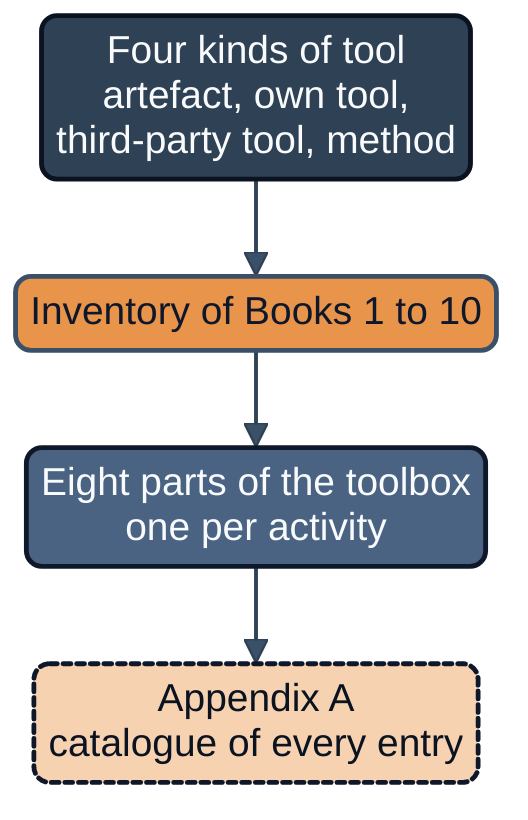
A practitioner who needs "the tool for X" in The Transformed Architecture has until now had to know which of ten books to open. A service record sits in the appendix of one volume, the rules-of-engagement manifest in two others, the delegation profile in four, and the open standard that a detection rule is written in is named in the chapters of a fifth. Tools is the eleventh volume of the series and the only one that is read by looking things up. It collects what the ten earlier volumes define or use, organises it by what the practitioner is doing and says for each tool what it is for, when to use it, what it needs, what it produces and which chapter of which volume holds the reasoning.
This chapter sets the rules of the reference. It defines the four kinds of tool the book treats and says what it does not treat. It explains how the book was compiled from an inventory of the ten volumes, so that the reader knows what the catalogue claims and what it leaves out. It shows how an entry is built and gives each kind of reader a path through the book. It closes by introducing the two fictional organisations, Nordvik Region and Hansa Mutual, that run through the series and through the final part of this book. Chapter 2 then describes the anatomy that all artefacts share, and Chapter 3 treats how a tool is chosen, adopted and retired.
The book builds on the ten volumes and refers to no later volume. It refers to the first volume as Architecture as Code (Chapter N) (1, Nordqvist, 2025) and to the others as AI Governance, Chapter N (2, Nordqvist, 2026), and so on down to AI Operations (10, Nordqvist, 2026). Those citations record where the series defines a tool. They are never the source for a fact about third-party software, which cites its own documentation.
Primary topics explored
- What a tool is
- How the book was compiled
- How to read an entry
- A path for each reader
- Nordvik Region and Hansa Mutual
- Using the tools directly
About Tools
Tools is a companion to The Transformed Architecture. It collects the tools that Books 1 to 10 describe in one reference, organised by what the practitioner is doing: artefacts (templates, manifests, records), own tools, third-party tools and standards, and methods. Each entry says what a tool is for, when to use it, what it needs and produces, and where the book that defines it explains the reasoning. The book covers choosing, adopting and retiring tools, architecture and delivery, governing AI, securing and testing, operating, agents and autonomy, and people, organisation and society, for European enterprises and public authorities. It comes with a template library, an inventory, three web tools and the Toolbox Maturity Method.
It builds on the conclusions of Architecture as Code, AI Governance, AI Platform and Security, AI Red Team, AI Threat, The Transformed Security Architect, AI Boss, AI Blue, AI Purple and AI Operations.
Architects and security architects, CIOs and CISOs, platform and operations leads, heads of governance, risk, compliance and third-party risk, AI governance and AI platform teams, red, blue and purple team leads, boards and management bodies, procurement and vendor managers, supervisors and auditors, works councils and unions, data protection officers, and public-sector leaders.

Gunnar Nordqvist
Conceived, directed and published the books of The Transformed Architecture.
Continue with the full chapter
Chapter 1: Introduction: A Toolbox for the Series in Tools gives the detailed explanations, practical examples and implementation patterns behind this summary.
This whitepaper belongs to “The Toolbox” and is one of 29 drawn from the manuscript.