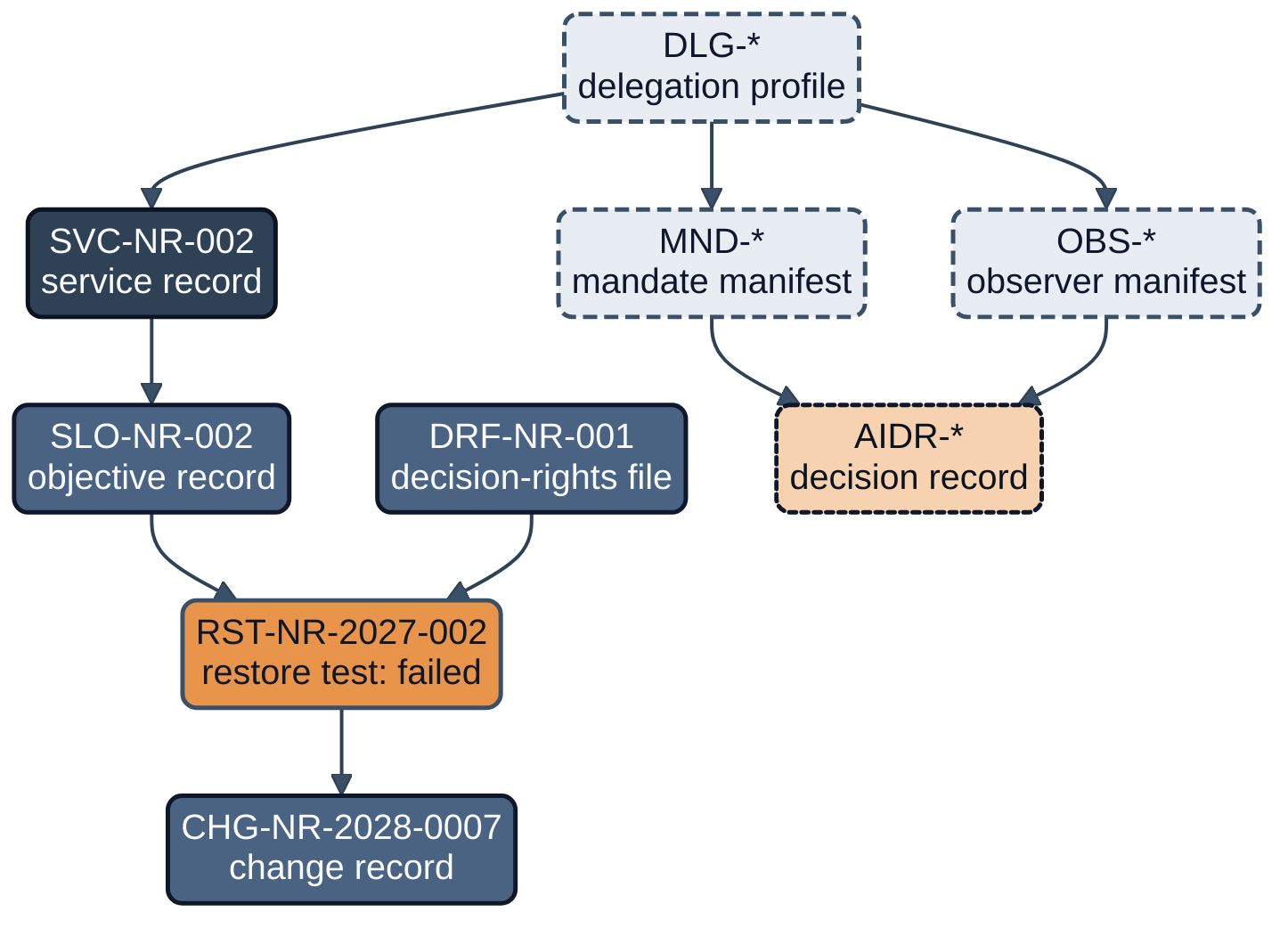
Chapter 1 defined the four kinds of tool: artefact, own tool, third-party tool and method. This chapter looks inside the largest group, the artefacts, and asks what a service record, a delegation profile, a mandate manifest, a rules-of-engagement manifest and a restore-test record have in common. The answer matters for the reader of a reference because a shared anatomy makes the catalogue searchable by habit. Once the reader knows that every artefact states a purpose, names its inputs and outputs, carries an identifier from a family, names an owner and gives a date on which its evidence is reviewed, she can read an unfamiliar artefact in half the time. The chapter also shows how the identifier families of ten volumes link into chains, so that a reader who holds one record can find the ones that depend on it.
The chapter treats no principal tool in the entry format, since the tools it discusses are treated in Parts II to VII. Its material comes from the templates and appendices of Architecture as Code (1, Nordqvist, 2025), AI Governance (2, Nordqvist, 2026), AI Platform and Security (3, Nordqvist, 2026), The Transformed Security Architect (6, Nordqvist, 2026), AI Purple (9, Nordqvist, 2026) and AI Operations (10, Nordqvist, 2026), and from the identifier families recorded in the inventory of the ten volumes.
The templates of the series were written by one author over several volumes, and they converge on a common frame. The frame is not a formal schema. It is a set of habits that show in the Appendix B entries of the later volumes, where each template is introduced by the same five labels: purpose, when to use, inputs, outputs and the chapter that explains the reasoning. This book uses the same labels for the entries of its chapters. The labels describe the tool as a reader meets it. Inside the template, the same habits appear as fields.
Primary topics explored
- The common anatomy
- Identifier families and how they link
- Evidence age on every tool
- Tools in version control
- Lifecycle of a tool
- Summary
About Tools
Tools is a companion to The Transformed Architecture. It collects the tools that Books 1 to 10 describe in one reference, organised by what the practitioner is doing: artefacts (templates, manifests, records), own tools, third-party tools and standards, and methods. Each entry says what a tool is for, when to use it, what it needs and produces, and where the book that defines it explains the reasoning. The book covers choosing, adopting and retiring tools, architecture and delivery, governing AI, securing and testing, operating, agents and autonomy, and people, organisation and society, for European enterprises and public authorities. It comes with a template library, an inventory, three web tools and the Toolbox Maturity Method.
It builds on the conclusions of Architecture as Code, AI Governance, AI Platform and Security, AI Red Team, AI Threat, The Transformed Security Architect, AI Boss, AI Blue, AI Purple and AI Operations.
Architects and security architects, CIOs and CISOs, platform and operations leads, heads of governance, risk, compliance and third-party risk, AI governance and AI platform teams, red, blue and purple team leads, boards and management bodies, procurement and vendor managers, supervisors and auditors, works councils and unions, data protection officers, and public-sector leaders.

Gunnar Nordqvist
Conceived, directed and published the books of The Transformed Architecture.
Continue with the full chapter
Chapter 2: The Anatomy of a Tool: Kinds, Identifiers and Lifecycle in Tools gives the detailed explanations, practical examples and implementation patterns behind this summary.
This whitepaper belongs to “The Toolbox” and is one of 29 drawn from the manuscript.