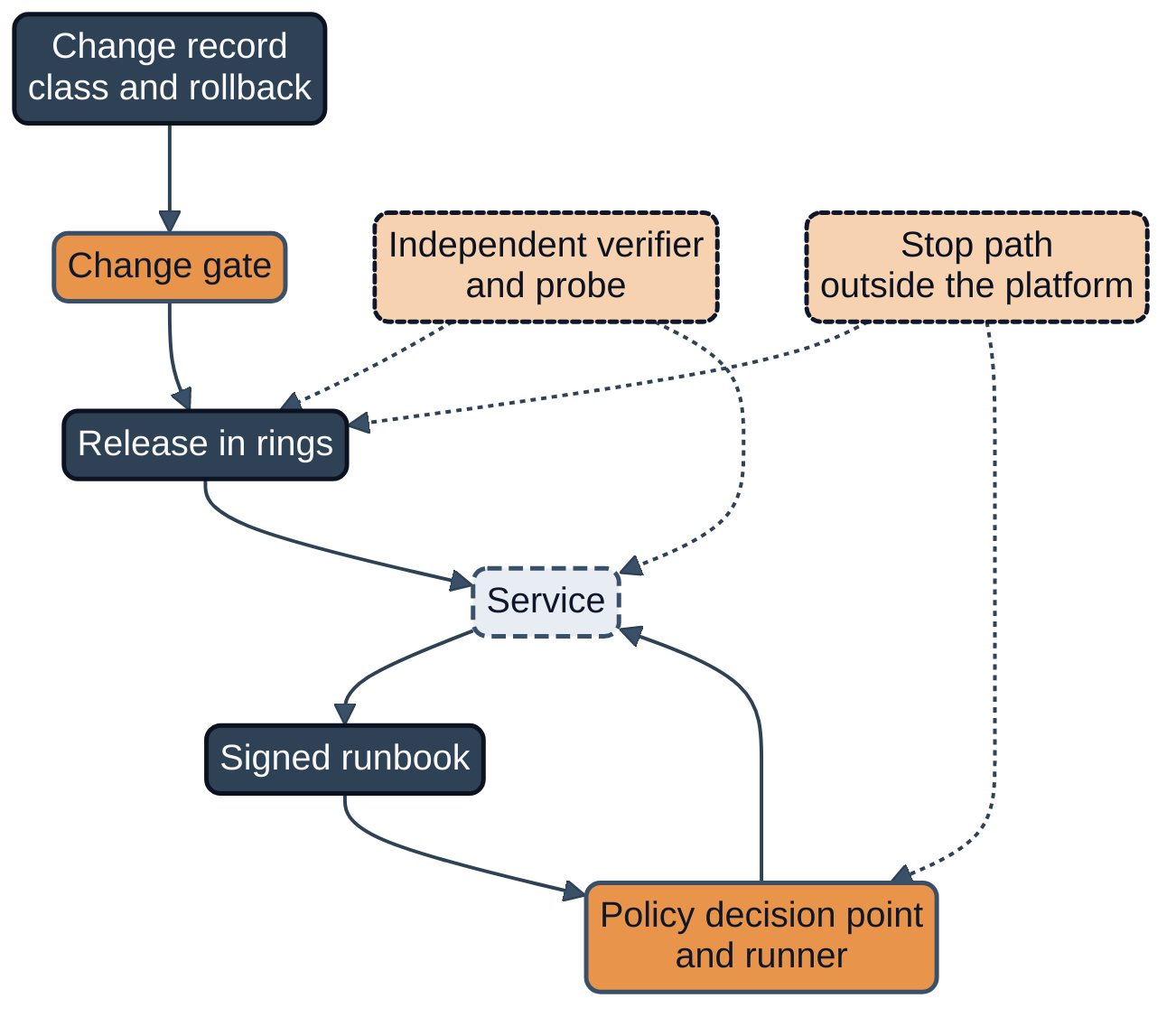
When a service must be altered or brought back, the operator acts, and the tools of this chapter decide how far an action may go before somebody else looks. They serve the activities that AI Operations calls O3 Change and O4 Restore (10, Nordqvist, 2026): classifying and recording a change, releasing it in stages, reconciling declared with actual state, writing a procedure that a machine may run, and fixing the calendar and the windows within which any of this happens. They are the series' instruments for one rule: what can be undone, and who can stop it, outside the system being stopped.
The four kinds of tool occur. The artefacts are the change record and change class (CHG-*), the progressive-delivery policy (ROL-*), the runbook manifest (RBK-*), the model-change record, the freeze calendar (FRZ-*), the catalogue of first remediation actions, the release record and the drift runbook of AI Platform and Security, and two listings of Architecture as Code. The third-party tools are the GitOps and progressive-delivery engines (Argo CD, Flux, Argo Rollouts, Flagger, Kargo), the OpenGitOps principles, the service mesh Istio and two workflow engines (Argo Workflows, Temporal). The methods are progressive delivery, feature flags, rollback safety, freezes, remediation tiers, safe execution of runbooks, signed runbooks and remediation windows. Most come from AI Operations (Book 10), which defines the change and restore artefacts; Architecture as Code (Book 1) and AI Platform and Security (Book 3) supply the earlier forms; AI Red Team (Book 4) and AI Purple (Book 9) each supply one.
The chapter follows the figure. Change classes and records come first, then progressive delivery and GitOps, then runbooks and remediation, then the tools that fix when change may happen. The third-party tools are described only as far as their documentation supports and the series claims; the versions current at the time of the originating book are not repeated, because they age quickly, and AI Operations, Chapter 8, dates its own snapshot.
Primary topics explored
- Change classes and records
- Progressive delivery and GitOps
- Runbooks and remediation
- Freezes and windows
- Across the degrees of delegation
- Treatment of the inventory
About Tools
Tools is a companion to The Transformed Architecture. It collects the tools that Books 1 to 10 describe in one reference, organised by what the practitioner is doing: artefacts (templates, manifests, records), own tools, third-party tools and standards, and methods. Each entry says what a tool is for, when to use it, what it needs and produces, and where the book that defines it explains the reasoning. The book covers choosing, adopting and retiring tools, architecture and delivery, governing AI, securing and testing, operating, agents and autonomy, and people, organisation and society, for European enterprises and public authorities. It comes with a template library, an inventory, three web tools and the Toolbox Maturity Method.
It builds on the conclusions of Architecture as Code, AI Governance, AI Platform and Security, AI Red Team, AI Threat, The Transformed Security Architect, AI Boss, AI Blue, AI Purple and AI Operations.
Architects and security architects, CIOs and CISOs, platform and operations leads, heads of governance, risk, compliance and third-party risk, AI governance and AI platform teams, red, blue and purple team leads, boards and management bodies, procurement and vendor managers, supervisors and auditors, works councils and unions, data protection officers, and public-sector leaders.

Gunnar Nordqvist
Conceived, directed and published the books of The Transformed Architecture.
Continue with the full chapter
Chapter 16: Change, Restore and Runbook Tools in Tools gives the detailed explanations, practical examples and implementation patterns behind this summary.
This whitepaper belongs to “Operating” and is one of 29 drawn from the manuscript.