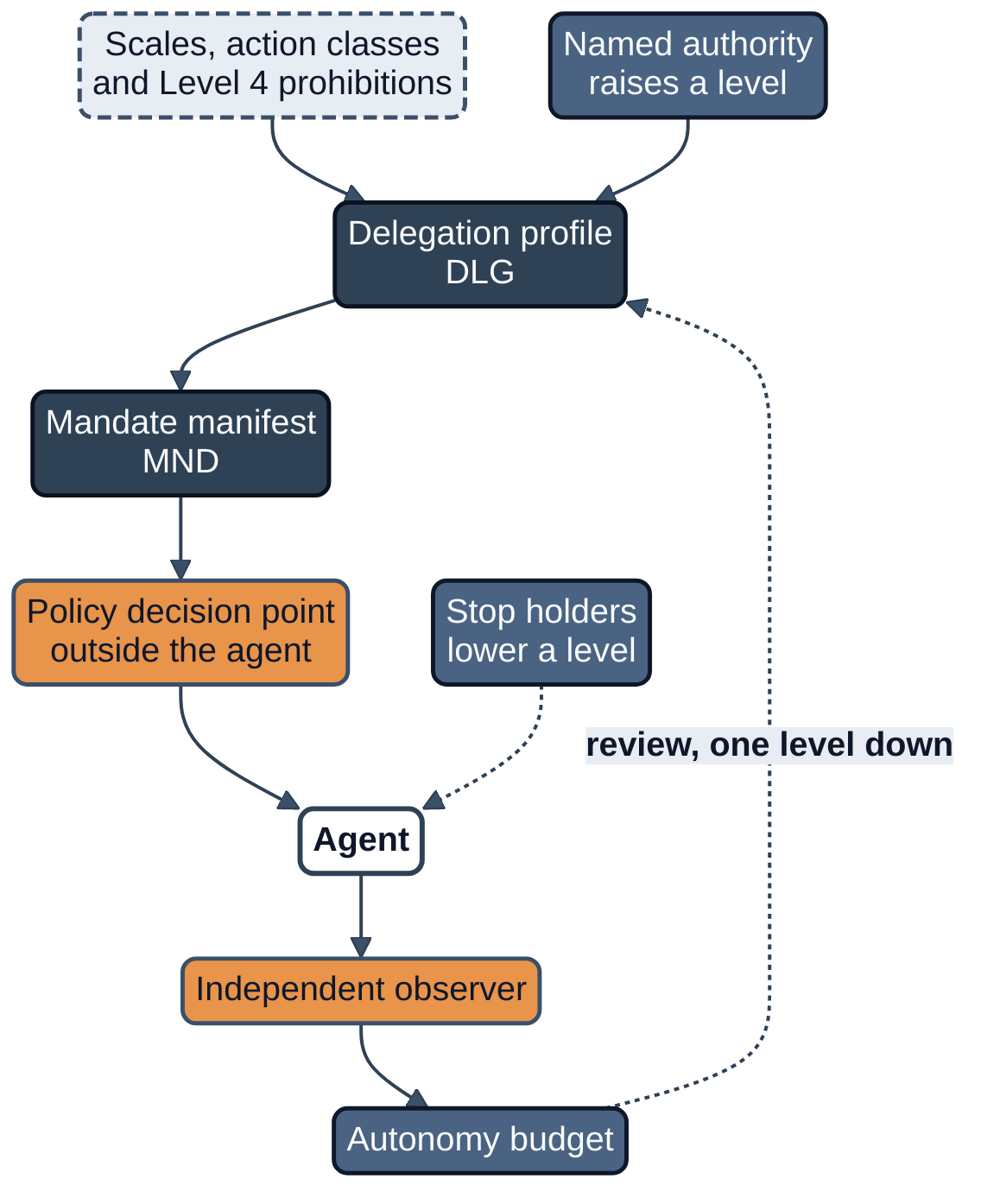
This chapter serves one activity: deciding, in writing and in a form that a machine can enforce, what an AI agent may do. The tools that do this are mostly artefacts, written as code and kept in version control: mandate manifests (MND-*), delegation profiles (DLG-*), charters, decision-rights files and delegation registers. Around them stand three scales and rules that the series defines (usage modes, autonomy levels and action classes), one method that gives the levels a budget, and a small group of third-party formats for the instruction files that agents read (SKILL.md and AGENTS.md). The tools come from AI Platform and Security (Book 3), The Transformed Security Architect (Book 6), AI Boss (Book 7), AI Blue (Book 8), AI Purple (Book 9) and AI Operations (Book 10), with the scales taken from AI Red Team (Book 4) and the delegation register from AI Threat (Book 5). The chapter is a reference: it says what each tool is for, when to use it, what it contains and where the originating book gives the reasoning.
The mandate and the delegation profile are the series' two answers to the same question, and they are easy to confuse because five books use the identifiers MND-* and DLG-* with different scopes. The first section therefore compares them. The remaining sections treat the scales and rules, the mandate manifests, the delegation profiles and charters, the registers and reversibility tests, the autonomy budget and its consequences for promotion and demotion, the instruction files, and one script that checks the rules. The worked example is a delegation profile for an operations agent.
The series defines the degree of delegation once: five autonomy levels from Level 0 Advisory to Level 4 Autonomous, set per action and not per agent, with Level 3 Bounded defined by a codified playbook that a policy decision point outside the model enforces (4, Nordqvist, 2026). Each later book adds an artefact that records the levels for its own subject. The artefacts share a family of identifiers and a purpose, but they do not share a schema, and a reader who opens two books will find two different files under the same prefix. Table 18.1 records the differences as the books state them.
Primary topics explored
- How the books use
MND-*andDLG-* - Scales and rules
- Mandate manifests
- Delegation profiles and charters
- Registers and reversibility tests
- The autonomy budget
About Tools
Tools is a companion to The Transformed Architecture. It collects the tools that Books 1 to 10 describe in one reference, organised by what the practitioner is doing: artefacts (templates, manifests, records), own tools, third-party tools and standards, and methods. Each entry says what a tool is for, when to use it, what it needs and produces, and where the book that defines it explains the reasoning. The book covers choosing, adopting and retiring tools, architecture and delivery, governing AI, securing and testing, operating, agents and autonomy, and people, organisation and society, for European enterprises and public authorities. It comes with a template library, an inventory, three web tools and the Toolbox Maturity Method.
It builds on the conclusions of Architecture as Code, AI Governance, AI Platform and Security, AI Red Team, AI Threat, The Transformed Security Architect, AI Boss, AI Blue, AI Purple and AI Operations.
Architects and security architects, CIOs and CISOs, platform and operations leads, heads of governance, risk, compliance and third-party risk, AI governance and AI platform teams, red, blue and purple team leads, boards and management bodies, procurement and vendor managers, supervisors and auditors, works councils and unions, data protection officers, and public-sector leaders.

Gunnar Nordqvist
Conceived, directed and published the books of The Transformed Architecture.
Continue with the full chapter
Chapter 18: Mandate, Delegation and Autonomy Tools in Tools gives the detailed explanations, practical examples and implementation patterns behind this summary.
This whitepaper belongs to “Agents and Autonomy” and is one of 29 drawn from the manuscript.