This chapter serves the activity of deciding what a person in a role may decide, showing what that person can do, and keeping the ability alive while AI does more of the work. It treats four kinds of tool. Most are artefacts: role charters (ROLE-*), competence frameworks, competence records (CMP-*), learning paths (LP-*), apprenticeship and craft records and the on-call charter (ONC-*). Some are methods, such as assessment by practical demonstration and the craft-keeping programme. A few are third-party frameworks, namely the skills frameworks and certifications to which the series maps its own. The own tools of the series that touch this activity are the Python utilities of Architecture as Code. The tools come from six volumes: Architecture as Code (Chapters 17 to 19), AI Governance, Chapter 14, The Transformed Security Architect, Chapters 4, 15, 16, 21 and 22, AI Boss, Chapters 19 and 29, AI Blue, Chapters 17, 22 and 23, AI Purple, Chapters 19 and 24 and AI Operations, Chapters 21, 25 and 26 (1, Nordqvist, 2025) (2, Nordqvist, 2026) (6, Nordqvist, 2026) (7, Nordqvist, 2026) (8, Nordqvist, 2026) (9, Nordqvist, 2026) (10, Nordqvist, 2026).
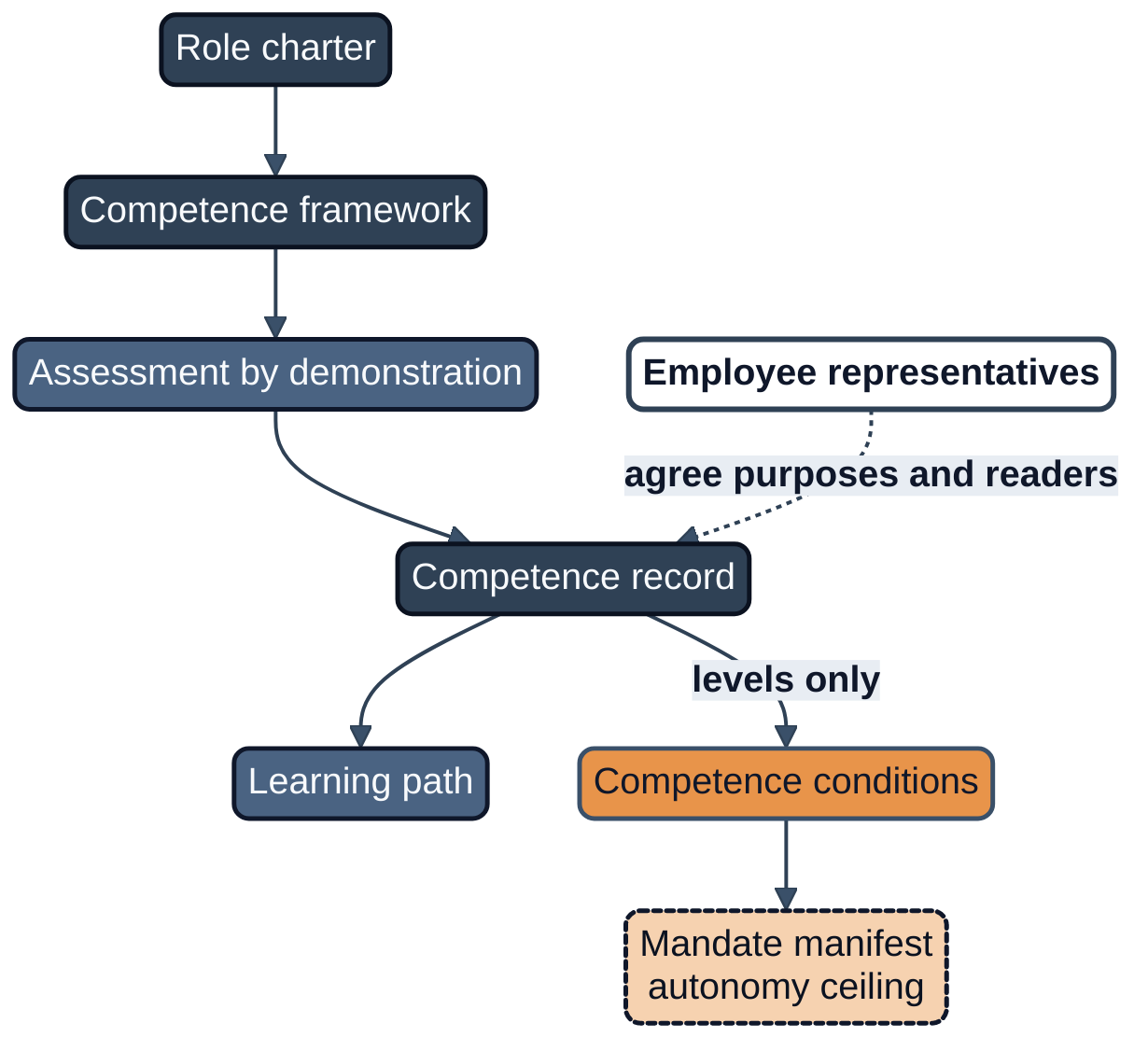
The tools form one chain, drawn in Figure 21.1. The role charter fixes what a role may decide and what it never delegates. The competence framework says which competences those decisions need, at which level and with what evidence. The competence record shows what a named person has demonstrated. Learning paths, craft programmes and apprenticeships feed the record. And the record, read for its levels and never for its content, may condition the autonomy that a mandate manifest grants an agent. The series puts one rule over the whole chain: a competence record is about development and about a check that a decision-right holder has the competence the delegation requires. It does not rank, pay or discipline anyone.
A word on the law that surrounds these tools. A competence record is personal data, and an assessment of judgement is among its more sensitive kinds. The series' architectural reading is that purposes, readers and retention belong in the record schema, which is why every record below carries purposes, not_used_for and readers. Under the GDPR, purpose limitation, data minimisation and storage limitation are principles of Article 5, and Article 88 lets Member States and collective agreements set more specific rules for employee data (196, European Union, 2016). Article 4 of the AI Act, as amended by the Digital Omnibus on AI, asks providers and deployers to support the AI literacy of their staff (195, European Union, 2024) (199, European Union, 2026). These are architectural implications, not legal advice.
Primary topics explored
- Role charters
- Competence frameworks
- Competence records
- Learning paths and training
- Keeping the craft
- Across the usage modes
About Tools
Tools is a companion to The Transformed Architecture. It collects the tools that Books 1 to 10 describe in one reference, organised by what the practitioner is doing: artefacts (templates, manifests, records), own tools, third-party tools and standards, and methods. Each entry says what a tool is for, when to use it, what it needs and produces, and where the book that defines it explains the reasoning. The book covers choosing, adopting and retiring tools, architecture and delivery, governing AI, securing and testing, operating, agents and autonomy, and people, organisation and society, for European enterprises and public authorities. It comes with a template library, an inventory, three web tools and the Toolbox Maturity Method.
It builds on the conclusions of Architecture as Code, AI Governance, AI Platform and Security, AI Red Team, AI Threat, The Transformed Security Architect, AI Boss, AI Blue, AI Purple and AI Operations.
Architects and security architects, CIOs and CISOs, platform and operations leads, heads of governance, risk, compliance and third-party risk, AI governance and AI platform teams, red, blue and purple team leads, boards and management bodies, procurement and vendor managers, supervisors and auditors, works councils and unions, data protection officers, and public-sector leaders.

Gunnar Nordqvist
Conceived, directed and published the books of The Transformed Architecture.
Continue with the full chapter
Chapter 21: Role, Competence and Career Tools in Tools gives the detailed explanations, practical examples and implementation patterns behind this summary.
This whitepaper belongs to “People, Organisation and Society” and is one of 29 drawn from the manuscript.