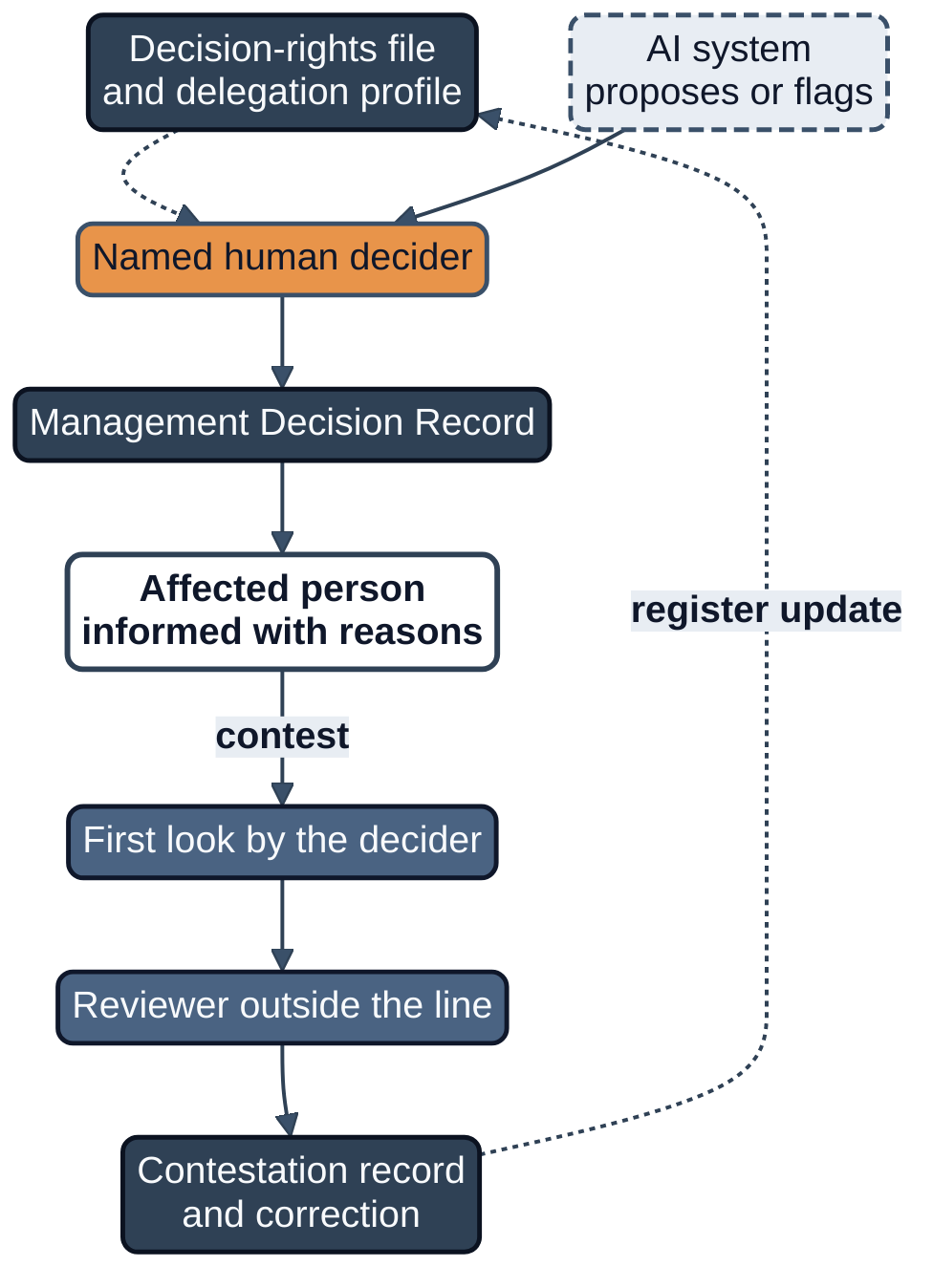
This chapter serves the activity of governing AI that takes part in managing people: directing their work, evaluating it, rewarding or disciplining them, developing them and caring for them. It collects four kinds of tool. The artefacts are the records and files that give a decision a named human decider and give a person a route to challenge it: the Management Decision Record (MDR-*), the contestation record (CNT-*), the decision-rights file (DRF-*), the disparate-impact test record (DIT-*), the survey plan (SVY-*) and the works agreement annex. The methods are the practical guides that produce them with employee representatives. A few third-party standards frame them, namely JSON Schema for validation and ISO 45003 for psychosocial risk. The series has no own tool in this activity apart from its publishing scripts. The tools come mainly from AI Boss, whose thesis is that AI may direct work but may not, on its own, decide about people, and from AI Governance, Architecture as Code, AI Threat, AI Purple and AI Operations (7, Nordqvist, 2026) (2, Nordqvist, 2026) (1, Nordqvist, 2025) (5, Nordqvist, 2026) (9, Nordqvist, 2026) (10, Nordqvist, 2026).
The law that surrounds these tools is stated here as architectural implication, not as legal advice. The decision-rights file cites Article 26(7) of the AI Act, which concerns informing workers and their representatives before a high-risk system is put into use at the workplace (195, European Union, 2024). The practical guide for the decision-rights file asks the data protection officer to check Article 22 of the GDPR on automated individual decision-making, and Article 88 of the GDPR allows Member States and collective agreements to lay down more specific rules for employees' data (196, European Union, 2016). The Region's contest deadline is kept within the two weeks of the Platform Work Directive, which it adopted as a benchmark (200, European Union, 2024).
The first question is which record shows who decided. The series answers it in three layers. The delegation profile says, per management function, what a system may do, at which degree, with which inputs and which reviews. The decision-rights file places the ceilings, the decision classes with their deciders, the stop rights and the representatives' fixed rights in one file that the management body adopts. The Management Decision Record records a single decision that a system made or shaped about a person. The profile and the file are written once and reopened by evidence; the record is written for every decision in the chosen classes.
Primary topics explored
- Management decision records
- Contestation and appeal
- Impact tests with the representatives
- Care and wellbeing
- Running the programme
- Across the degrees of delegation
About Tools
Tools is a companion to The Transformed Architecture. It collects the tools that Books 1 to 10 describe in one reference, organised by what the practitioner is doing: artefacts (templates, manifests, records), own tools, third-party tools and standards, and methods. Each entry says what a tool is for, when to use it, what it needs and produces, and where the book that defines it explains the reasoning. The book covers choosing, adopting and retiring tools, architecture and delivery, governing AI, securing and testing, operating, agents and autonomy, and people, organisation and society, for European enterprises and public authorities. It comes with a template library, an inventory, three web tools and the Toolbox Maturity Method.
It builds on the conclusions of Architecture as Code, AI Governance, AI Platform and Security, AI Red Team, AI Threat, The Transformed Security Architect, AI Boss, AI Blue, AI Purple and AI Operations.
Architects and security architects, CIOs and CISOs, platform and operations leads, heads of governance, risk, compliance and third-party risk, AI governance and AI platform teams, red, blue and purple team leads, boards and management bodies, procurement and vendor managers, supervisors and auditors, works councils and unions, data protection officers, and public-sector leaders.

Gunnar Nordqvist
Conceived, directed and published the books of The Transformed Architecture.
Continue with the full chapter
Chapter 22: Tools for Managing People with AI: Decision, Contestation and Care in Tools gives the detailed explanations, practical examples and implementation patterns behind this summary.
This whitepaper belongs to “People, Organisation and Society” and is one of 29 drawn from the manuscript.