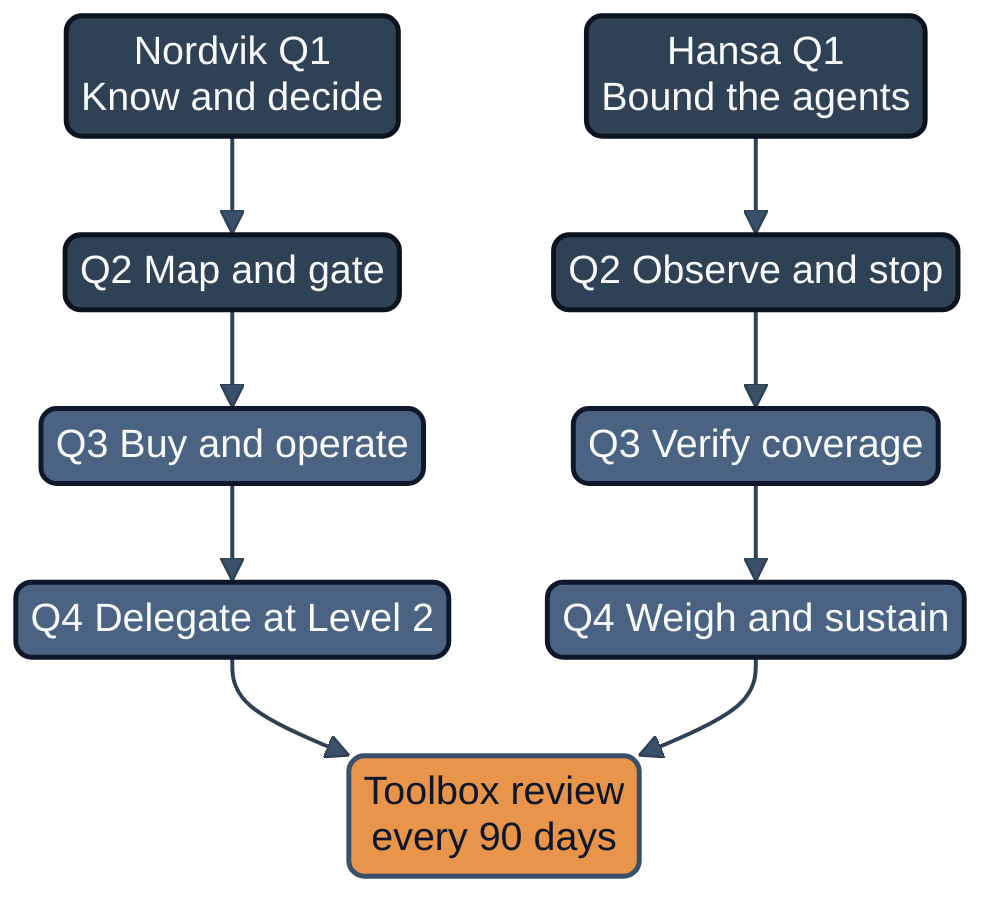
This chapter follows the two fictional organisations of the series as they build and run a toolbox over one year. The earlier chapters of this book treat the tools by activity, and a reader who has followed them has met every tool named here. What the earlier chapters could not show is order: which tool an organisation takes up first, what it leaves out on purpose, what it measures to know that the toolbox works, and what it retires. The chapter draws on the selection, adoption and retirement tools of Chapter 3, the anatomy and evidence-age rules of Chapter 2, and the Nordvik Region and Hansa Mutual subsections of Chapters 4 to 23.
The status of the facts matters, and the chapter keeps them apart. The profiles of the two organisations, the identifiers and the figures quoted from the examples of the earlier volumes are established (2, Nordqvist, 2026) (3, Nordqvist, 2026) (10, Nordqvist, 2026). The year itself, its four quarters and the order of adoption within them are illustrative: no earlier volume narrates a year of tool adoption at either organisation, and the chapter proposes an order that is consistent with what the volumes do record. Where the chapter states a measure that the volumes do not give, it says so. The chapter does not add tools, identifiers or numbers to the profiles.
The two organisations are chosen to differ in the ways that matter for tool choice (Chapter 1). Nordvik Region is a regional public authority with about 6,000 employees and about 450,000 residents, under one legal regime, which mostly procures its AI systems. It runs no autonomous production agent (no Mode 5), and its engineering capacity is small: a platform team of seven engineers who carry site reliability practice, a team of six on the security side, and a duty manager and platform lead who hold the stop path for its runbook runner (10, Nordqvist, 2026). Hansa Mutual is a multinational mutual insurance group with about 9,500 employees and seven legal regimes. It builds as well as buys, and it runs Mode 5 agents in several domains: a claims-triage agent, an IT-operations agent with write access to production, and agents in the security operations centre and in the purple loop (2, Nordqvist, 2026) (10, Nordqvist, 2026).
Primary topics explored
- The two starting points
- Nordvik Region: a year of a cautious buyer
- Hansa Mutual: a year of a builder
- Compared
- What each measures
- Summary
About Tools
Tools is a companion to The Transformed Architecture. It collects the tools that Books 1 to 10 describe in one reference, organised by what the practitioner is doing: artefacts (templates, manifests, records), own tools, third-party tools and standards, and methods. Each entry says what a tool is for, when to use it, what it needs and produces, and where the book that defines it explains the reasoning. The book covers choosing, adopting and retiring tools, architecture and delivery, governing AI, securing and testing, operating, agents and autonomy, and people, organisation and society, for European enterprises and public authorities. It comes with a template library, an inventory, three web tools and the Toolbox Maturity Method.
It builds on the conclusions of Architecture as Code, AI Governance, AI Platform and Security, AI Red Team, AI Threat, The Transformed Security Architect, AI Boss, AI Blue, AI Purple and AI Operations.
Architects and security architects, CIOs and CISOs, platform and operations leads, heads of governance, risk, compliance and third-party risk, AI governance and AI platform teams, red, blue and purple team leads, boards and management bodies, procurement and vendor managers, supervisors and auditors, works councils and unions, data protection officers, and public-sector leaders.

Gunnar Nordqvist
Conceived, directed and published the books of The Transformed Architecture.
Continue with the full chapter
Chapter 24: Building a Toolbox: Nordvik Region and Hansa Mutual in Tools gives the detailed explanations, practical examples and implementation patterns behind this summary.
This whitepaper belongs to “Experience and Conclusions” and is one of 29 drawn from the manuscript.