This chapter serves the activity of deciding what could go wrong with a system, who could make it go wrong and by what technique, and recording the answer so that a control and a test can be attached to it. It treats four kinds of tool: a small number of artefacts (the threat model as code, in three versions from three books, and the priority list of techniques); five methods for producing and reviewing threat models; the adversary frameworks and lists of AI security risks that give the models a shared vocabulary; and the software that supports the work. The tools come from Architecture as Code (1, Nordqvist, 2025), AI Platform and Security (3, Nordqvist, 2026), AI Red Team (4, Nordqvist, 2026), The Transformed Security Architect (6, Nordqvist, 2026), AI Blue (8, Nordqvist, 2026), AI Purple (9, Nordqvist, 2026) and AI Operations (10, Nordqvist, 2026), with entries inherited from AI Governance (2, Nordqvist, 2026).
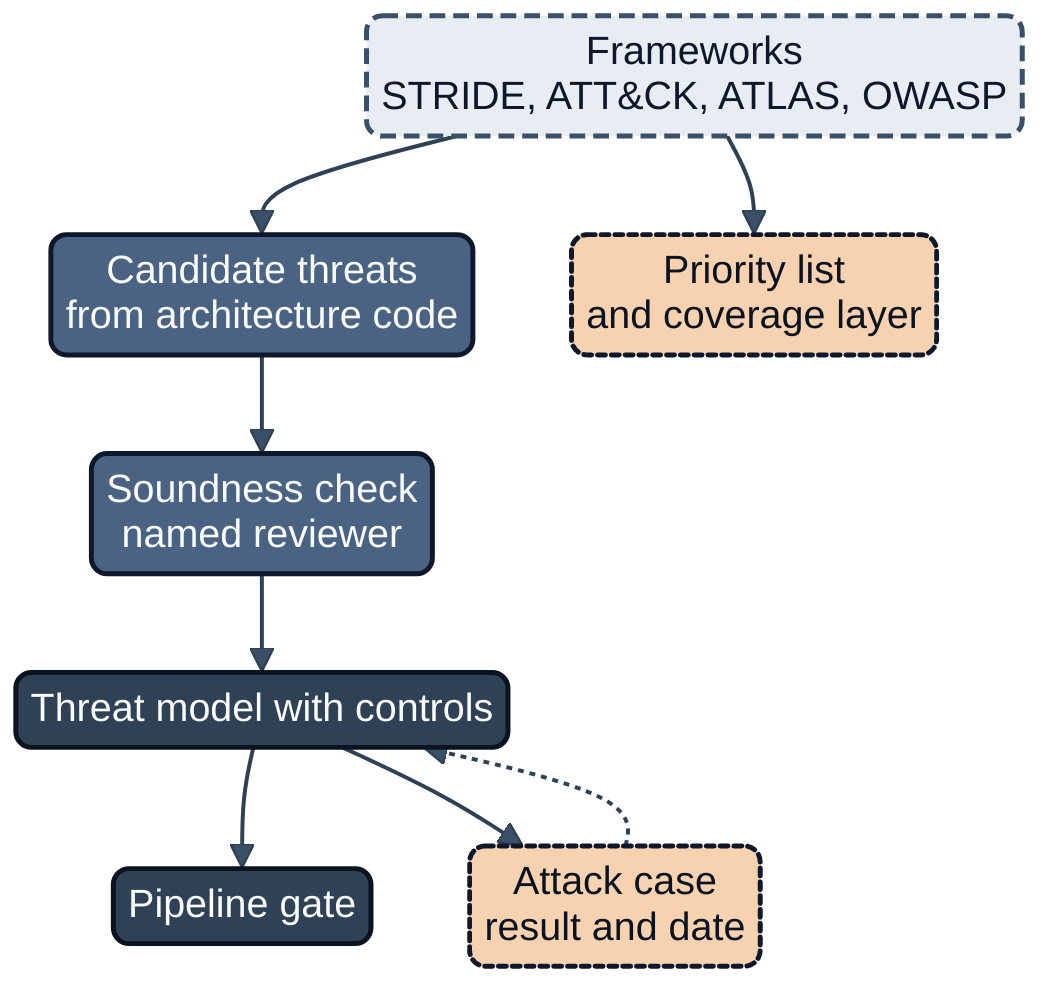
The order of the chapter follows the order in which the tools are used, as Figure 10.1 shows. A framework supplies names. A method turns the architecture into candidate threats expressed in those names and puts a named reviewer in front of each. The artefact records the accepted threats with the controls that answer them, and a pipeline gate refuses a threat that has none. The tests that verify the threats, and the priority list that decides which techniques are tested first, close the loop. The chapter stays at the level the earlier volumes keep: threats are described as classes of behaviour and by technique identifier, never as operational recipes, and every red-team use named here is authorised, scoped by written rules of engagement and ends in a defensive improvement.
A threat model is useful to the extent that other people can act on it, and that requires shared names. The Transformed Security Architect sets out five vocabularies and states the limit of each; the table is the compact form of that argument (6, Nordqvist, 2026).
Primary topics explored
- Adversary frameworks and vocabularies
- Lists of AI security risks
- Threat modelling methods
- Threat model as code
- Software that supports threat modelling
- Across the usage modes
About Tools
Tools is a companion to The Transformed Architecture. It collects the tools that Books 1 to 10 describe in one reference, organised by what the practitioner is doing: artefacts (templates, manifests, records), own tools, third-party tools and standards, and methods. Each entry says what a tool is for, when to use it, what it needs and produces, and where the book that defines it explains the reasoning. The book covers choosing, adopting and retiring tools, architecture and delivery, governing AI, securing and testing, operating, agents and autonomy, and people, organisation and society, for European enterprises and public authorities. It comes with a template library, an inventory, three web tools and the Toolbox Maturity Method.
It builds on the conclusions of Architecture as Code, AI Governance, AI Platform and Security, AI Red Team, AI Threat, The Transformed Security Architect, AI Boss, AI Blue, AI Purple and AI Operations.
Architects and security architects, CIOs and CISOs, platform and operations leads, heads of governance, risk, compliance and third-party risk, AI governance and AI platform teams, red, blue and purple team leads, boards and management bodies, procurement and vendor managers, supervisors and auditors, works councils and unions, data protection officers, and public-sector leaders.

Gunnar Nordqvist
Conceived, directed and published the books of The Transformed Architecture.
Continue with the full chapter
Chapter 10: Threat Modelling and Adversary Frameworks in Tools gives the detailed explanations, practical examples and implementation patterns behind this summary.
This whitepaper belongs to “Securing and Testing” and is one of 29 drawn from the manuscript.