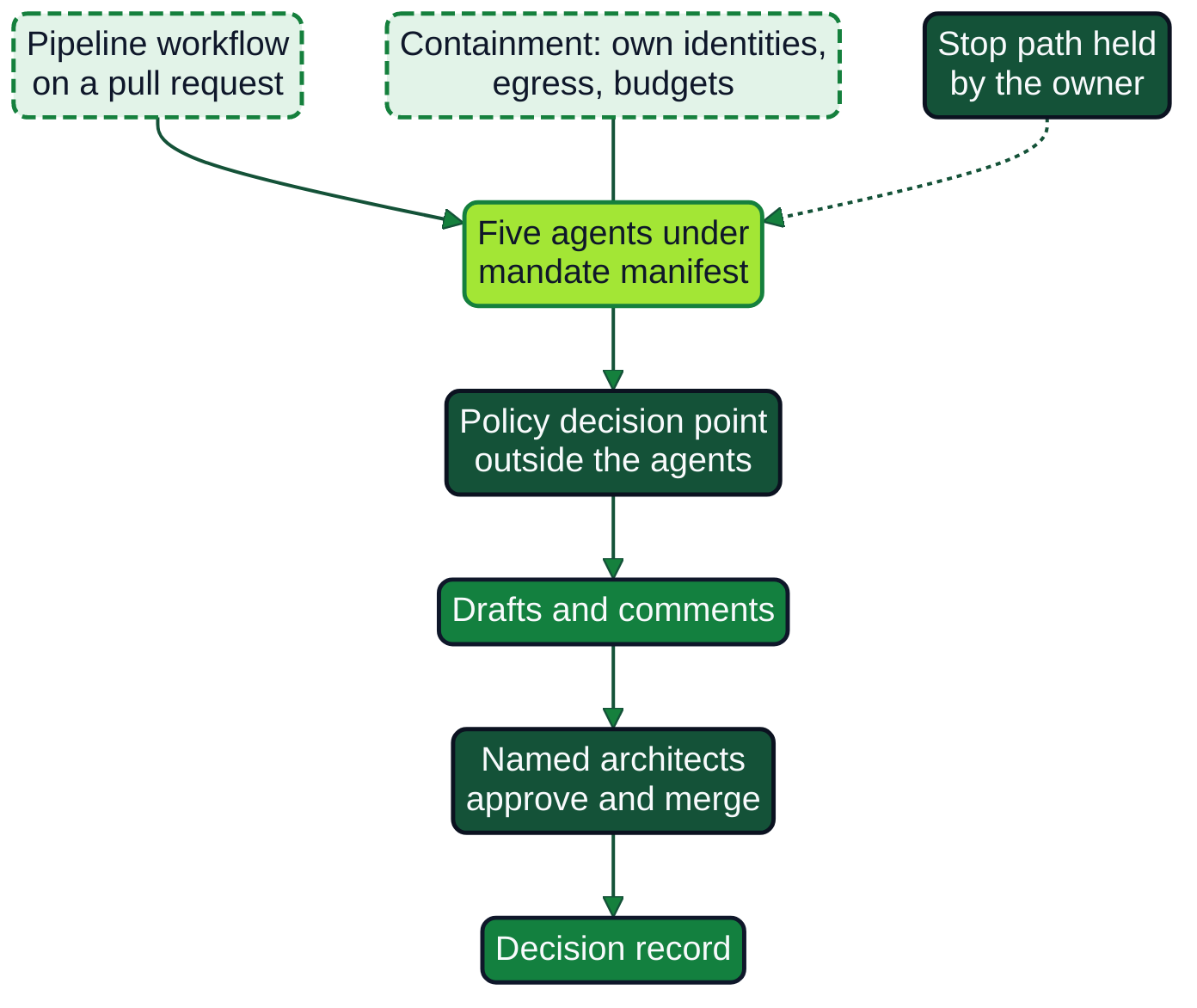
Chapter 12 described one AI tool acting with the architect's own identity. This chapter takes the next step: a team of narrow agents, each with its own skills, identity, autonomy level per action and containment. It shows which agents a security architecture team needs, how their mandate is written as a mandate manifest (MND-*) and enforced outside the agents, and how the team is contained so that it cannot change its own controls or approve its own output. It is the clearest case of Shift 4, from sole author to conductor of an AI team, because the architect becomes the accountable verifier of what a team proposes. It is equally a case of Shift 2, from gatekeeper to boundary designer, because the architect's most important work is not reviewing each draft but designing the boundaries that hold whatever the agents produce.
The chapter builds on the agent team of Architecture as Code (Chapter 20) and on the usage modes and autonomy levels that AI Red Team, Chapter 6, defined for security AI (161, Nordqvist, 2025) (164, Nordqvist, 2026). It applies them to agents that are unusual in one respect: they read and draft the very controls that contain every other agent in the estate.
An agent team is a standing arrangement in which several narrow agents are triggered by events in the architecture repository and write their output on the pull request. Narrowness matters for security more than for productivity: one general assistant that reviews, models threats, writes policy and reads the internet needs the union of all those permissions, whereas narrow agents need only what each task requires and can be stopped one at a time.
Primary topics explored
- From assistants to an agent team
- The roles
- The mandate manifest
- Autonomy levels for architecture work
- Containment of the architect's own agents
- Agents draft; humans approve
About The Transformed Security Architect
The Transformed Security Architect is Book 6 of The Transformed Architecture. It describes how the security architect role is transformed when architecture is code, when AI drafts and acts, and when adversaries move at machine speed: the craft, the architect's own AI team, the role in the organisation, the competences and the career, for European enterprises and public authorities.
It builds on the conclusions of Architecture as Code, AI Governance, AI Platform and Security, AI Red Team and AI Threat.
Security architects, CISOs and heads of security architecture, enterprise, solution and AI architects, engineering leads, competence and hiring leads, procurement and programme leaders, and risk, compliance and audit.

Gunnar Nordqvist
Conceived, directed and published the books of The Transformed Architecture.
Continue with the full chapter
Chapter 13: An AI Agent Team for Security Architecture: Skills, Mandates and Containment in The Transformed Security Architect gives the detailed explanations, practical examples and implementation patterns behind this summary.
This whitepaper belongs to “The Architect's AI Team” and is one of 31 drawn from the manuscript.