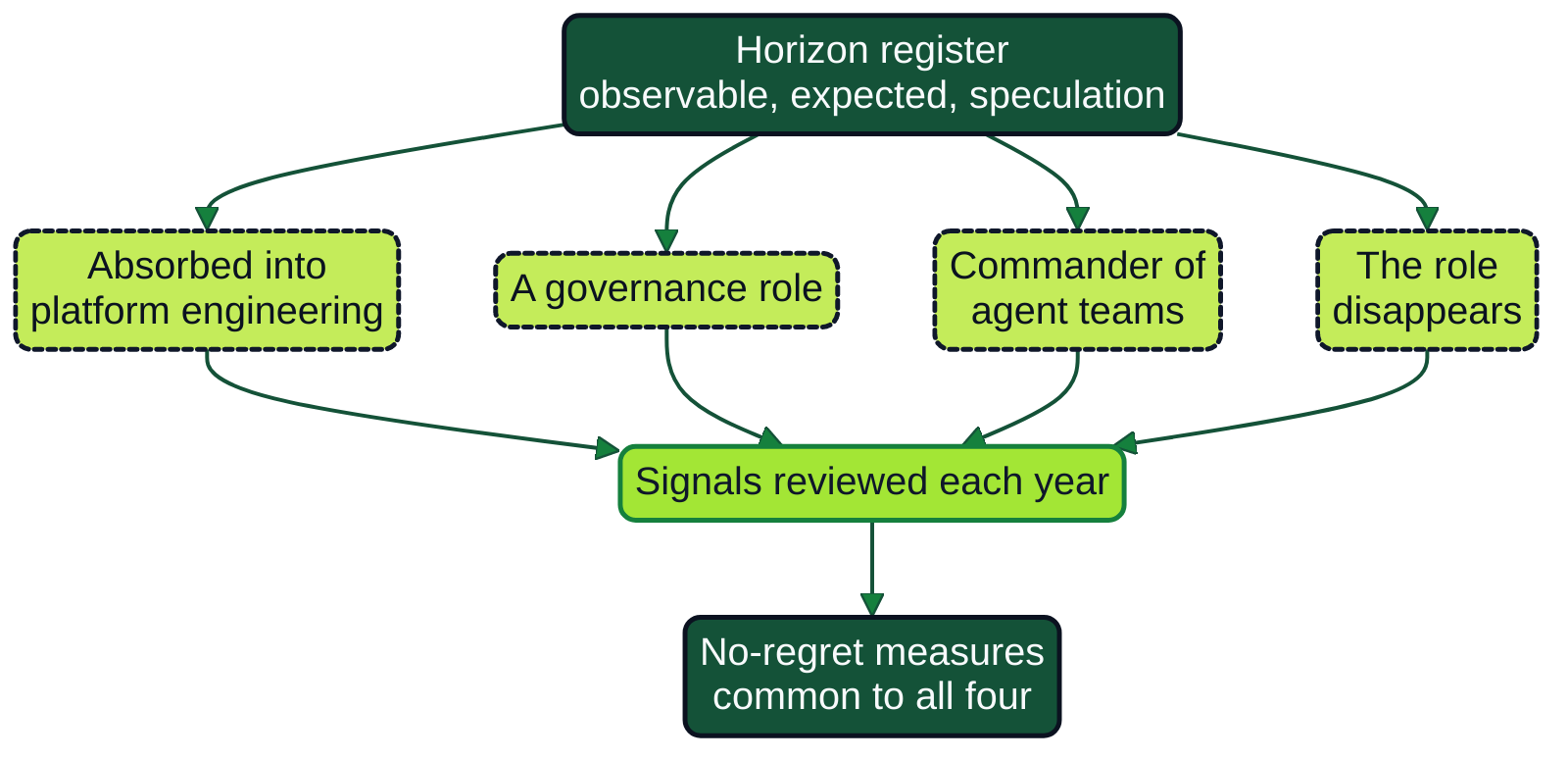
This chapter asks the question the book has carried since Chapter 1: will there be a security architect in 2036, or will the role be absorbed into platform engineering, governance or the command of agent teams? It answers with a horizon register for the role, in which every trend is labelled observable, expected or speculation, and with four scenarios, their signals and the measures that make sense whichever arrives. The chapter concerns all four shifts, because each, pushed far enough, produces a scenario: Shift 1, from documents to code and Shift 2, from gatekeeper to boundary designer lead towards absorption into the platform; Shift 3, from periodic to continuous, at machine speed makes the role's timing a measured property; and Shift 4, from sole author to conductor of an AI team leads towards either the command of agents or the disappearance of the role.
The chapter builds on four earlier conclusions. AI Governance, Chapter 22, concluded that an outlook is governed as a horizon register, in which observable trends justify commitment, expected ones preparation and speculative ones reversibility, and AI Governance, Chapter 24, kept the author's judgement apart from the book's findings (162, Nordqvist, 2026). AI Platform and Security, Chapter 25, labelled as speculation that security architecture will assume machine-speed adversaries and insiders as the normal case (163, Nordqvist, 2026). AI Threat, Chapter 26, found that small delegations erode skill, process and memory until the documented fallback no longer exists, and proposed a delegation register and reversibility tests (165, Nordqvist, 2026). This is one of two places in the book where the author's own judgement is written, confined to the last main section and labelled.
Ten years is a long horizon. Tetlock's long study of expert forecasts found that experts predicting political and economic outcomes did little better than chance, and that those who held one big idea did worse than those who combined many small ones and revised often (214, Tetlock, 2005). The lesson for a profession forecasting its own future is uncomfortable: those most qualified to speak about the role have the strongest interest in a particular answer.
Primary topics explored
- Why a horizon register for a role
- Observable trends
- Expected trends
- Speculation
- Four scenarios for 2036
- Signals and no-regret measures
About The Transformed Security Architect
The Transformed Security Architect is Book 6 of The Transformed Architecture. It describes how the security architect role is transformed when architecture is code, when AI drafts and acts, and when adversaries move at machine speed: the craft, the architect's own AI team, the role in the organisation, the competences and the career, for European enterprises and public authorities.
It builds on the conclusions of Architecture as Code, AI Governance, AI Platform and Security, AI Red Team and AI Threat.
Security architects, CISOs and heads of security architecture, enterprise, solution and AI architects, engineering leads, competence and hiring leads, procurement and programme leaders, and risk, compliance and audit.

Gunnar Nordqvist
Conceived, directed and published the books of The Transformed Architecture.
Continue with the full chapter
Chapter 23: The Future of the Role: Will There Be a Security Architect in 2036? in The Transformed Security Architect gives the detailed explanations, practical examples and implementation patterns behind this summary.
This whitepaper belongs to “Competence and Career” and is one of 31 drawn from the manuscript.