This book began with a question that the five earlier volumes had left behind: what has happened to the security architect, the person on whose work every one of their conclusions depends? This chapter tests the thesis, draws the conclusions that hold across the parts and says how firm each is, settles the open questions Q1 to Q12 where it can, and sets out what to do first, next and later. As the conclusion of the book it concerns all four shifts: Shift 1, from documents to code; Shift 2, from gatekeeper to boundary designer; Shift 3, from periodic to continuous, at machine speed; and Shift 4, from sole author to conductor of an AI team. The author's own judgement is kept to one labelled section, as in Chapter 23.
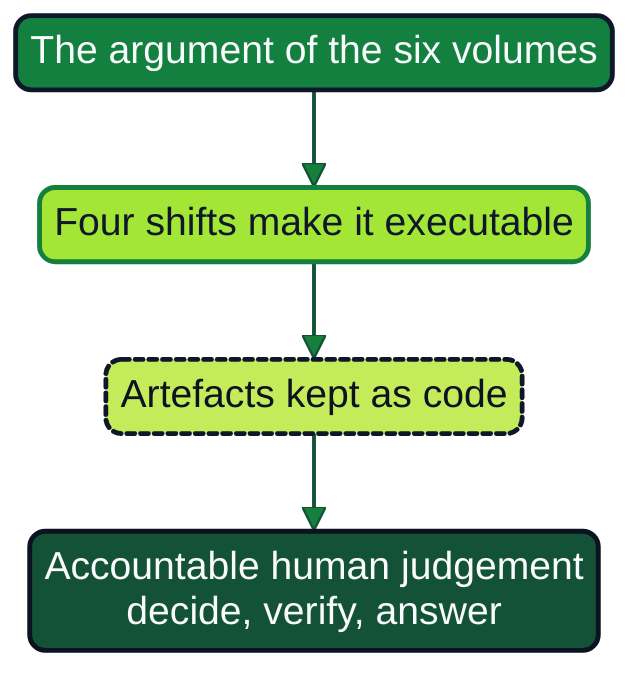
The working thesis of Chapter 1 was that the security architect role is being transformed, not abolished: from author of documents and reviewer at gates to designer of executable boundaries and decision rights, from periodic review to continuous verification at machine speed, and from sole expert to the accountable conductor of an AI team whose proposals the architect must be able to verify. What remains scarce, and therefore defines the role, is accountable human judgement: deciding what a boundary should be, verifying that code and AI output are sound, and answering for the decision. Because an architect who cannot do the craft without AI cannot verify AI, the role keeps the craft deliberately.
The chapters support the thesis. Every part of the inherited practice (Chapter 2) either moved into an artefact or was delegated to a gate, and something remained that neither could hold: the choice of which principle deserves a rule (Chapter 5), the placement of a boundary (Chapter 7), the honest classification of evidence (Chapter 9) and the review of an agent's proposal (Chapter 14). Fowler located the architect's contribution in the decisions that are important and hard to change (71, Fowler, 2003), and Hohpe in connecting the board with the engine room (72, Hohpe, 2020); both definitions survive intact.
Primary topics explored
- The thesis restated
- Reflections on each part
- Cross-cutting conclusions
- How the conclusions interact
- How firm the conclusions are
- Answered and open questions
About The Transformed Security Architect
The Transformed Security Architect is Book 6 of The Transformed Architecture. It describes how the security architect role is transformed when architecture is code, when AI drafts and acts, and when adversaries move at machine speed: the craft, the architect's own AI team, the role in the organisation, the competences and the career, for European enterprises and public authorities.
It builds on the conclusions of Architecture as Code, AI Governance, AI Platform and Security, AI Red Team and AI Threat.
Security architects, CISOs and heads of security architecture, enterprise, solution and AI architects, engineering leads, competence and hiring leads, procurement and programme leaders, and risk, compliance and audit.

Gunnar Nordqvist
Conceived, directed and published the books of The Transformed Architecture.
Continue with the full chapter
Chapter 27: Conclusions: The Transformed Security Architect in The Transformed Security Architect gives the detailed explanations, practical examples and implementation patterns behind this summary.
This whitepaper belongs to “Experience and Conclusions” and is one of 31 drawn from the manuscript.